





How Branding Builds Customer Trust Before They Buy

Before a customer sends an enquiry, visits a store, books a consultation, or makes a purchase, something important has already happened: they have formed an opinion about the brand.
That opinion may come from a logo, website, social media post, packaging, advertisement, Google listing, review, or even the way a company responds to a message.
This is where branding becomes much more than visual design.
Strong branding helps a business communicate who it is, what it stands for, what customers can expect, and why they should feel confident choosing it. When these signals remain clear and consistent across different customer touchpoints, trust can begin developing before the first transaction takes place.
For businesses searching for a professional Branding Agency India, the objective should therefore go beyond creating an attractive logo. Effective branding should create recognition, credibility, consistency, and a customer experience that supports long-term business growth.
What Does Branding Really Mean?
Branding is the complete identity and perception of a business.
A logo is part of that identity, but it is only one element.
A brand can include:
- Logo and visual identity
- Brand colors
- Typography
- Brand voice
- Messaging
- Tagline
- Website experience
- Social media presence
- Packaging
- Marketing materials
- Photography and visual style
- Customer communication
- Brand values
- Customer experience
When these elements work together, customers receive a consistent impression of the business.
Think about branding as the answer to a simple question:
“What should people remember and feel when they encounter this business?”
Good branding makes that answer clearer.
That opinion may come from a logo, website, social media post, packaging, advertisement, Google listing, review, or even the way a company responds to a message.
This is where branding becomes much more than visual design.
Strong branding helps a business communicate who it is, what it stands for, what customers can expect, and why they should feel confident choosing it. When these signals remain clear and consistent across different customer touchpoints, trust can begin developing before the first transaction takes place.
For businesses searching for a professional Branding Agency India, the objective should therefore go beyond creating an attractive logo. Effective branding should create recognition, credibility, consistency, and a customer experience that supports long-term business growth.
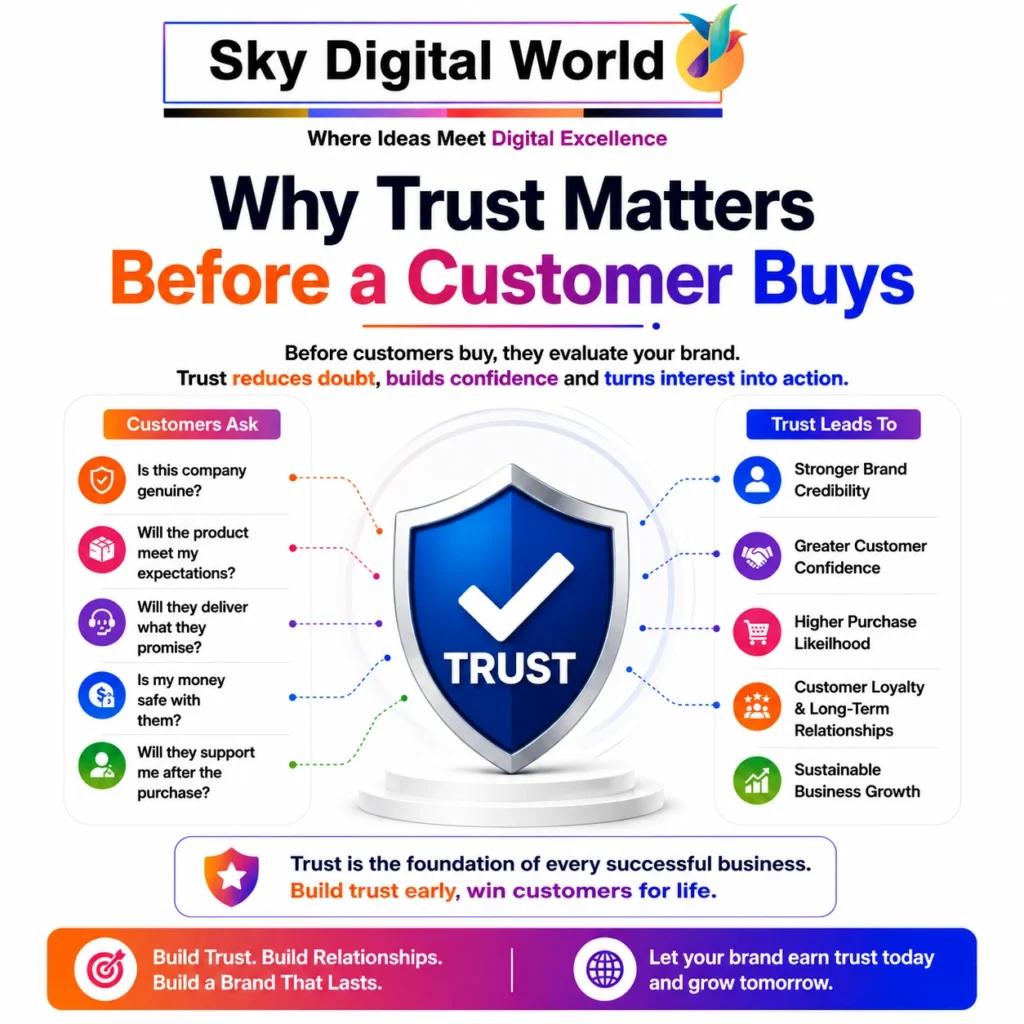
Why Trust Matters Before a Customer Buys
Buying involves uncertainty.
A potential customer may wonder:
Is this company genuine?
Will the product match my expectations?
Will they deliver what they promise?
Is my money safe with them?
Will they support me after the purchase?
These questions become even more important when customers are dealing with a business for the first time.
Branding cannot replace product quality or good service. However, it can help reduce uncertainty by presenting the business in a clear, professional and consistent manner.
A brand that looks disconnected, outdated or inconsistent may create unnecessary doubt.
A brand with clear positioning and consistent communication can make the decision feel more confident.
How Branding Builds Customer Trust Before They Buy
1. A Professional Identity Creates a Strong First Impression
Customers often encounter the visual identity of a business before they experience its product or service.
That first interaction may happen through:
- Google Search
- An advertisement
- A business card
- Product packaging
- A website
- A marketplace listing
- A brochure
Visual presentation immediately communicates something about the company.
Professional design can suggest that a business pays attention to details and takes its market presence seriously.
This does not mean every brand needs an expensive or complicated identity.
In many cases, simplicity works better.
The objective is to make the business look intentional rather than accidental.
2. Consistency Makes a Brand Familiar
Imagine seeing one company on Instagram with a premium black-and-gold identity.
You click through to its website and suddenly find bright green colors, completely different fonts and a different communication style.
Then its brochure looks different again.
Even when the company is legitimate, inconsistency can create confusion.
Consistent branding connects these experiences.
When customers repeatedly encounter the same:
Logo → Colors → Typography → Tone → Message → Visual Style
the brand becomes easier to recognize.
Recognition creates familiarity.
And familiarity can make customers more comfortable when they eventually need the product or service.
3. Clear Brand Messaging Removes Confusion
Customers should not need several minutes to understand what a business does.
Good branding creates clarity around questions such as:
Who are you?
What do you offer?
Who is it for?
What makes you relevant?
Why should customers consider you?
For example, a generic message such as:
“We provide innovative solutions for your needs.”
could apply to thousands of businesses.
A more specific message explains the actual value the company provides.
Clear positioning makes it easier for the right customers to understand whether a business is relevant to them.
And clarity supports trust.
4. Branding Creates Expectations
Every brand makes a promise, whether intentionally or unintentionally.
A luxury hotel’s branding creates expectations about service.
A children’s brand creates expectations around friendliness and accessibility.
A technology company may communicate speed, innovation and efficiency.
A financial services brand may emphasize stability, clarity and professionalism.
Customers use these signals to predict what their experience might be like.
This is why branding should match reality.
A business should not create a premium image if the actual customer experience cannot support that positioning.
The strongest brands align:
Brand Promise + Product Quality + Customer Experience
When those three elements reinforce one another, trust becomes much stronger.
5. A Strong Website Reinforces Brand Credibility
For many customers, a website is where brand evaluation becomes more serious.
Someone may discover the business through social media but visit its website before submitting an enquiry.
At this stage, customers may look for:
- Clear service information
- Professional presentation
- Company information
- Testimonials
- Previous work
- Contact details
- FAQs
- Policies
- Useful content
- Easy navigation
The website should feel like a natural extension of the brand.
If an advertisement looks professional but the landing page looks unreliable, trust can disappear quickly.
Branding therefore needs to continue throughout the entire digital experience.
6. Social Media Shows Whether the Brand Is Active
Social media provides customers with a more dynamic view of a business.
A website may explain what the company offers, while social platforms can show how the brand communicates day to day.
Businesses can use social media to share:
- Educational content
- Product information
- Behind-the-scenes moments
- Customer experiences
- Industry knowledge
- Company updates
- Team stories
- FAQs
- Demonstrations
- Brand campaigns
Consistent social media activity can make a business feel more accessible and current.
The important point is not simply to post frequently.
The content should reinforce the same identity and positioning customers experience elsewhere.
7. Social Proof Makes Brand Claims More Believable
A business saying “customers trust us” is a claim.
Customers saying they trust the business is evidence.
That is why social proof can play an important role in branding.
Useful forms of social proof include:
- Customer reviews
- Testimonials
- Case studies
- Client logos where permission exists
- Customer stories
- Ratings
- Project examples
- Before-and-after results where appropriate
- User-generated content
The most convincing proof is specific.
Instead of simply publishing:
“Excellent service!”
a detailed testimonial explaining the customer’s challenge, experience and result can provide much more context.
Social proof helps customers see that the brand promise has been experienced by others.
8. Content Allows a Brand to Demonstrate Expertise
Customers trust businesses that understand their problems.
Content provides a way to demonstrate that understanding before a sales conversation begins.
A business can publish:
- Blogs
- Guides
- Videos
- FAQs
- Tutorials
- Industry insights
- Comparisons
- Case studies
- Social media educational posts
Imagine a customer comparing two companies.
One company only publishes promotional content.
The other consistently answers customer questions and explains its field clearly.
The second business may appear more knowledgeable because customers can see evidence of its expertise.
This is where branding, content marketing and SEO begin working together.
9. Brand Voice Makes Communication Feel Consistent
Branding is also about how a business speaks.
A brand voice could be:
Professional and authoritative
Friendly and conversational
Premium and refined
Bold and energetic
Simple and educational
There is no universally correct voice.
The right style depends on the audience, industry and positioning.
What matters is consistency.
Website copy should not sound extremely formal while social media feels like an entirely unrelated company.
A recognizable communication style helps create a coherent brand personality.
10. Transparency Builds Confidence
Customers appreciate knowing what they can expect.
Businesses can strengthen trust by communicating important information clearly rather than hiding it behind vague claims.
Depending on the business, transparency may involve:
- Clearly explaining services
- Showing processes
- Providing realistic timelines
- Explaining what is and is not included
- Displaying policies
- Answering common questions
- Using authentic product information
- Providing accurate contact details
- Avoiding exaggerated claims
Trust is difficult to build when branding promises more than the business can realistically deliver.
Strong branding should make a company look credible without pretending to be something it is not.
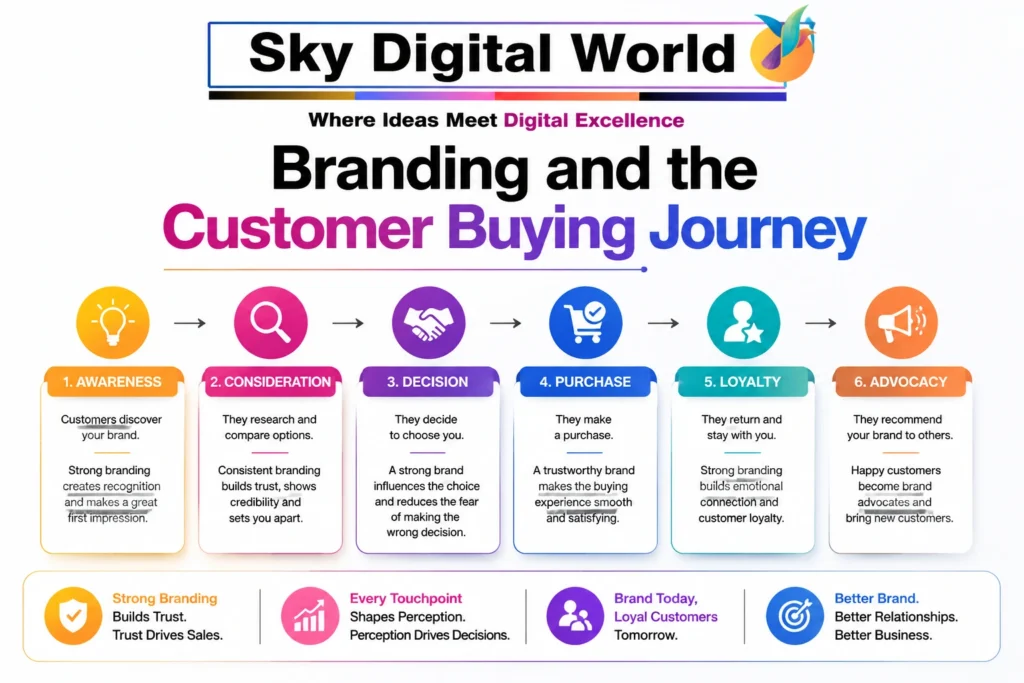
Branding and the Customer Buying Journey
Customers do not always move directly from seeing a brand to purchasing.
Their journey might look more like this:
Stage 1: Discovery
The customer encounters an advertisement, social post, search result or recommendation.
Branding goal: Create recognition and interest.
Stage 2: Research
The customer visits the website, social profiles or Google listing.
Branding goal: Establish credibility and clarity.
Stage 3: Comparison
The customer compares alternatives.
Branding goal: Communicate differentiation and value.
Stage 4: Validation
The customer checks reviews, testimonials, case studies or previous work.
Branding goal: Reduce uncertainty.
Stage 5: Decision
The customer contacts the business or makes a purchase.
Branding goal: Make the next action simple and reassuring.
Stage 6: Experience
The customer receives the actual product or service.
Branding goal: Deliver the promise made before the sale.
This final stage matters enormously.
Branding may help create trust before purchase, but the actual customer experience determines whether that trust survives afterward.
Emotional Branding Can Strengthen Customer Connections
People do not make every buying decision based purely on technical specifications.
Emotion can influence perception and preference.
Different brands may attempt to create feelings such as:
Confidence
Security
Excitement
Belonging
Comfort
Achievement
Aspiration
Consider a real estate company.
It could communicate only:
“3 BHK homes available.”
Or it could connect the property to ideas of family, stability, achievement and owning a place to call home.
The factual information remains important, but emotional context can make the message more meaningful.
Effective emotional branding should remain authentic rather than manipulative.
Why Brand Positioning Matters in Competitive Markets
Customers frequently have several businesses offering similar products or services.
If every company communicates the same message, price often becomes the easiest comparison.
Brand positioning gives customers another reason to choose.
A business might position itself around:
- Specialized expertise
- Premium experience
- Convenience
- Innovation
- Customer service
- Reliability
- Local market understanding
- Speed
- Simplicity
- A specific customer segment
Strong positioning answers:
“Why should the right customer remember us instead of another option?”
A professional Branding Agency India should therefore begin with strategy and positioning rather than jumping directly into logo design.
Brand Identity vs Brand Image: Know the Difference
These terms are related but not identical.
Brand Identity
Brand identity is what the company intentionally creates.
It includes the logo, colors, messaging, tone, visual system and positioning.
Brand Image
Brand image is how customers actually perceive the business.
A company controls its identity.
It can influence its image.
But it cannot completely control customer perception.
This distinction is important because attractive branding alone cannot compensate indefinitely for poor products or bad service.
The customer experience ultimately influences the brand image.
Why Businesses Work With a Professional Branding Agency India
Building a professional brand requires more than choosing colors and creating a logo.
A complete branding process may involve:
- Market understanding
- Competitor research
- Audience definition
- Brand positioning
- Brand strategy
- Naming
- Tagline development
- Logo design
- Color palette development
- Typography
- Brand voice
- Messaging framework
- Social media identity
- Marketing collateral
- Brand guidelines
- Website identity
- Packaging design where relevant
Businesses looking for a Branding Agency India should therefore evaluate whether an agency understands the strategic side of branding as well as design.
The objective should be to create an identity that is not only attractive but also recognizable, relevant, consistent and usable across different platforms.
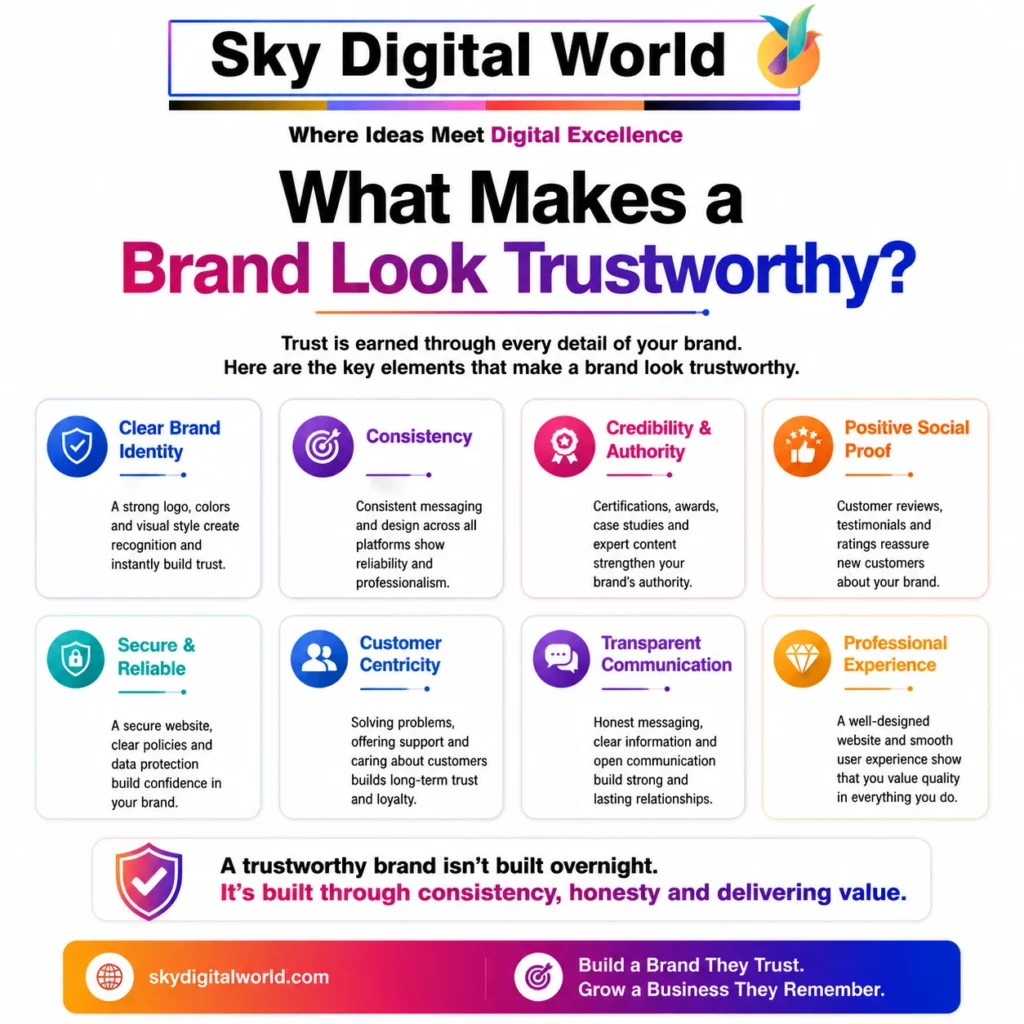
What Makes a Brand Look Trustworthy?
There is no single design formula for trust.
However, several characteristics can strengthen brand credibility.
Clarity
Customers quickly understand the company and its offering.
Consistency
The brand feels connected across websites, social media, advertisements and offline materials.
Authenticity
The company avoids claims it cannot support.
Professional Presentation
Visual and written communication reflects attention to detail.
Evidence
Reviews, testimonials, case studies and actual work support marketing claims.
Accessibility
Customers can easily find contact details and communicate with the business.
Reliability
The customer experience matches what the brand promised.
When these elements work together, trust becomes part of the complete brand experience.
Common Branding Mistakes That Can Reduce Customer Trust
Even established businesses can weaken their brand through inconsistent execution.
Common mistakes include:
Changing visual styles constantly
Frequent changes make recognition difficult.
Using different logos across platforms
Customers may wonder whether accounts belong to the same company.
Copying competitors
Imitation makes differentiation harder.
Making unrealistic claims
Overpromising can damage credibility.
Ignoring mobile experience
A professional desktop website with a poor mobile experience creates friction.
Using low-quality visuals
Poor images and inconsistent graphics can reduce perceived professionalism.
Having no clear positioning
Customers cannot remember why the business is different.
Ignoring customer feedback
Brand reputation depends on experiences, not only marketing.
Branding Should Remain Consistent, Not Static
Consistency does not mean a brand can never change.
Markets evolve.
Customers change.
Businesses introduce new services and enter new regions.
Brands can evolve with them.
A company might refresh its:
- Visual identity
- Website
- Messaging
- Photography
- Packaging
- Social media style
- Brand guidelines
The goal is to modernize without unnecessarily destroying existing recognition.
A successful brand evolution retains what customers already recognize while improving what no longer represents the business effectively.
How to Measure Whether Branding Is Working
Branding can feel less measurable than advertising, but businesses can still observe useful indicators.
Depending on the objective, these may include:
- Branded search growth
- Direct website traffic
- Returning website visitors
- Social engagement
- Customer enquiries
- Referral traffic
- Review sentiment
- Conversion rates
- Customer retention
- Brand mentions
- Share of search
- Repeat purchases
Qualitative feedback is valuable too.
Ask customers:
How did you hear about us?
What made you consider our company?
What did you notice first about the brand?
Why did you choose us over another option?
The answers can reveal how branding influences actual buying decisions.
Branding Is What Customers Experience, Not Just What They See
A beautifully designed logo can create attention.
A professional website can create confidence.
Consistent content can build familiarity.
Testimonials can reduce uncertainty.
But long-term trust comes from something deeper:
the business consistently delivering what the brand promises.
That means branding involves marketing, sales, communication, service and customer experience.
Every interaction contributes to the customer’s perception of the brand.
Build a Brand Customers Can Trust With Sky Digital World
A strong brand should make customers feel more confident about taking the next step.
At Sky Digital World, branding can be approached as part of the complete digital presence of a business—connecting visual identity, brand communication, website experience, social media, content and digital marketing.
For businesses searching for a Branding Agency India, the priority should not simply be getting a new logo.
The goal should be building an identity customers can recognize, understand, remember and trust.
When brand strategy, visual identity, communication and customer experience work together, branding becomes more than design.
It becomes a reason for customers to choose your business
Frequently Asked Questions
What is branding in business?
Branding is the process of developing a recognizable identity and perception for a business through elements such as positioning, logo design, colors, messaging, communication style and customer experience.
How does branding build customer trust?
Branding can strengthen trust by creating consistency, professional presentation, clear communication, recognizable identity and realistic expectations across customer touchpoints.
Is a logo the same as branding?
No. A logo is one component of a brand identity. Branding also includes positioning, messaging, visual style, tone of voice, customer experience and how people perceive the company.
Why is consistent branding important?
Consistency helps customers recognize a business across different channels. Familiar visual and verbal signals can reduce confusion and strengthen brand recall.
What does a Branding Agency India do?
A branding agency may provide brand strategy, positioning, logo and identity design, messaging, brand guidelines, marketing collateral, packaging, digital identity and other services depending on the agency’s capabilities.
Can branding help increase sales?
Branding alone does not guarantee sales. However, a strong brand can improve recognition, differentiation, credibility and customer confidence, all of which can support purchasing decisions when combined with a strong product, service and marketing strategy.
How often should a business rebrand?
There is no fixed schedule. Rebranding may be appropriate when a company’s positioning, audience, products or market have significantly changed, or when its existing identity no longer represents the business effectively.