




How Content Marketing Builds Long-Term Online Authority
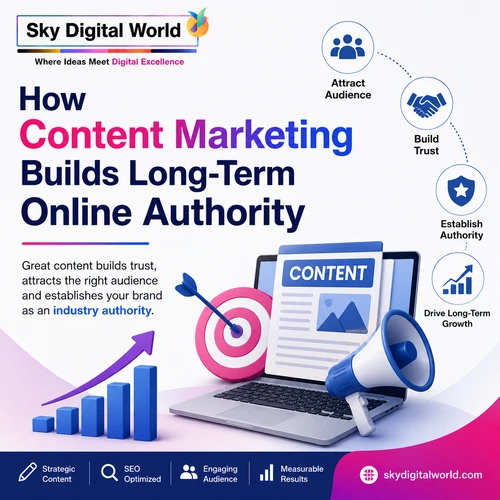
Publishing content is easy. Building authority through content is not.
Every day, businesses publish blogs, social media posts, videos, guides and website pages hoping to attract more visitors. Yet only a small percentage of that content becomes a meaningful business asset.
The difference lies in strategy.
Effective content marketing does more than bring temporary traffic to a website. It helps a business become a useful source of information within its industry. When customers repeatedly find relevant answers, practical guidance and trustworthy information from the same brand, familiarity grows. Familiarity can lead to trust, and trust can influence enquiries, purchases and long-term customer relationships.
This is why businesses looking for Content Marketing Services India should think beyond simply publishing more articles. The real objective is to create a connected library of useful content that strengthens search visibility, demonstrates expertise and continues delivering value long after publication.
What Is Online Authority?
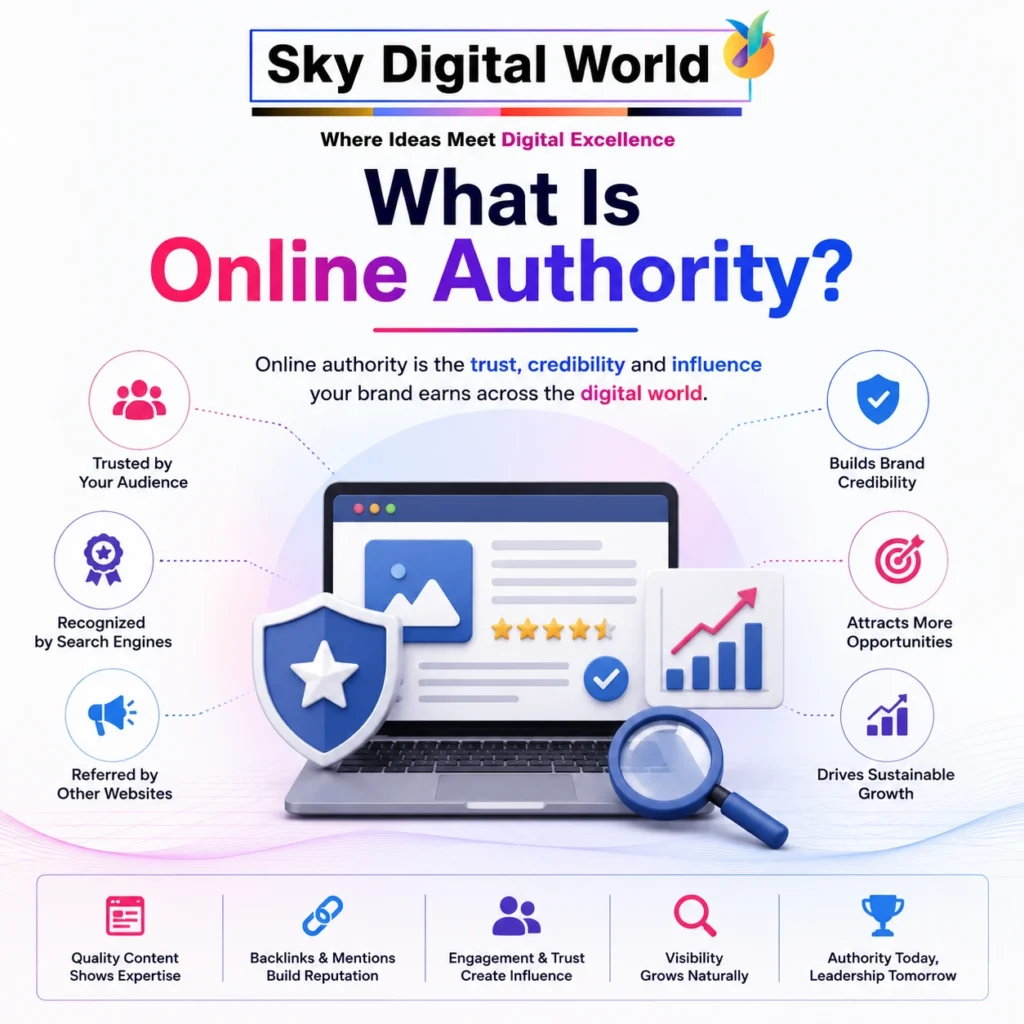
Online authority is the level of credibility, expertise and trust a business develops across its digital presence.
It is not created by declaring that a company is an “industry leader.” It develops when a business consistently demonstrates that it understands its market and can provide useful answers to the questions its audience is asking.
A strong online authority can be reflected through:
- Detailed and useful website content
- Search visibility for relevant topics
- Helpful blogs and guides
- Consistent subject expertise
- Quality backlinks and brand mentions
- Customer reviews and testimonials
- Original insights and experiences
- Strong internal linking between related resources
- Accurate and regularly maintained information
Authority therefore develops gradually.
One excellent article can attract attention. A well-planned collection of valuable resources can build a reputation.
Why Content Marketing Is a Long-Term Strategy
Advertising usually works while campaigns are active. Once spending stops, paid visibility can reduce immediately.
Content operates differently.
A useful article published today may continue attracting visitors months or even years later if the information remains relevant and the page continues to provide a strong experience.
Consider a company that publishes a detailed guide answering an important customer question.
The article can potentially:
Rank in search → attract relevant visitors → answer questions → introduce the brand → build confidence → generate enquiries
Now imagine creating dozens of strategically connected resources around the problems, questions and decisions customers regularly face.
The website gradually becomes more than a digital brochure.
It becomes a knowledge resource.
That is where the long-term value of content marketing begins.
How Content Marketing Builds Long-Term Online Authority
1. Helpful Content Demonstrates Real Expertise
People trust businesses that clearly understand their problems.
Instead of constantly telling visitors:
“We are experts.”
Content gives a business an opportunity to demonstrate expertise.
For example, imagine two digital marketing companies.
Company A has a basic service page saying:
“We provide SEO services. Contact us today.”
Company B publishes useful resources covering topics such as:
- Why website rankings suddenly drop
- How local SEO works
- How to improve Google Business Profile visibility
- Technical SEO problems that prevent indexing
- How businesses should select SEO keywords
- How SEO and content marketing work together
Which company appears more knowledgeable to a potential customer researching SEO?
Usually, the company that answers the customer’s questions before asking for the sale.
Useful content turns expertise into something visitors can actually experience.
2. Content Creates Multiple Search Entry Points
A website with only five service pages has limited opportunities to answer different search queries.
A website with a strategically developed content library can potentially appear for many more relevant searches.
Suppose a business provides content marketing.
Its main service page might target:
Content Marketing Services India
Supporting articles could address related topics such as:
- What is content marketing?
- How does content marketing generate leads?
- Content marketing vs paid advertising
- How to build a content marketing strategy
- How blogging supports SEO
- How to create content for different stages of the buyer journey
- How content builds brand authority
- How often should businesses publish blog content?
Each article addresses a different search intent while remaining connected to the company’s primary expertise.
This approach creates a stronger topical ecosystem around the main service.
3. Topic Clusters Build Depth Around Your Expertise
Random blogging is not the same as strategic content marketing.
A better approach is to organize content into topic clusters.
A topic cluster usually contains one broad core resource supported by several more specific articles.
For example:
Core Topic: Content Marketing
Supporting topics could include:
Content Strategy
SEO Content Writing
Blog Marketing
Content Distribution
Lead Generation Through Content
Content Performance Measurement
Content Optimization
Content Marketing for Small Businesses
These resources can then be connected through relevant internal links.
The result is a structured content ecosystem that helps users explore a subject naturally.
Instead of publishing isolated articles with no relationship to one another, the website develops meaningful depth around its core areas of expertise.
4. Search Intent Makes Content More Useful
Ranking for a keyword means little if the content does not satisfy what the searcher actually wants.
Before creating an article, businesses should understand the intention behind the query.
Search intent can generally be divided into several categories.
Informational Intent
The user wants to learn.
Example:
“How does content marketing work?”
Commercial Investigation
The user is comparing options before making a decision.
Example:
“Best content marketing strategies for B2B companies”
Transactional Intent
The user is closer to taking action.
Example:
“Content Marketing Services India”
Navigational Intent
The user is looking for a particular company, website or resource.
Content should match the stage and expectation of the searcher.
Trying to force a service pitch into every informational article can make the content less useful.
A better strategy is to answer the question thoroughly and then provide a relevant next step.
5. Original Insights Separate a Brand From Generic Content
The internet does not need another article that simply repeats information available on hundreds of other websites.
Strong content should contribute something useful.
That might include:
- Original observations
- First-hand experience
- Practical examples
- Internal research
- Customer questions
- Industry-specific insights
- Case studies
- Original frameworks
- Process explanations
- Expert commentary
Consider an article about local SEO.
Instead of writing:
“Local SEO helps businesses improve local visibility.”
A digital marketing agency could explain common problems it repeatedly observes while working with local businesses, such as inconsistent business information, weak service pages, poor review management or location pages created without meaningful local information.
That additional experience makes the article more useful and distinctive.
6. Consistency Builds Recognition
Authority rarely comes from publishing ten articles in one month and then abandoning the blog for a year.
A sustainable content strategy is more valuable.
Businesses can create a realistic publishing schedule based on their resources and industry.
The frequency matters less than maintaining quality and strategic relevance.
Every new article should have a purpose.
Ask:
Who is this content for?
What question does it answer?
What business topic does it support?
What should the reader understand after finishing it?
Where should the reader go next?
These questions help prevent a blog from becoming a collection of disconnected posts.
7. Internal Linking Strengthens the Content Journey
Internal linking is one of the most useful parts of a well-organized content strategy.
Suppose someone reads an article titled:
“How Content Marketing Builds Long-Term Online Authority.”
Within that article, the reader might naturally be directed toward resources about:
SEO Services → Content Strategy → Social Media Marketing → Lead Generation
This creates a logical path through the website.
Internal links can help users discover additional relevant information while also helping search engines understand relationships between pages.
The key is relevance.
Links should be added because they genuinely help the reader continue exploring the topic, not simply because a certain number of internal links must be inserted.
8. Quality Content Can Attract Natural Backlinks
Backlinks remain valuable because links from relevant websites can introduce new audiences and provide signals about useful resources.
But earning meaningful links usually requires content worth referencing.
Generic promotional pages are rarely compelling citation sources.
Resources with greater link potential may include:
- Original research
- Industry statistics
- Detailed tutorials
- Comprehensive guides
- Checklists
- Templates
- Case studies
- Original graphics
- Infographics
- Expert insights
- Useful tools
This creates an important relationship:
Better Resource → More Reasons to Reference It → Greater Visibility → Stronger Authority
Businesses should therefore create some content specifically designed to become a useful industry resource rather than making every article directly promotional.
9. Content Supports Every Stage of the Customer Journey
Content marketing should not focus exclusively on website traffic.
Different content can support different stages of the buying process.
Awareness
The potential customer discovers a problem.
Useful content:
- Educational blogs
- Beginner guides
- Social media content
- Explainer videos
Consideration
The customer begins evaluating solutions.
Useful content:
- Comparison articles
- Detailed guides
- FAQs
- Case studies
- Solution-focused content
Decision
The customer is considering a provider.
Useful content:
- Service pages
- Testimonials
- Case studies
- Consultation pages
- Pricing information where appropriate
Retention
The person has already become a customer.
Useful content:
- Tutorials
- Knowledge bases
- Email resources
- Product updates
- Advanced guides
This is why content marketing is much larger than blogging.
It supports the entire relationship between a business and its audience.
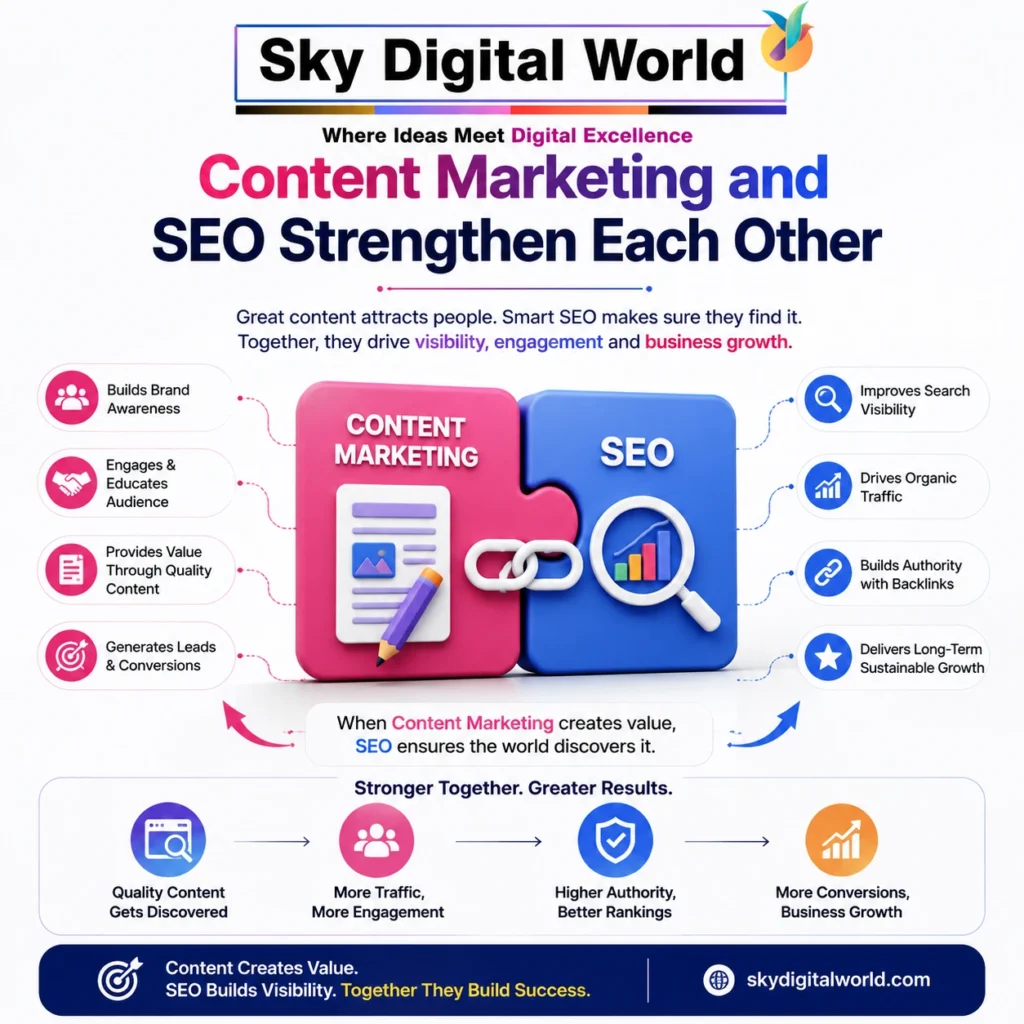
10. Content Marketing and SEO Strengthen Each Other
SEO helps search engines discover and understand content.
Content gives SEO something valuable to present to searchers.
The strongest strategies combine both.
Content marketing can support SEO through:
Keyword relevance – creating useful resources around topics customers search for.
Topical depth – developing multiple high-quality resources around important subject areas.
Internal linking – connecting related pages logically.
Search intent – creating pages that match what users actually need.
Backlink opportunities – publishing resources other websites may want to reference.
Freshness where necessary – updating information when industries, products or recommendations change.
User experience – organizing information so visitors can understand and navigate it easily.
SEO should enhance useful content rather than dictate unnatural writing.
11. Content Can Build Authority Beyond Google
Online authority is not limited to traditional search results.
One strong piece of content can be adapted across several channels.
For example, a detailed blog can become:
Blog Article → LinkedIn Post → Instagram Carousel → Short Video → Email Newsletter → Infographic → FAQ → Sales Resource
This extends the useful life of the original idea.
It also helps audiences encounter the brand across multiple touchpoints.
Someone may first see an Instagram post, later read the full blog, subscribe to an email list and eventually contact the business.
The individual channels are different, but the underlying expertise remains connected.
12. Content Helps Build Brand Trust Before the First Conversation
Many customers research a company before contacting it.
They may visit the website, read blogs, check social profiles, look at reviews and compare competitors.
Content plays an important role during this silent research stage.
Potential customers are effectively asking:
Does this company understand my problem?
Do they know what they are talking about?
Can I trust their recommendations?
Do they have enough experience in this area?
Useful content can answer many of these questions before a sales conversation begins.
That means content marketing can influence lead quality as well as traffic.
What Makes High-Authority Content Different?
High-authority content is not necessarily the longest article.
Length should follow the needs of the topic.
Strong content generally provides:
Clear Purpose
Every page should solve a specific problem or answer a meaningful question.
Original Value
Add knowledge, experience, examples or perspectives rather than simply repeating competitors.
Logical Structure
Use descriptive headings and short sections so readers can quickly find relevant information.
Credible Information
Support important claims with reliable sources where appropriate.
First-Hand Experience
Include practical knowledge and genuine observations when available.
Useful Visuals
Original images, diagrams, screenshots, charts and videos can make complex information easier to understand.
Natural Language
Write for readers first rather than forcing keywords into every paragraph.
Clear Next Steps
Help readers understand what they can do after consuming the information.
Why Businesses Need Professional Content Marketing Services India
Creating occasional blog posts is relatively simple.
Building a content system that contributes to visibility, authority and customer acquisition requires considerably more planning.
Professional Content Marketing Services India can bring together:
- Content strategy
- Audience research
- Search intent analysis
- Keyword research
- SEO content writing
- Blog development
- Content optimization
- Topic cluster planning
- Internal linking
- Content distribution
- Visual content
- Performance measurement
- Existing-content updates
The goal should not be to publish the maximum number of articles.
The goal should be to create the right content for the right audience at the right stage of their journey.
A Practical Content Authority Framework
Businesses can simplify their strategy into five stages:
1. Discover
Identify what potential customers genuinely want to know.
2. Create
Develop original, useful and experience-driven content around those needs.
3. Connect
Link related resources together to build a logical knowledge ecosystem.
4. Distribute
Promote valuable content through search, social media, email and other relevant channels.
5. Improve
Measure performance and strengthen existing resources based on actual user behaviour and business results.
Think of content authority as a cycle rather than a one-time campaign:
Research → Create → Publish → Distribute → Measure → Improve
Every cycle should make the overall content library stronger.
How to Measure Content Marketing Success
Traffic is important, but it should not be the only metric.
A content strategy should be evaluated according to its business objective.
Useful measurements can include:
- Organic search impressions
- Search clicks
- Relevant keyword visibility
- Engaged sessions
- Returning visitors
- Newsletter sign-ups
- Enquiries
- Qualified leads
- Assisted conversions
- Backlinks
- Brand searches
- Content-driven sales
For example, an article attracting 500 highly relevant visitors and generating 20 qualified enquiries may be more valuable than an article generating 20,000 visits from an audience unlikely to become customers.
Traffic quality matters.
Common Content Marketing Mistakes to Avoid
Businesses can publish consistently and still struggle to build authority.
Common reasons include:
Writing only for search engines
Keywords should guide content, not control every sentence.
Publishing generic information
If an article offers nothing beyond what already exists, users have little reason to remember it.
Ignoring search intent
Ranking for the wrong audience does not create meaningful growth.
Creating disconnected topics
Random articles make it difficult to develop recognizable subject expertise.
Ignoring old content
Useful articles should be reviewed and improved when information becomes outdated.
Publishing without distribution
Even excellent content benefits from promotion.
Measuring only rankings
Search visibility matters, but leads, engagement and conversions reveal whether content contributes to business growth.
Content Marketing Is a Business Asset, Not Just an SEO Task
The most important shift is to stop viewing content as something businesses create merely because “Google needs blogs.”
Content should serve customers first.
A strong article can answer a sales question.
A case study can reduce uncertainty.
A guide can educate a prospect.
A comparison can help someone make a decision.
An infographic can simplify a complicated subject.
A video can demonstrate expertise.
A service page can convert existing demand.
When these resources work together, content becomes part of the company’s digital infrastructure.
And unlike a short-lived campaign, that infrastructure can continue becoming more valuable as it grows.
Build Sustainable Digital Authority With Sky Digital World
Long-term online authority cannot be manufactured overnight.
It is earned by consistently providing useful information, demonstrating genuine expertise and creating better digital experiences for potential customers.
At Sky Digital World, content marketing can be approached as part of a wider digital growth strategy—connecting SEO, content development, social media, website optimization and performance-focused marketing.
For businesses exploring Content Marketing Services India, the priority should be bigger than publishing blogs.
The objective is to build a digital knowledge ecosystem that helps potential customers discover your business, understand your expertise, trust your brand and confidently take the next step.
When that happens consistently, content stops being another marketing expense.
It becomes a long-term digital asset.
Frequently Asked Questions
What is content marketing?
Content marketing is the strategic creation and distribution of useful information designed to educate, attract, engage and influence a defined audience. It can include blogs, guides, videos, social media content, infographics, case studies, email content and other digital resources.
How does content marketing build online authority?
Content marketing builds authority by consistently demonstrating knowledge around topics important to a company’s audience. Useful guides, expert insights, original examples and well-connected resources can help establish the business as a credible source of information.
How does content marketing help SEO?
Content marketing gives businesses opportunities to address relevant searches, build topical depth, create internal linking relationships and earn references from other websites. SEO then helps search engines discover and understand those resources.
How long does content marketing take to show results?
There is no fixed timeline. Results depend on website authority, competition, content quality, technical SEO, search demand and distribution. Some pages may gain visibility relatively quickly, while building meaningful authority generally requires consistent long-term effort.
Is blogging enough for content marketing?
No. Blogging can be an important component, but content marketing can also include videos, case studies, landing pages, email campaigns, infographics, social content, guides, reports and other resources.
What should businesses look for in Content Marketing Services India?
Look for a strategy that combines audience understanding, search intent, original content development, SEO, internal linking, distribution and measurement. Avoid services that focus primarily on publishing large quantities of generic articles.
Can content marketing generate leads?
Yes. Content can attract potential customers at different stages of the buying journey and direct relevant visitors toward consultations, enquiries, downloads, demonstrations or other conversion actions.