





How Can Manufacturers Create a Digital Product Catalogue That Generates Enquiries?
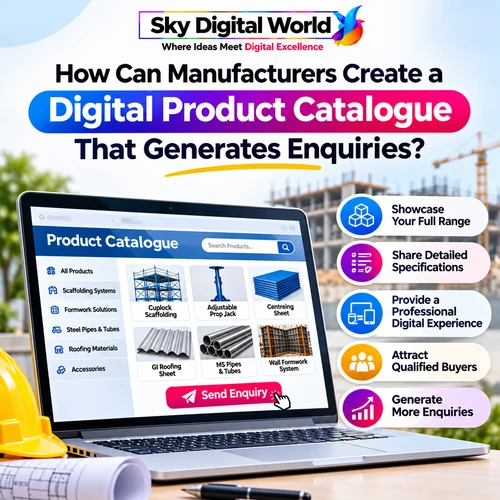
How Can Manufacturers Create a Digital Product Catalogue That Generates Enquiries?
Imagine a construction contractor searching for scaffolding materials, a factory owner comparing industrial machinery, or a distributor looking for a reliable manufacturer.
They find your product catalogue online.
But instead of contacting your company, they close it and continue searching.
Why?
The problem may not be your products or prices. Your catalogue might simply be missing the information buyers need before making an enquiry.
Many manufacturers still use digital catalogues as online brochures. They display product photographs, technical specifications and company details, but they rarely guide potential customers towards the next step.
A well-designed Digital Product Catalogue for Manufacturers should do more than showcase products. It should help buyers understand what you manufacture, compare suitable options, build confidence in your business and contact your sales team.
Let’s explore how manufacturers can create a catalogue that turns product interest into genuine business enquiries.
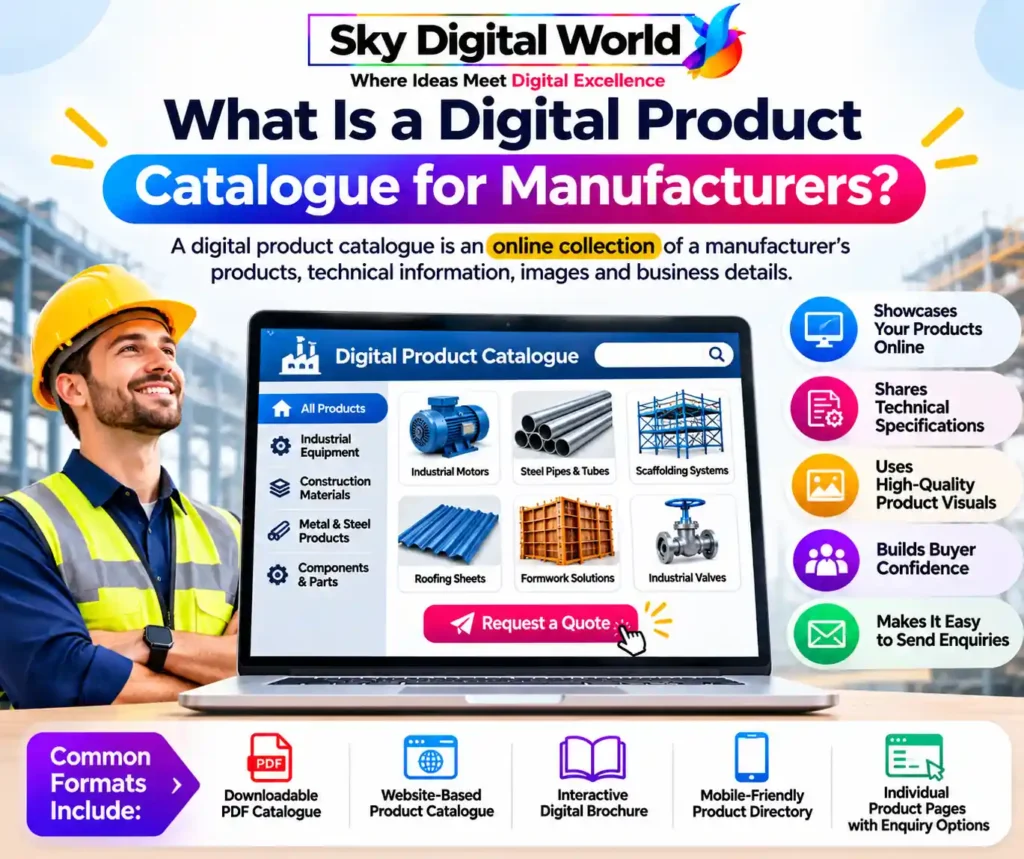
What Is a Digital Product Catalogue for Manufacturers?
A digital product catalogue is an online collection of a manufacturer’s products, technical information, images and business details.
Unlike traditional printed brochures, digital catalogues can be shared through websites, WhatsApp, emails, QR codes and other online channels.
A manufacturer can use different formats, including:
- Downloadable PDF product catalogues
- Website-based product catalogues
- Interactive digital brochures
- Mobile-friendly product directories
- Individual product pages with enquiry options
The most effective format depends on how customers research products and how frequently the product range changes.
For example, an industrial equipment manufacturer may benefit from a website catalogue with searchable technical specifications, while a distributor may prefer a downloadable PDF for quickly comparing products.
The objective is the same: make product information easy to understand and make enquiries easy to submit.
Why Do Some Digital Product Catalogues Fail to Generate Enquiries?
Consider two manufacturers selling similar industrial products.
Manufacturer A provides a catalogue containing product names, a few photographs and a general contact number.
Manufacturer B provides clear product categories, applications, dimensions, material specifications, downloadable technical sheets and a direct enquiry button for every product.
Which manufacturer makes the buying process easier?
Usually, Manufacturer B.
Industrial buyers often need more information than retail customers. They may be purchasing products for large projects, production facilities or commercial applications.
Before contacting a supplier, they want answers to practical questions:
- Is this product suitable for my application?
- What materials and dimensions are available?
- Can the manufacturer supply customised specifications?
- Can I request a quotation for bulk quantities?
- How can I contact the right sales representative?
When a catalogue fails to answer these questions, potential customers may leave without contacting the manufacturer.
How Can Manufacturers Organise Products to Make Buying Easier?
A manufacturer may offer 20, 50 or even 200 different products.
Displaying everything on one page creates confusion.
Instead, products should be organised into logical categories based on their applications, industries or product types.
For example, a steel and construction material manufacturer might organise its catalogue as follows:
Product Category | Example Products |
Scaffolding Systems | Cuplock Scaffolding, H-Frame Scaffolding |
Formwork Solutions | Wall Formwork, Column Formwork, Bridge Formwork |
Steel Pipes & Tubes | MS Pipes, GI Pipes, Square Tubes |
Roofing Materials | GI Roofing Sheets, Colour Coated Sheets |
Scaffolding Accessories | Adjustable Jacks, Wing Nuts, Base Plates |
This structure helps buyers quickly identify relevant products.
It also allows manufacturers to create dedicated category pages that can attract visitors through search engines.
Practical tip: Use product category names that buyers commonly search for rather than relying only on internal product codes.
What Information Should Every Product Catalogue Page Include?
A product catalogue should answer important buying questions without overwhelming visitors.
Every product page should contain a consistent set of information.
1. Clear product name
Use a descriptive product name that identifies the item.
For example, “Adjustable Steel Prop Jack” communicates more than an internal code such as “Product SP-104.”
2. High-quality product photographs
Use clear images showing the actual product.
Where relevant, include photographs of the product from different angles and images showing it in real-world applications.
3. Technical specifications
Industrial buyers frequently compare specifications before requesting quotations.
Include relevant details such as dimensions, material grades, thickness, load capacity, finishes and available sizes.
Only publish specifications verified by the manufacturing or technical team.
4. Product applications
Explain where and how the product is used.
For example, a scaffolding product page can mention relevant construction applications rather than simply describing it as strong and durable.
5. Customisation options
If your company offers custom dimensions, finishes or manufacturing specifications, explain the available options.
6. Clear enquiry option
Add a visible button such as:
Request a Quote, Send Product Enquiry, or Talk to Our Sales Team.
The enquiry option should be accessible without requiring customers to search for contact information.
How Can Product Images Help Manufacturers Generate More Enquiries?
Industrial products can be difficult to evaluate from written descriptions alone.
A customer may understand the dimensions of a machine but still struggle to visualise how it operates.
This is where product visuals become valuable.
Instead of using only one product photograph, manufacturers can include application images, close-up views, dimension diagrams and short demonstration videos.
For example, a roofing sheet manufacturer can show both a standalone product image and a completed roofing installation.
A machinery manufacturer can demonstrate how equipment operates in a short video.
These visuals help customers understand the product before contacting the sales team.
However, avoid using misleading illustrations that make products appear different from what the company actually manufactures.
How Can Manufacturers Turn Product Views Into Enquiries?
A visitor viewing a product is not automatically ready to purchase.
They may be comparing suppliers, checking specifications or preparing a quotation request for a future project.
Your catalogue should support these different stages of interest.
Example: Product enquiry journey
Find a Product
Search engine or catalogue navigation
Review Specifications
Dimensions, features and applications
Request a Quotation
Product-specific enquiry form or WhatsApp
Sales Follow-Up
Confirm requirements and discuss supply options
A useful technique is to automatically include the product name in the enquiry form.
For example, when a visitor clicks “Request a Quote” on an H-Frame Scaffolding page, the enquiry should already identify H-Frame Scaffolding as the product of interest.
This saves time for both customers and sales representatives.
Should Manufacturers Add WhatsApp Enquiry Buttons to Their Digital Catalogues?
WhatsApp can provide a convenient communication channel, particularly for customers who prefer quick conversations.
Manufacturers can add product-specific WhatsApp enquiry links so visitors can contact the sales team directly.
A prefilled message might say:
Hello, I am interested in your H-Frame Scaffolding System. Please share specifications, availability and quotation details.
This approach gives the sales team immediate context.
However, WhatsApp should not be the only enquiry option.
Some corporate procurement teams prefer email, formal quotation forms or direct phone calls.
Providing multiple contact methods allows customers to choose their preferred communication channel.
How Can SEO Help Manufacturers Get More Visitors to Their Product Catalogues?
A digital catalogue can also support a manufacturer’s search engine optimisation strategy.
When product pages are properly structured, search engines can discover and understand their content.
For example, instead of placing all scaffolding products inside a single downloadable PDF, a manufacturer can create individual website pages for different scaffolding systems.
Each page can target relevant product searches.
Important SEO elements include descriptive page titles, product-specific headings, original descriptions, image alt text, internal links and mobile-friendly page layouts.
Manufacturers can also create helpful supporting articles answering buyer questions.
Examples include:
- How to Choose the Right Scaffolding System for a Construction Project
- What Factors Affect Industrial Pipe Selection?
- How to Compare Different Roofing Sheet Materials
These articles can link naturally to relevant catalogue pages.
Remember: SEO should attract the right buyers, not just increase website traffic.
Why Should Digital Product Catalogues Be Mobile-Friendly?
A procurement manager may review a catalogue on a desktop computer, while a contractor might open the same catalogue on a smartphone at a construction site.
Your catalogue should work comfortably on both devices.
Mobile-friendly catalogues should have readable text, appropriately sized product images, easy navigation and accessible enquiry buttons.
Avoid making visitors zoom repeatedly to read specifications.
If you provide downloadable PDFs, ensure the content remains readable on smaller screens or offer a mobile-friendly website version alongside the PDF.
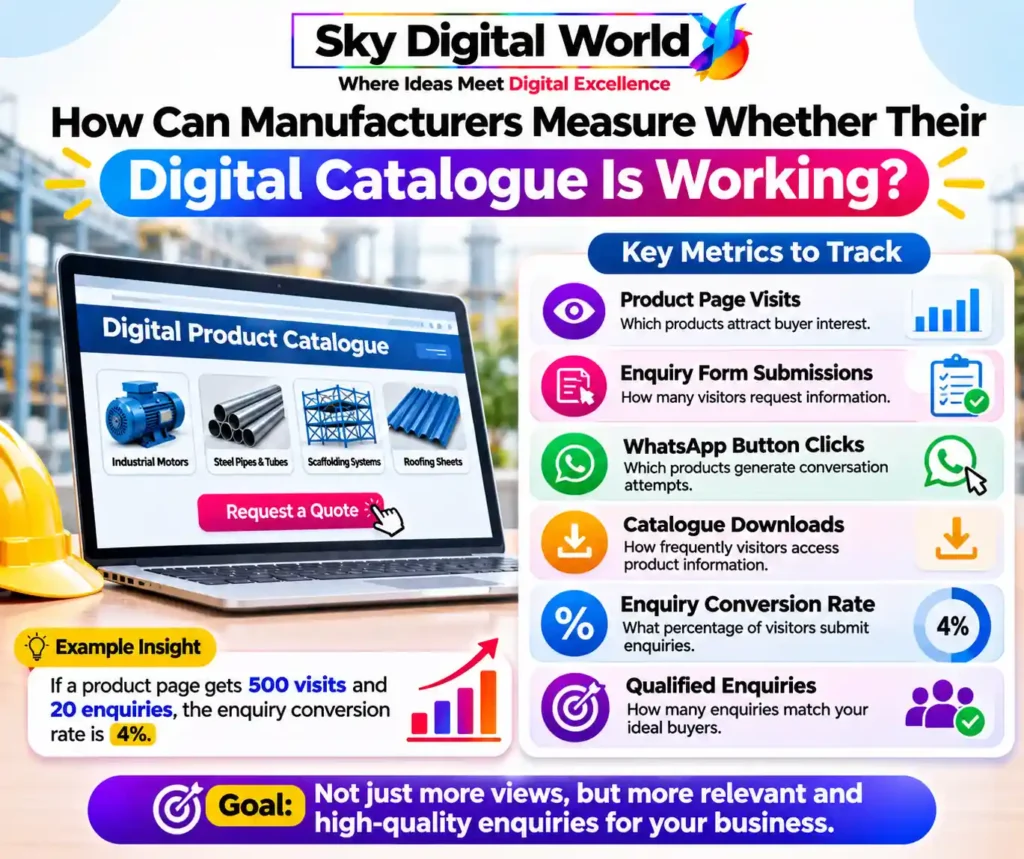
How Can Manufacturers Measure Whether Their Digital Catalogue Is Working?
A catalogue’s success should not be measured only by downloads or page views.
Manufacturers should track whether visitors are taking meaningful actions.
Useful metrics include:
Metric | What It Helps You Understand |
Product Page Visits | Which products attract buyer interest |
Enquiry Form Submissions | How many visitors request information |
WhatsApp Button Clicks | Which products generate conversation attempts |
Catalogue Downloads | How frequently visitors access product information |
Enquiry Conversion Rate | What percentage of visitors submit enquiries |
Qualified Enquiries | How many enquiries match your ideal buyers |
For example, a product page receiving 500 visits and generating 20 enquiries has a 4% enquiry conversion rate.
However, the quality of those enquiries matters more than the percentage alone.
A manufacturer receiving 10 relevant bulk-order enquiries may find them more valuable than 100 unrelated enquiries.
Review performance regularly and improve pages that receive traffic but generate few meaningful enquiries.
What Common Mistakes Should Manufacturers Avoid?
Even professionally designed catalogues can underperform when important details are overlooked.
Common mistakes include using outdated product photographs, publishing incomplete specifications, displaying too many products without categories and hiding contact information.
Another mistake is creating a visually attractive catalogue that loads slowly or is difficult to navigate.
Manufacturers should also avoid publishing unsupported claims about product quality, certifications or technical performance.
Accurate information builds confidence and helps sales teams handle enquiries more effectively.
How Can Manufacturers Build a Better Digital Catalogue Step by Step?
Start by reviewing your existing product range and identifying the categories customers search for most frequently.
Next, collect accurate product information from the production, technical and sales teams.
Prepare high-quality photographs, specifications and application details for each product.
Create a consistent page layout that makes products easy to compare.
Add product-specific enquiry forms, WhatsApp links and downloadable technical information where appropriate.
Once the catalogue is published, test it on mobile devices and desktop computers.
Finally, monitor enquiries and update the catalogue as products, specifications and customer requirements change.
A digital catalogue should be treated as an evolving sales resource rather than a one-time design project.
Final Thoughts: Make Your Product Catalogue Work Like a Sales Assistant
A digital product catalogue should not simply tell visitors what your company manufactures.
It should help them discover suitable products, understand technical details, evaluate applications and confidently request a quotation.
When manufacturers combine accurate product information, clear visuals, organised categories, SEO and convenient enquiry options, their catalogue becomes a practical tool for supporting business development.
At Sky Digital World, we help businesses strengthen their online presence through website development, SEO, digital marketing and conversion-focused content strategies.
If your manufacturing business has a product catalogue that attracts visitors but rarely generates enquiries, improving the buying experience could be the next important step.
Your products deserve more than online visibility. They deserve a digital presentation that helps turn interested visitors into potential customers.
Frequently Asked Questions
A website-based catalogue is useful for search visibility and frequent updates, while a downloadable PDF is convenient for sharing with customers. Many manufacturers benefit from offering both.
Yes. Manufacturers can generate enquiries using quotation forms, WhatsApp links, phone numbers and email contact options without accepting online payments.
It depends on the business model. Manufacturers offering customised products or bulk quantities may prefer quotation-based pricing, while businesses selling standardised products may benefit from displaying indicative prices.
Catalogues should be updated whenever product specifications, availability, certifications or product ranges change. Regular reviews also help identify outdated information.
Include detailed specifications, application information and enquiry fields that capture quantity, location and product requirements. This helps sales teams identify serious buyers.