





How Can Short-Form Videos Explain Complex Products in 30 Seconds?
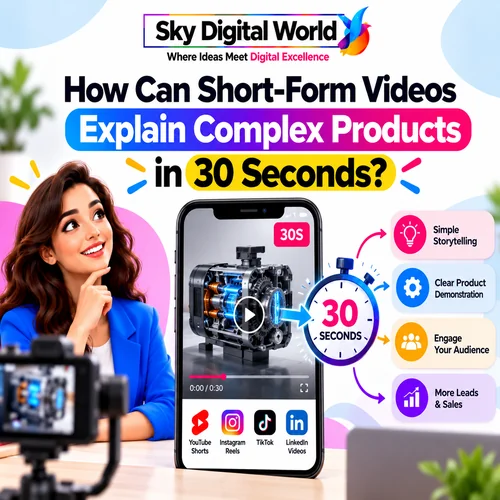
How Can Short-Form Videos Explain Complex Products in 30 Seconds?
In today’s digital world, customers do not always have the time or patience to read lengthy product descriptions. They want to understand what a product does, how it works, and why it matters to them as quickly as possible.
This becomes challenging when businesses sell technical products, industrial equipment, software solutions, or services that require detailed explanations.
That is where Short-Form Video Marketing can make a difference.
A well-planned 30-second video can simplify complicated information, demonstrate product benefits, and help potential customers understand a solution without feeling overwhelmed.
But creating an effective short video is not simply about reducing a long explanation to 30 seconds. It requires understanding the customer, selecting the right information, and presenting it in a clear visual story.
In this guide, we will explore how businesses can use short-form videos to explain complex products, improve customer understanding, and support their marketing goals.
What Is Short-Form Video Marketing?
Short-Form Video Marketing is a digital marketing approach that uses brief, engaging videos to communicate a message, demonstrate a product, or educate potential customers.
These videos are commonly shared on platforms such as Instagram Reels, YouTube Shorts, Facebook Reels, and LinkedIn.
Unlike traditional promotional videos, short-form content focuses on delivering one useful message within a limited time.
For businesses selling complex products, these videos can explain:
- What the product does.
- Which problem it solves.
- How customers can use it.
- What makes it different.
- Why someone might consider purchasing it.
The goal is not to explain every technical detail. Instead, it is to help customers understand the product’s most important value.
Why Are Complex Products Difficult to Explain Through Traditional Marketing?
Some products cannot be understood through a photograph or a short written description alone.
For example, a construction equipment manufacturer may need to explain how a scaffolding component connects with other parts. A software company may need to demonstrate how its dashboard works. A machinery supplier may need to show how a particular mechanism improves an industrial process.
Traditional marketing materials often rely on technical specifications, detailed descriptions, and industry terminology.
Although this information is valuable, it may be difficult for new customers to understand immediately.
Short-form videos solve part of this communication challenge by combining visuals, demonstrations, text, and narration.
Instead of telling customers how something works, businesses can show them.

How Can Businesses Explain Complex Products in Just 30 Seconds?
The most effective approach is to divide the video into small sections, with each section serving a specific purpose.
A simple 30-second structure can make even technical subjects easier to follow.
1. Start With a Customer Problem
The opening seconds should introduce a problem that the target audience recognizes.
For example, instead of starting with a product name, an industrial equipment supplier could ask:
“Struggling with slow scaffolding assembly at your construction site?”
This immediately establishes relevance.
Customers are more likely to continue watching when they recognize a challenge they face.
Avoid starting with lengthy company introductions or complicated technical descriptions.
2. Introduce the Product as a Solution
Once the problem is clear, introduce the product.
Show what it looks like and explain its main purpose in simple language.
For example:
“A modular scaffolding system helps workers assemble supporting structures using compatible components.”
The explanation should focus on the product’s function rather than listing every feature.
3. Demonstrate How It Works
This is often the most important part of a product explanation video.
Use real footage, product animations, close-up shots, or screen recordings to demonstrate the process.
For physical products, show how the components fit together.
For software, demonstrate a specific action on the screen.
For services, show a simple before-and-after workflow.
A visual demonstration can communicate information that would otherwise require several paragraphs.
4. Highlight One or Two Important Benefits
After showing how the product works, explain why it matters.
Select benefits that are directly relevant to the target customer.
These might include easier operation, improved convenience, reduced manual effort, better organization, or greater compatibility.
Avoid making unsupported claims such as guaranteed cost savings or superior performance.
The strongest videos connect a visible product feature with a practical customer benefit.
5. End With a Clear Next Step
The final seconds should guide interested viewers toward the next action.
Depending on the business, this could be:
- Request a product catalogue.
- Watch a complete demonstration.
- Visit the product page.
- Contact the sales team.
- Request a quotation.
The call to action should match the customer’s likely level of interest.
A technical buyer who has just discovered a product may prefer detailed specifications before speaking with a salesperson.
What Is the Best 30-Second Video Structure for Product Marketing?
Here is a practical example for a business explaining a technical product.
Video Duration | Content | Visual Direction |
0–3 seconds | Introduce the customer problem | Show the challenge |
4–8 seconds | Introduce the product | Clear product close-up |
9–18 seconds | Explain how it works | Demonstration or animation |
19–25 seconds | Highlight key benefits | Show practical applications |
26–30 seconds | Present the next step | Brand name and CTA |
This structure keeps the message focused while allowing enough time for viewers to understand the main idea.
However, the exact timing should depend on the complexity of the product and the footage available.
How Can Visual Storytelling Make Technical Products Easier to Understand?
Visual storytelling turns technical information into a sequence that customers can follow.
Imagine a company selling an automated packaging machine.
A written explanation might describe the machine’s operating mechanism, conveyor movement, filling system, and control interface.
A short video could instead show the complete process:
An empty container enters the machine, moves through the filling section, receives its packaging, and exits as a finished product.
Simple on-screen labels can identify the main stages.
This approach gives viewers a clear understanding of the workflow without requiring extensive technical knowledge.
Businesses can also use arrows, highlights, close-ups, and simple comparisons to explain specific functions.
The key is to make visuals informative rather than decorative.
Why Should Businesses Use Simple Language in Short-Form Videos?
Technical terminology may be familiar to manufacturers, engineers, and experienced buyers, but not every potential customer has the same knowledge.
Using complicated language can make a product seem more difficult than it actually is.
For example, a software company might replace:
“An integrated analytics interface enables cross-channel performance visualization.”
With:
“See your marketing results from different platforms in one dashboard.”
Both statements describe a similar function, but the second is easier to understand.
This does not mean removing technical accuracy.
Instead, businesses should explain the product in everyday language first and provide detailed specifications through their website, catalogue, or longer videos.
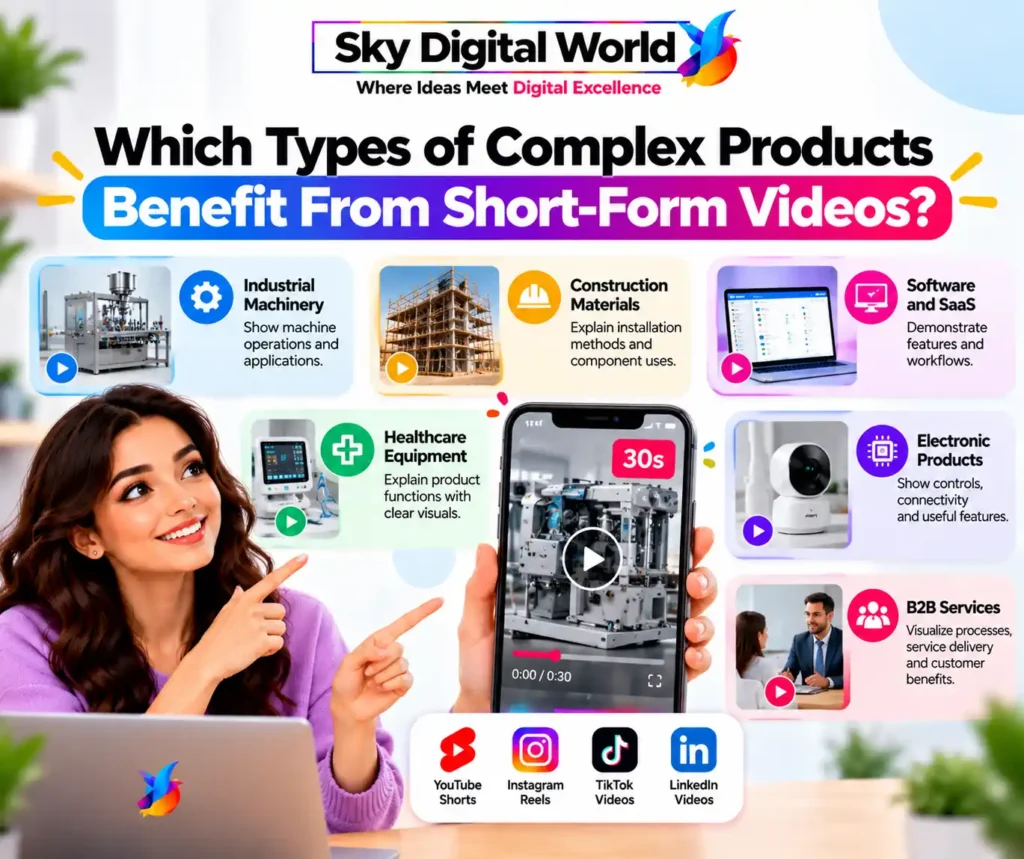
Which Types of Complex Products Benefit From Short-Form Videos?
Short-form video marketing can support businesses across several industries.
Industrial machinery: Demonstrate machine operations, manufacturing processes, and product applications.
Construction materials: Explain installation methods, component compatibility, and practical site uses.
Software and SaaS: Show dashboards, automation features, and common workflows through screen recordings.
Healthcare equipment: Explain general product functions and approved usage information without making unsupported medical claims.
Electronic products: Demonstrate controls, connectivity, and useful features.
B2B services: Visualize business processes, service delivery stages, and customer problems.
The format is especially useful when the product has a feature that can be demonstrated visually.
What Common Mistakes Should Businesses Avoid in 30-Second Product Videos?
One common mistake is trying to explain everything in a single video.
When too many specifications, features, and benefits appear together, the viewer may struggle to identify the main message.
Another mistake is using visuals that look impressive but do not explain the actual product.
For example, a video filled with animated transitions may attract attention without helping customers understand how the equipment operates.
Businesses should also avoid excessive text, unclear narration, misleading demonstrations, and calls to action unrelated to the video.
A better strategy is to create a series of short videos, with each one answering a different customer question.
One video might explain the product’s purpose, another could show installation, and a third could discuss important selection criteria.
This creates a more useful educational content library.
How Can Short-Form Videos Support SEO and Lead Generation?
Short-form videos can support a broader digital marketing strategy when businesses connect them with relevant website content.
For example, a manufacturer can publish a short demonstration on YouTube Shorts and direct interested viewers to a detailed product page.
That page can provide technical specifications, product images, application details, FAQs, and an enquiry form.
Businesses can also embed relevant videos within blog articles to help visitors understand the topic.
Descriptive video titles, captions, and accompanying text can make the content easier for users and search systems to interpret.
However, publishing short videos does not automatically guarantee higher Google rankings or qualified leads.
Results depend on content relevance, audience targeting, website experience, and the quality of the conversion process.
How Can Businesses Measure the Success of Short-Form Product Videos?
Video views alone do not indicate whether viewers understood the product or became interested in purchasing it.
Businesses should monitor metrics that connect video engagement with meaningful customer actions.
Important measurements include:
- Average watch time: How long viewers continue watching.
- Video completion rate: How many viewers reach the end.
- Saves and shares: Whether viewers find the information useful enough to revisit or share.
- Website visits: How many viewers move to the product page.
- Product enquiries: How many relevant conversations or quotation requests originate from video campaigns.
- Lead quality: Whether those enquiries match the business’s target customer profile.
For B2B businesses, a smaller number of relevant enquiries may be more valuable than thousands of views from an unrelated audience.
Reviewing these metrics can help businesses improve future video topics, opening hooks, demonstrations, and calls to action.
How Can Businesses Build a Consistent Short-Form Video Marketing Strategy?
Creating one successful video is useful, but building a consistent content strategy can provide more opportunities to educate customers.
Start by collecting questions frequently asked by customers and sales teams.
These questions can become individual video topics.
For example, an industrial product manufacturer could create videos explaining product applications, component differences, installation processes, material selection, and common purchasing considerations.
Use a recognizable visual style, consistent brand colors, readable captions, and accurate product footage.
Each video should have one clear educational purpose.
Over time, this approach can help businesses develop a collection of videos that customers can explore at different stages of their buying journey.
Conclusion
Explaining a complex product in 30 seconds is possible when businesses focus on clarity rather than the amount of information.
Effective Short-Form Video Marketing begins with a relevant customer problem, introduces a practical solution, demonstrates how the product works, and communicates its most important benefits.
For technical and B2B businesses, these videos can make unfamiliar products easier to understand and encourage interested customers to explore more detailed information.
The goal is not to replace technical catalogues, product pages, or sales discussions. It is to make the first explanation simple enough that customers want to learn more.
At Sky Digital World, we help businesses develop digital marketing content strategies that communicate product value through clear messaging, engaging visuals, and audience-focused storytelling.
Frequently Asked Questions (FAQs)
Yes, its main purpose and a few important benefits can often be explained in 30 seconds. Detailed technical specifications may require additional videos or supporting product content.
A 20–30-second video can work well for explaining one focused idea. More complicated demonstrations may benefit from a longer format.
Yes. B2B businesses can use short videos to demonstrate products, explain processes, answer common buyer questions, and introduce technical solutions.
Both can be effective. Real footage is useful for demonstrating actual products, while animation can help explain internal mechanisms or processes that are difficult to film.
Businesses can connect informative videos with relevant product pages, catalogues, quotation forms, or contact options, making it easier for interested viewers to take the next step.