




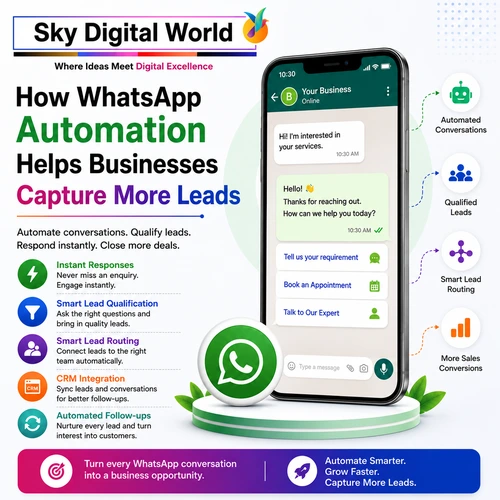
How WhatsApp Automation Helps Businesses Capture More Leads
A potential customer visits your website, checks your services, and decides to ask a question on WhatsApp.
They send a simple message:
“Hi, can you share more details?”
Five minutes pass. Then twenty. By the time your team replies, the customer may already be speaking with another business.
This is one of the biggest challenges businesses face in digital lead generation: customer interest happens instantly, but human response is not always instant.
WhatsApp automation helps close this gap.
Instead of leaving every enquiry dependent on manual replies, businesses can create structured WhatsApp journeys that acknowledge enquiries, collect important lead information, answer common questions, route conversations, and help sales teams respond more efficiently.
For companies exploring WhatsApp Automation Services India, the real opportunity is not simply automating messages. It is creating a faster and more organized communication system that helps turn customer interest into genuine sales opportunities.
What Is WhatsApp Automation?
WhatsApp automation is the use of approved tools, workflows, integrations, and predefined communication processes to handle repetitive parts of customer conversations.
Depending on the setup and applicable WhatsApp policies, automation can help businesses manage activities such as:
- Initial enquiry responses
- Lead qualification
- Frequently asked questions
- Appointment requests
- Product or service enquiries
- Lead routing
- Follow-up workflows
- Order-related communication
- Customer support
- CRM integration
- Sales-team notifications
The objective is not to make every customer conversation robotic.
The better approach is:
Automate repetitive steps. Keep important conversations human.
This balance can improve efficiency without sacrificing customer experience.
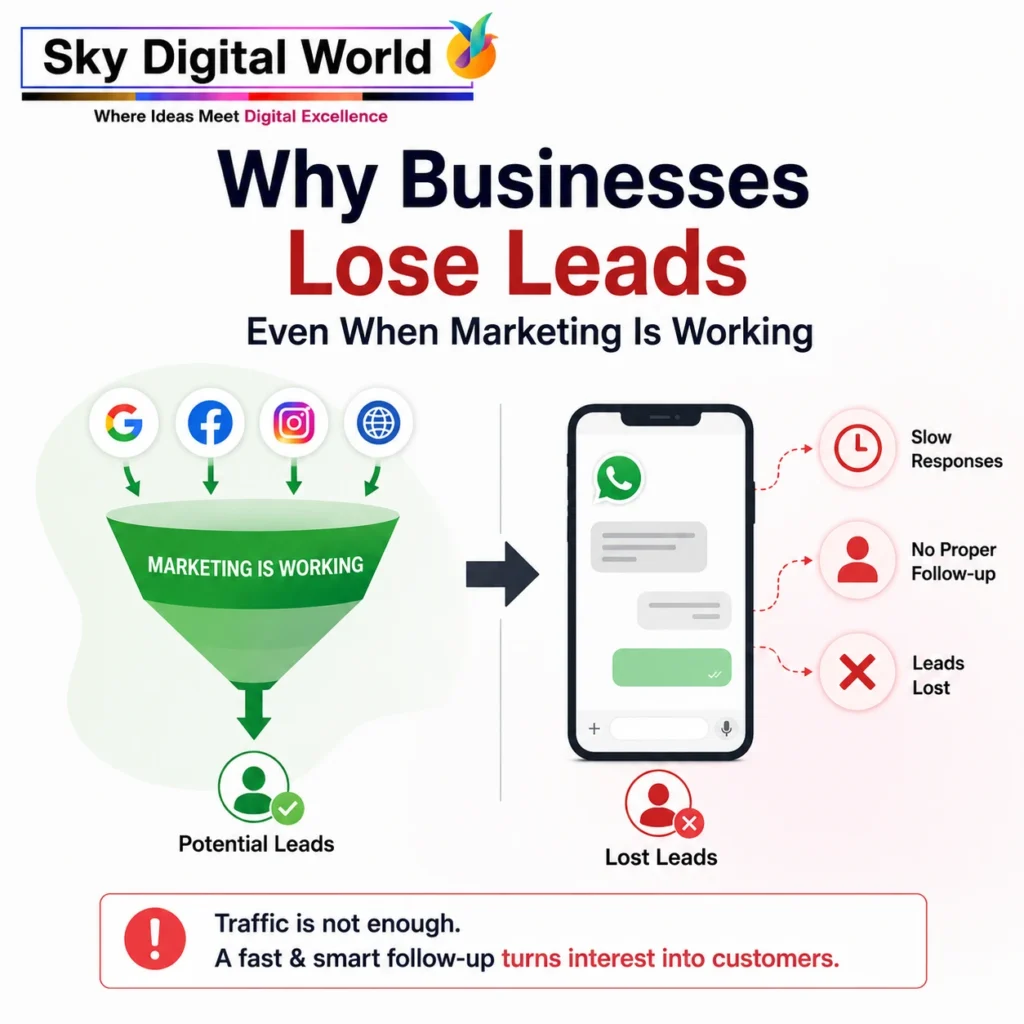
Why Businesses Lose Leads Even When Marketing Is Working
Businesses often focus heavily on generating leads through SEO, Google Ads, Meta Ads, social media, and websites.
But generating the enquiry is only the beginning.
Imagine spending money to bring 100 interested prospects to your website. Some click the WhatsApp button and ask for details.
If those conversations are handled slowly or inconsistently, part of the marketing investment can be wasted.
Common problems include delayed responses, missed messages, incomplete lead information, no follow-up, enquiries reaching the wrong team member, and sales teams spending time repeatedly answering basic questions.
WhatsApp automation addresses the process after the customer shows interest.
That makes it an important bridge between marketing and sales.
How WhatsApp Automation Helps Businesses Capture More Leads
1. Instant Responses Keep Customer Interest Alive
Speed matters when someone is actively considering a purchase.
A prospect who sends a WhatsApp message is often closer to action than someone who simply views an advertisement.
An automated acknowledgement can immediately confirm that the enquiry has been received.
For example:
Thanks for contacting us. Please select the service you’re interested in, and we’ll help you with the relevant information.
The customer receives direction immediately rather than wondering whether anyone has seen the message.
Automation does not necessarily complete the sale.
It keeps the conversation moving until the appropriate human response is needed.
2. Automation Can Qualify Leads Before Sales Teams Step In
Not every enquiry has the same value or requirement.
A real estate company may need to know:
Property Type → Preferred Location → Budget Range → Buying Timeline
A digital marketing agency might ask:
Required Service → Business Type → Location → Primary Marketing Goal
A salon could collect:
Required Service → Preferred Branch → Preferred Date → Preferred Time
Instead of the sales team manually asking the same questions repeatedly, a structured WhatsApp flow can collect essential information first.
The sales representative then enters the conversation with better context.
This can make conversations more productive for both the business and the customer.
3. WhatsApp Can Reduce Friction in Lead Generation
Traditional website forms often ask users to complete several fields before submitting an enquiry.
WhatsApp feels different because many customers already use it regularly.
A customer can move from:
Ad → Landing Page → WhatsApp → Conversation
with relatively little friction.
Businesses can also connect WhatsApp calls-to-action with appropriate marketing touchpoints such as websites, landing pages, social profiles, and advertising campaigns.
The easier it is for an interested customer to start a relevant conversation, the fewer unnecessary steps exist between interest and enquiry.
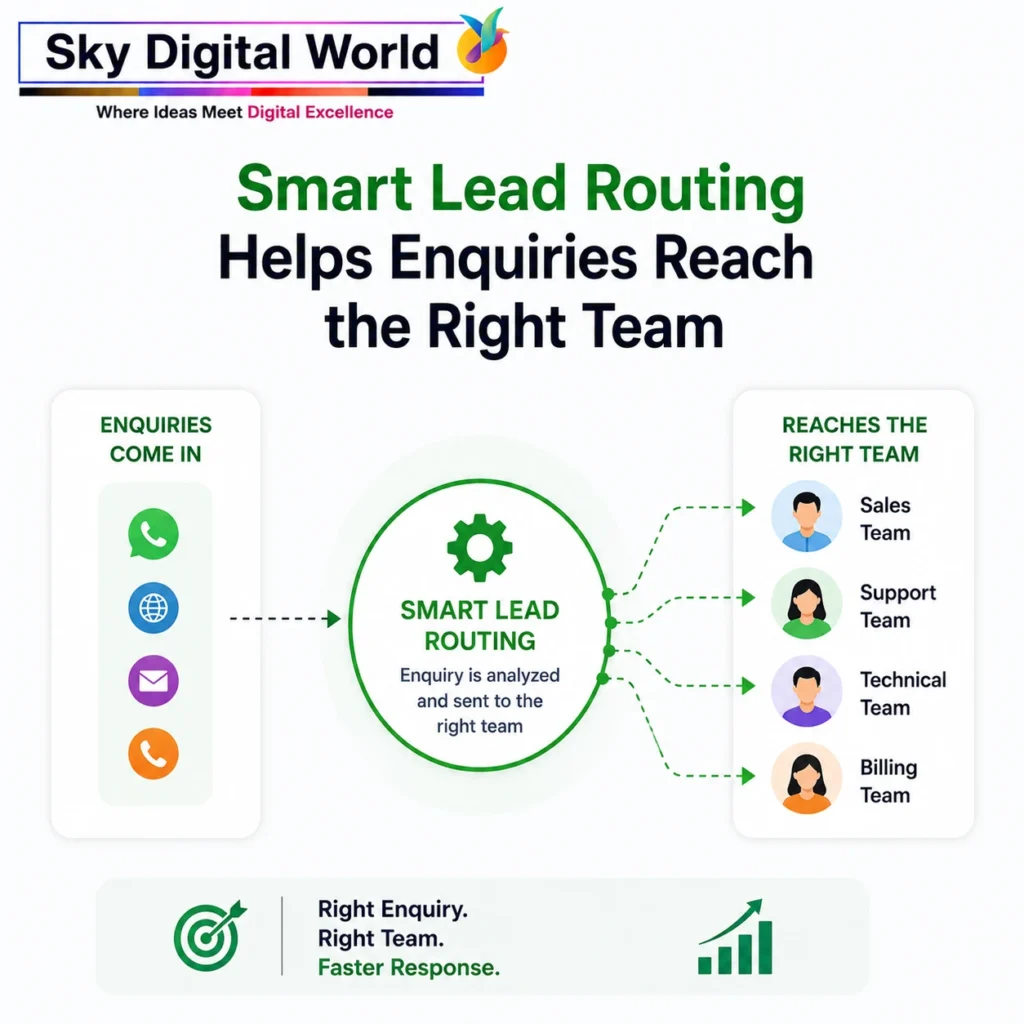
4. Smart Lead Routing Helps Enquiries Reach the Right Team
Capturing a lead is useful.
Getting that lead to the correct person is even more important.
Consider a company offering:
Sales | Support | Billing | Partnerships
If every conversation reaches the same inbox without organization, response times can suffer.
A structured automation flow can first understand the customer’s requirement.
The conversation can then be categorized or routed appropriately depending on the tools and integrations being used.
For a multi-location business, routing could also be based on location:
Indore → Indore Team
Bhopal → Bhopal Team
Mumbai → Mumbai Team
This reduces unnecessary internal forwarding and helps customers reach relevant teams faster.
5. Automated FAQs Save Time Without Making Customers Search
Sales and support teams often answer the same questions every day:
What are your timings?
Where are you located?
What services do you provide?
How can I book an appointment?
How can I speak to your team?
These questions do not always require a salesperson.
A carefully designed WhatsApp flow can provide basic information quickly while allowing customers to request human assistance when necessary.
This creates a better division of work:
Automation handles repetition.
People handle complexity.
6. WhatsApp Automation Can Support Lead Follow-Up
A large percentage of potential customers do not purchase during their first interaction.
They may be interested but need more information, approval from another person, additional time, or a comparison with other providers.
Without an organized follow-up process, these leads can easily be forgotten.
Businesses can design compliant follow-up workflows based on customer actions, consent, and the messaging rules that apply to their WhatsApp setup.
For example, a customer who requested a consultation may receive appropriate booking-related communication rather than relying entirely on someone remembering to follow up manually.
The purpose is not to repeatedly message people who are not interested.
Good automation should make communication more relevant, not more intrusive.
7. Marketing Campaigns Become More Action-Oriented
WhatsApp automation becomes particularly useful when connected with digital campaigns.
Consider this journey:
Instagram Ad → WhatsApp Conversation → Requirement Selection → Lead Details → Sales Team
Instead of asking users to browse multiple pages before contacting the company, the campaign can create a more direct conversational path.
Businesses running digital advertising can use this approach for campaigns involving:
- Property enquiries
- Service consultations
- Product enquiries
- Education admissions
- Appointment requests
- Event registrations
- B2B enquiries
The exact workflow should always match the business and the customer’s intent.
8. Website Visitors Can Become Conversations Faster
A website may receive hundreds or thousands of visitors, but visitors alone do not create revenue.
Businesses need meaningful actions.
Adding a clear WhatsApp contact option to relevant pages can provide another conversion path for people who prefer messaging over forms or phone calls.
Useful placements may include:
Service Pages → WhatsApp Enquiry
Product Pages → Ask About Product
Pricing Pages → Discuss Requirements
Contact Page → Chat on WhatsApp
Landing Pages → Get More Information
The call-to-action should explain what happens after clicking rather than simply displaying a generic WhatsApp icon everywhere.
For example:
“Discuss Your SEO Requirements on WhatsApp”
is more informative than:
9. CRM Integration Creates a More Organized Lead Pipeline
One of the biggest problems with manually managed WhatsApp enquiries is that important information can remain scattered across conversations.
When supported tools are integrated appropriately, businesses can create a more organized workflow where lead information can be connected with their CRM or sales process.
A structured pipeline might look like:
New Enquiry → Qualified Lead → Sales Follow-Up → Proposal → Won/Lost
The sales team can then work from a process rather than relying only on individual chat history.
This becomes increasingly valuable as enquiry volume grows.
10. Automation Can Improve Appointment Booking
Service businesses frequently use WhatsApp for appointments.
This includes industries such as:
- Salons
- Clinics
- Consultants
- Real estate
- Education
- Professional services
- Home services
- Automotive businesses
A structured conversation can collect information such as:
Service → Location → Preferred Date → Preferred Time → Contact Details
Depending on the booking system and integrations used, the information can then be passed into the appropriate booking or staff workflow.
This reduces repetitive back-and-forth communication.
11. Businesses Can Capture Leads Outside Working Hours
Customers do not always enquire between 10 AM and 6 PM.
Someone may discover a business at 11:30 PM after seeing an Instagram Reel or finding the company through Google.
A human team may not be available.
Automation can still acknowledge the enquiry and collect essential information.
For example:
Thanks for contacting us. Our team is currently unavailable. Please share your requirement, and we’ll continue the conversation during business hours.
This is much better than leaving the customer with no confirmation at all.
The customer knows the enquiry has reached the business, while the sales team receives context when work resumes.
12. Personalized Automation Is Better Than Generic Automation
Automation should not mean sending the same message to everyone.
A better workflow responds to what the customer actually needs.
For example:
Customer A
Interested in SEO.
They receive SEO-related questions and information.
Customer B
Interested in social media marketing.
They enter a different conversation path.
Customer C
Already purchased and needs support.
They should not be pushed through a new-sales sequence.
This is where intelligent workflow design matters.
The goal is to make automation feel relevant.
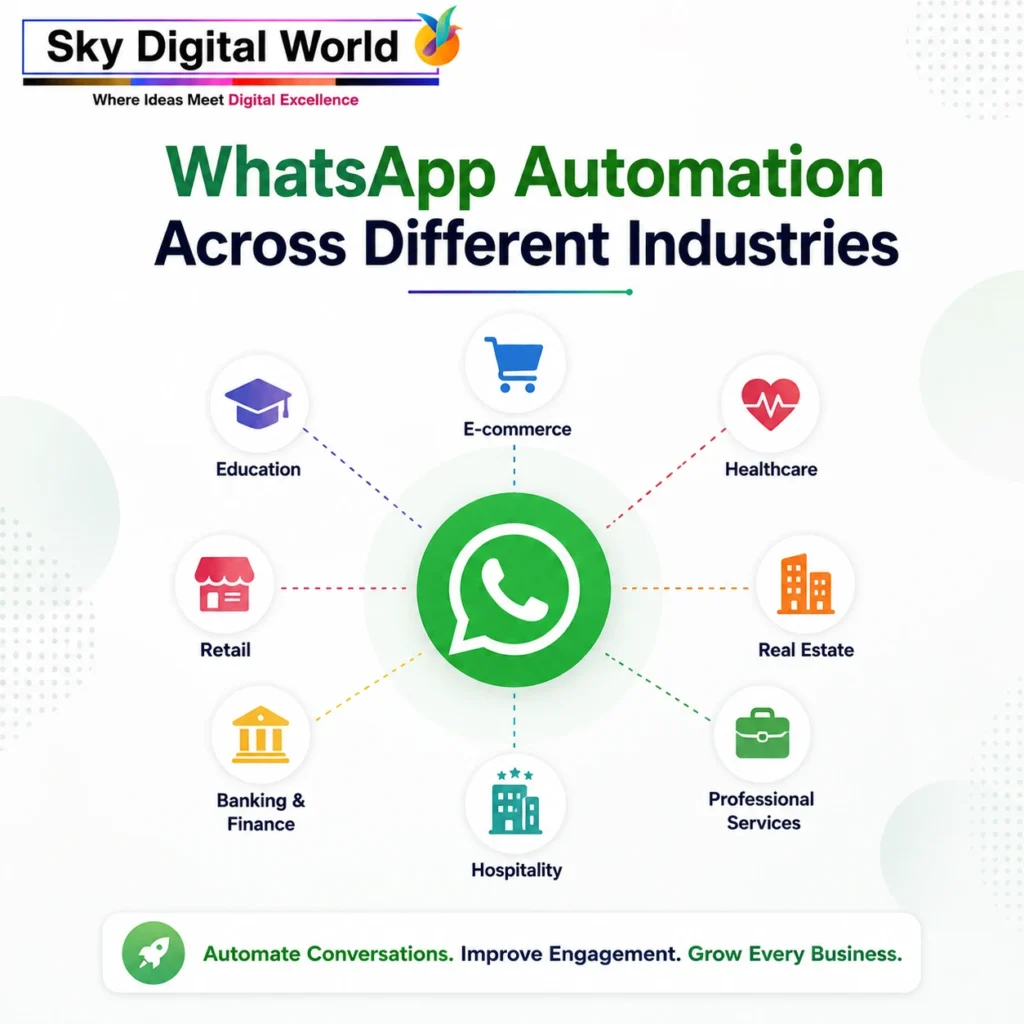
WhatsApp Automation Across Different Industries
Different industries require different lead journeys.
Real Estate
Project → Property Type → Budget → Site Visit → Sales Executive
Healthcare
Service/Department → Appointment Request → Relevant Information → Staff Assistance
Automation should not replace professional medical judgment or emergency communication.
Education
Course → Qualification → Location → Admission Enquiry → Counsellor
E-commerce
Product Enquiry → Availability → Order Assistance → Customer Support
B2B Manufacturing
Product → Quantity → Location → Requirement → Sales Team
Digital Marketing
Service → Business Type → Marketing Goal → Consultation → Marketing Specialist
The strongest automation is built around the actual customer journey rather than using one generic chatbot flow for every industry.
WhatsApp Automation vs Manual WhatsApp Management
Manual WhatsApp communication works reasonably well when enquiry volume is very low.
Problems start appearing as businesses grow.
Manual Process | Automated Process |
Response depends on staff availability | Initial acknowledgement can be immediate |
Repetitive questions handled manually | Common questions can follow structured flows |
Lead details may remain inside chats | Data can be organized through integrations |
Follow-up depends heavily on staff memory | Workflows can support systematic follow-up |
Routing may require manual forwarding | Enquiries can be categorized more efficiently |
Scaling requires more manual effort | Repetitive processes can be standardized |
The best setup is often not automation versus humans.
It is automation + humans.
The Most Important Rule: Don’t Automate the Entire Relationship
Poor automation can damage customer experience.
Imagine a customer asking a complicated question and repeatedly receiving irrelevant menu options.
That is not efficiency.
It is friction.
Businesses should identify when automation needs to hand the conversation to a person.
Human intervention is especially important when customers have unusual requirements, complaints, complex pricing questions, high-value enquiries, sensitive issues, or situations that cannot be accurately handled through predefined flows.
A simple principle works well:
Automate predictable actions. Humanize important conversations.
Local Businesses Can Benefit From WhatsApp Automation
WhatsApp automation is not only useful for national brands.
It can be particularly valuable for businesses competing in specific cities.
For example, companies searching for WhatsApp Automation Services in Indore may want to capture enquiries from local SEO, Google Ads, Meta Ads, Instagram, or their websites and route them into an organized communication process.
Similarly, businesses may search for solutions such as:
WhatsApp Marketing Services Indore
WhatsApp Business Automation Indore
WhatsApp Chatbot Services Indore
WhatsApp Lead Generation Services Indore
WhatsApp Automation Company in Indore
Local optimization should remain natural.
Creating dozens of city names inside one article purely to target keywords makes content less useful. If a business genuinely serves different cities, dedicated location pages with meaningful local information are generally a cleaner strategy.
What Should a Good WhatsApp Lead Automation Flow Look Like?
A simple service-business workflow could look like this:
Step 1 — Welcome
Acknowledge the customer’s enquiry.
Step 2 — Identify Intent
Ask what service or product they need.
Step 3 — Collect Essential Details
Request only the information necessary to understand the requirement.
Step 4 — Qualify
Categorize the enquiry based on relevant criteria.
Step 5 — Provide Immediate Value
Share useful information appropriate to the customer’s request.
Step 6 — Human Handoff
Connect qualified or complex conversations to the appropriate team.
Step 7 — Record the Lead
Store relevant information in the company’s approved CRM or lead-management workflow where applicable.
Step 8 — Follow Up
Continue appropriate communication according to customer consent, context, and applicable messaging policies.
This creates a much more purposeful customer journey than simply displaying:
Common WhatsApp Automation Mistakes Businesses Should Avoid
Automation only works well when it respects the customer.
Common mistakes include:
Creating extremely long chatbot menus — Customers should not have to navigate ten steps before reaching a person.
Collecting unnecessary information — Ask only for information needed to serve the enquiry.
Sending irrelevant follow-ups — More messages do not automatically create more conversions.
Ignoring consent and platform rules — Messaging should follow applicable WhatsApp requirements and privacy obligations.
No human handoff — Customers need an easy route to a person when automation cannot solve their problem.
Using robotic language — Messages should sound clear and natural.
Automating without measurement — Businesses should understand whether automation actually improves response handling and lead progression.
Measure More Than the Number of Messages
A successful WhatsApp automation strategy should not be measured by how many messages the system sends.
Useful business metrics can include:
Enquiries Started — How many people begin conversations?
Lead Completion Rate — How many provide the required information?
Qualified Leads — How many match the business’s target customer profile?
Response Efficiency — How quickly are relevant enquiries handled?
Human Handoff Rate — How often does automation transfer conversations to the team?
Appointment or Consultation Rate — How many leads reach the next meaningful stage?
Lead-to-Customer Conversion — How many qualified conversations eventually generate business?
These metrics help businesses improve the actual customer journey rather than simply increasing automation volume.
Why Businesses Choose WhatsApp Automation Services India
Setting up a few automatic replies is easy.
Building a useful lead-generation system is more complex.
Professional WhatsApp Automation Services India may involve planning the complete customer communication journey, including lead sources, qualification questions, conversation flows, integrations, routing, human handoff, follow-up logic, and performance measurement.
A well-designed implementation should consider:
- Business objectives
- Target audience
- Lead sources
- Customer intent
- Conversation design
- WhatsApp Business Platform requirements
- CRM requirements
- Team responsibilities
- Data handling
- Human handoff
- Reporting
- Optimization
Technology is only one part of the solution.
Strategy determines whether the automation actually helps customers and the business.
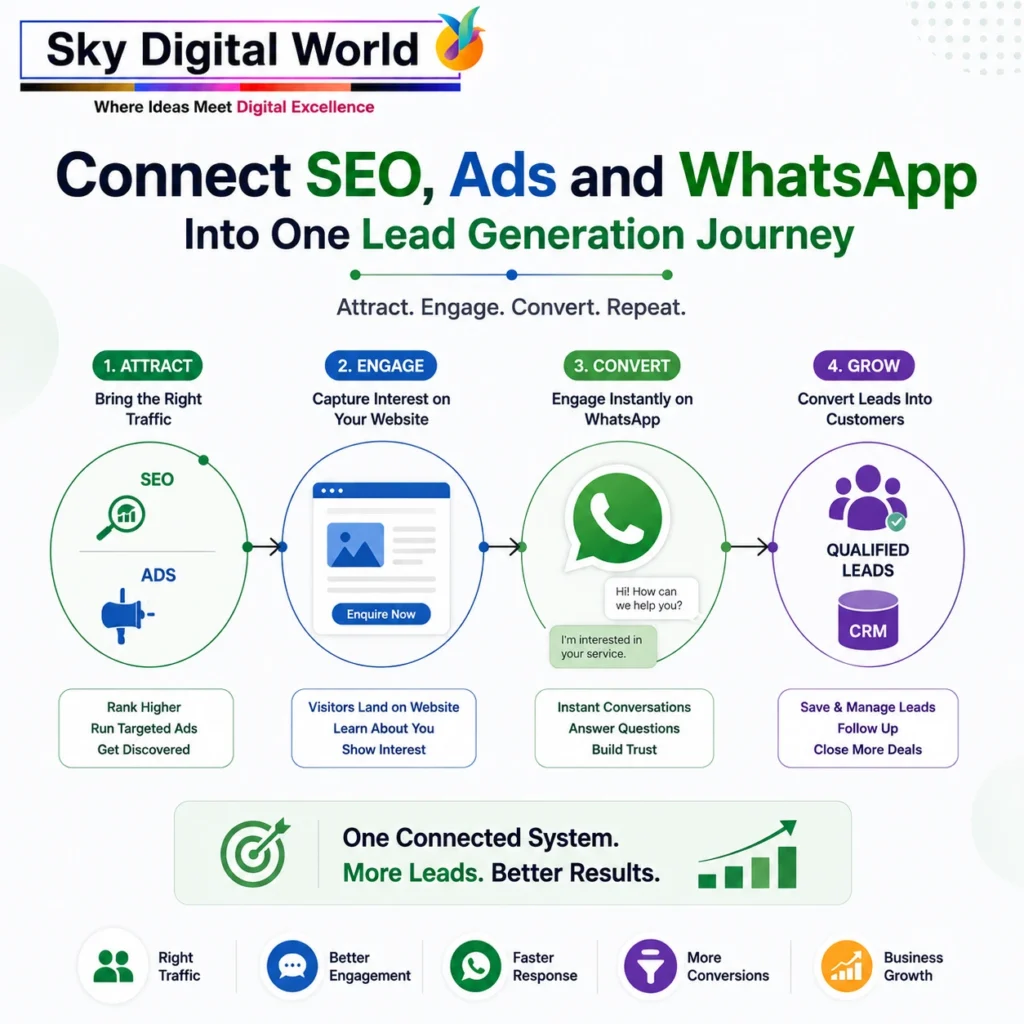
Connect SEO, Ads and WhatsApp Into One Lead Generation Journey
WhatsApp automation becomes more powerful when it is not treated as an isolated marketing tool.
A complete digital journey might look like:
Google Search → SEO Landing Page → WhatsApp → Qualified Lead → Sales Conversation
or:
Meta Ad → WhatsApp → Requirement Capture → Sales Team → Conversion
or:
Instagram Content → Profile → Website → WhatsApp → Consultation
This connects customer acquisition with lead management.
Instead of evaluating SEO, social media, paid advertising, website optimization, and WhatsApp separately, businesses can design them as parts of the same conversion journey.
Turn More Conversations Into Opportunities With Sky Digital World
Generating traffic is only valuable when businesses have a reliable way to handle customer interest.
At Sky Digital World, WhatsApp automation can be integrated into a wider digital marketing strategy involving websites, landing pages, SEO, social media, and paid advertising.
For businesses looking for WhatsApp Automation Services India or WhatsApp Automation Services in Indore, the focus should not simply be on installing a chatbot.
The objective is to create a smarter lead journey that helps customers get relevant information faster while helping sales teams focus on conversations that genuinely need human attention.
When implemented thoughtfully, WhatsApp automation can help businesses:
Respond Faster → Capture Better Information → Organize Leads → Improve Follow-Up → Create More Sales Opportunities
The future of business messaging is not about removing humans from customer communication.
It is about using automation to help humans respond at the right moment with the right context.
Frequently Asked Questions
What is WhatsApp automation for businesses?
WhatsApp automation uses approved messaging tools, predefined workflows, and integrations to streamline repetitive customer communication such as enquiry acknowledgement, qualification, FAQs, routing, and follow-up.
Can WhatsApp automation help generate leads?
It can support lead generation by making it easier to start conversations, collecting relevant information, reducing response delays, and routing qualified enquiries to sales teams. Results still depend on factors such as traffic quality, offer, sales process, and customer demand.
Is WhatsApp automation suitable for small businesses?
Yes. Small businesses can use simple automation for enquiry acknowledgement, FAQs, appointment requests, and lead collection without necessarily creating a highly complex system.
Can WhatsApp automation work with Meta Ads?
Businesses can create advertising journeys that encourage users to start conversations on WhatsApp where appropriate. The exact setup and available functionality depend on the advertising and WhatsApp tools being used.
Can WhatsApp automation be connected with a CRM?
Depending on the CRM, WhatsApp solution, and available integrations, lead information and conversation workflows can be connected with customer-management systems.
What are WhatsApp Automation Services India?
These services generally help businesses plan, configure, integrate, and optimize WhatsApp-based communication workflows for activities such as lead capture, qualification, support, sales routing, and customer communication.
Is WhatsApp automation better than a human sales team?
They perform different roles. Automation is useful for repetitive and predictable processes, while people are better suited to complex conversations, relationship building, negotiation, and high-value sales interactions.