




Why Isn’t My Website Ranking on Google?
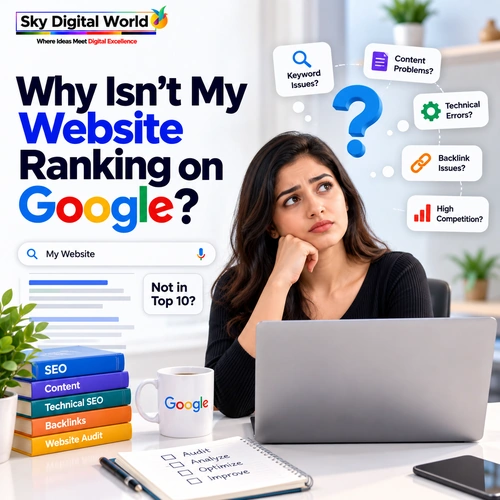
You have invested time in building your website. Your services are listed, the design looks professional, and you may even be publishing blogs regularly. But when you search for the products or services your business offers, your website is nowhere near the results you expected.
This leads to one of the most common questions business owners ask:
“Why isn’t my website ranking on Google?”
The answer is rarely as simple as “you need more keywords.”
A website’s organic search visibility depends on several connected factors, including whether Google can crawl and index your pages, how well your content matches search intent, your website structure, technical performance, internal linking, competition, and the overall usefulness of your pages.
Google itself distinguishes between crawling, indexing and serving search results. Being discovered or indexed does not automatically guarantee that a page will rank prominently for a particular search.
This guide explains the common reasons a website may struggle in Google Search and, more importantly, what you can do about them.
First, Understand the Difference Between Indexing and Ranking
Before changing your SEO strategy, determine whether you actually have a ranking problem or an indexing problem.
These are not the same thing.
Crawling happens when Google discovers and accesses pages on your website.
Indexing happens when Google processes a page and may add it to its search index.
Ranking determines where an eligible page may appear for a particular search query.
For example, imagine that you publish a page targeting SEO Services.
If Google cannot crawl the page, it may never properly discover its content.
If Google crawls it but does not index it, the page generally cannot compete normally in Search.
If the page is indexed but appears far down the search results, you are dealing with a visibility or ranking challenge rather than simply an indexing issue.
This distinction should determine what you investigate next.
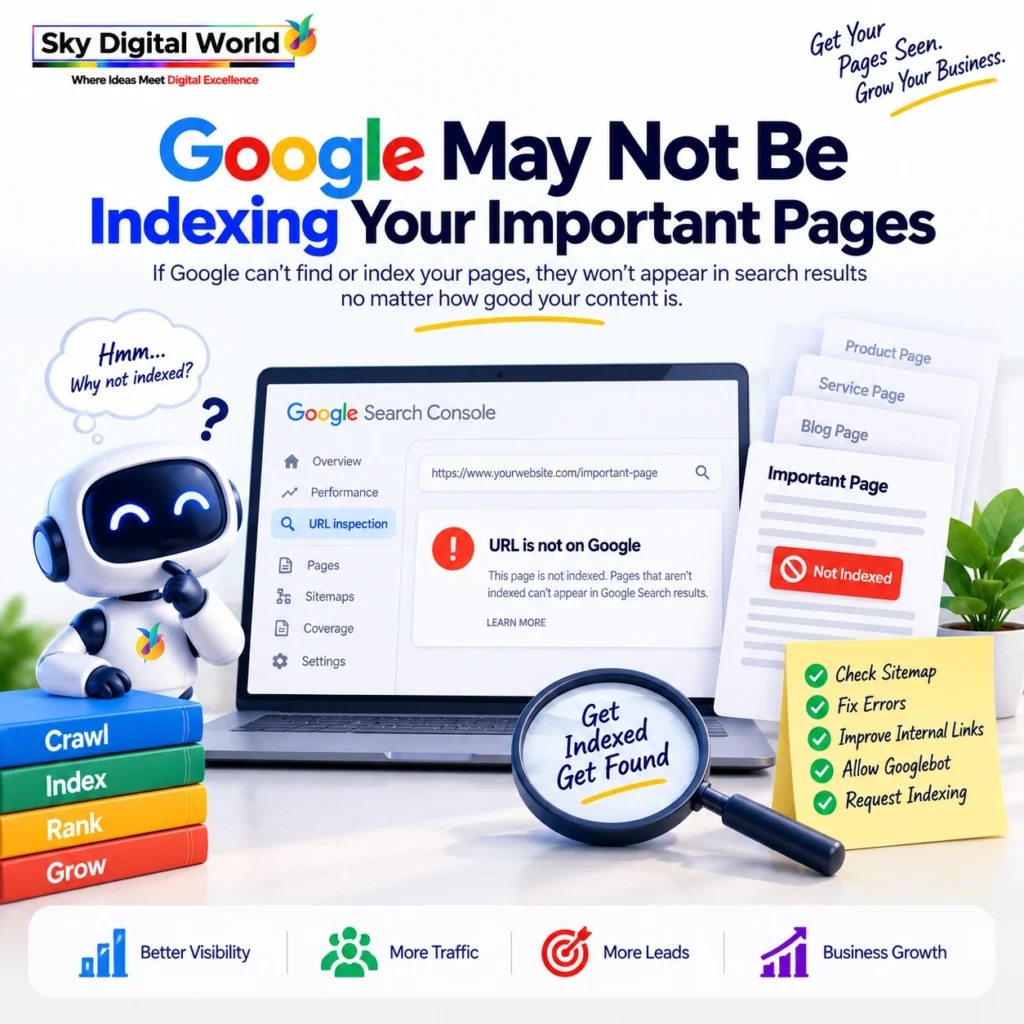
1. Google May Not Be Indexing Your Important Pages
One of the first things to check is whether the page you want to rank is actually indexed.
Several technical situations can interfere with indexing, including noindex directives, crawling restrictions, redirects, duplicate URLs, canonicalization issues and server-related problems.
Google Search Console’s URL Inspection tool can help you investigate individual URLs and understand their indexing and crawl information.
What should you check?
Start by reviewing:
- URL Inspection in Google Search Console
- Page indexing reports
- XML sitemap
- robots.txt
- canonical tags
- redirects
- server response codes
- internal links pointing to important pages
Do this before rewriting the page. Improving content will not solve a technical issue that prevents Google from properly accessing or indexing it.
2. Your Keywords and Search Intent May Not Match
Adding a keyword to a page does not automatically make that page the right answer for the search.
Consider these searches:
“What is SEO?”
“SEO services”
“SEO company near me”
“SEO audit cost”
They are all related to SEO, but the person searching each phrase wants something different.
The first user wants information.
The second may be researching a service.
The third is showing local commercial intent.
The fourth may be comparing pricing before making a decision.
If your service page targets an informational query but mainly says “Contact us for SEO services,” it may not adequately answer what that searcher wants.
How to improve search intent alignment
Before optimizing a page, ask:
Who is searching this keyword?
What problem are they trying to solve?
What information would they expect to find?
Are they learning, comparing, buying or looking for a local provider?
Does my page satisfy that intention better than simply repeating the keyword?
Modern SEO should begin with the person behind the search—not just the phrase inside the search box.
3. Your Content May Be Too Generic
Many business websites contain paragraphs such as:
“We provide high-quality and innovative digital solutions according to our clients’ requirements.”
It sounds professional, but it tells a potential customer very little.
The same sentence could appear on hundreds of websites.
A strong service page should provide useful, specific information.
For example, an SEO Services page could explain what the service includes, what problems it addresses, how the process works, what businesses should consider before investing in SEO, and how technical SEO, content and on-page optimization fit together.
Instead of trying to make content longer, make it more useful.
A useful service page should answer:
What is the service?
Explain it clearly without unnecessary jargon.
Who is it for?
Help visitors understand whether it is relevant to their situation.
What problems can it address?
Connect the service with genuine customer challenges.
What does your process include?
Set realistic expectations.
What should the customer do next?
Provide a logical CTA.
This creates content for people first while still giving search engines clearer context.
4. Keyword Stuffing May Be Making the Content Worse
There was a time when SEO content frequently looked like this:
“Looking for SEO Services India? We provide the best SEO Services India as a leading SEO Company India offering affordable SEO Services India…”
That is not natural communication.
Repeating a target keyword excessively does not automatically make a page more relevant.
Google’s Search Essentials and spam policies emphasize creating useful content while avoiding techniques designed primarily to manipulate search rankings.
A better approach is to use the primary keyword naturally and support it with closely related concepts.
For an SEO Services page, that could include terms such as:
Search Engine Optimization, Technical SEO, On-Page SEO, Search Intent, Content Optimization, Website Structure, Internal Linking and Organic Search Visibility.
The goal is topical clarity—not keyword repetition.
5. Your Website Structure May Be Confusing
Imagine walking into a shopping mall where there are no signs.
The stores exist, but finding the right one becomes unnecessarily difficult.
Websites can have the same problem.
If important service pages are buried deep inside the website or have very few internal links, both visitors and search engines may have difficulty understanding how the pages relate to one another.
A cleaner structure might look like:
Home → Services → SEO Services → Technical SEO
Then relevant educational content can support that structure:
SEO Blog → SEO Services → Contact
This creates logical relationships between your informational and commercial pages.
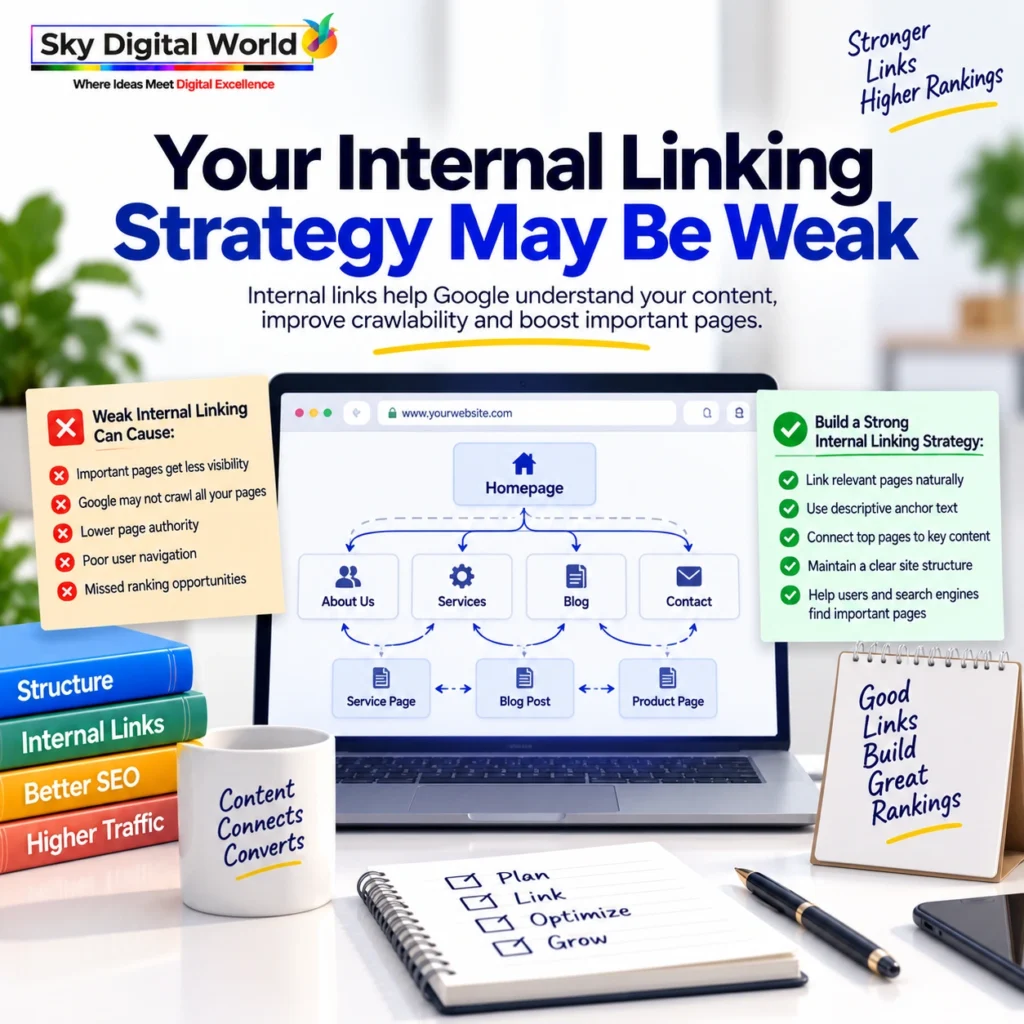
6. Your Internal Linking Strategy May Be Weak
Internal links are more than navigation.
They help users move naturally between related topics and help search engines discover and understand relationships between pages.
For example, if you publish an article called:
“Why Isn’t My Website Ranking on Google?”
it would be natural to link relevant sections to pages covering:
SEO Services
Technical SEO
Content Marketing
Website Development
Local SEO
But internal links should have a purpose.
Do not add dozens of links simply because you want to send “SEO value” everywhere. Link when the destination genuinely helps the reader understand or take the next step.
7. Multiple Pages May Be Targeting the Same Topic
Suppose your website contains:
/seo-services/
/professional-seo-services/
/best-seo-company/
/seo-agency/
/seo-solutions/
If all five pages contain almost the same information and target essentially the same intent, creating additional pages may not provide additional value.
Instead, decide which URL should be the strongest resource for that particular topic.
Then improve it.
Create separate pages when there is a genuine difference in service, audience, location or search intent—not simply because you discovered another keyword variation.
8. Your Website Experience May Be Losing Visitors
SEO should not stop when someone clicks your result.
A visitor lands on the page and immediately starts making decisions.
Does this page answer my question?
Can I understand what this business offers?
Is it easy to use on my phone?
Can I find the information I need?
What am I supposed to do next?
A confusing layout, slow experience, unclear heading structure or hidden CTA can make an otherwise useful page difficult to use.
SEO and user experience should therefore support each other.
Your goal should not simply be:
Search → Click
Think about the complete journey:
Search → Click → Understand → Explore → Trust → Enquire
That is much closer to how a real customer experiences your website.
9. Your Website May Lack Topical Depth
Publishing random articles every week does not automatically build a strong content strategy.
A more structured approach is to develop useful resources around the subjects closely connected to your business.
For example, an SEO service provider might build a content ecosystem around:
SEO Services → Technical SEO → Indexing → Search Intent → On-Page SEO → Internal Linking → Local SEO → Content Optimization → SEO Audits
Each article should solve a distinct problem while naturally connecting with related resources.
This is more useful than publishing unrelated topics simply to increase the number of pages on the website.
10. Your Competitors May Simply Have Stronger Search Signals
Sometimes there isn’t one dramatic problem with your website.
Your competitors may simply have a stronger overall search presence.
They may have:
more useful content,
better-established pages,
stronger relevant backlinks,
clearer topical coverage,
better internal linking,
stronger local visibility,
or a website that has accumulated search signals for longer.
This is why competitor analysis should go beyond checking where competitors rank.
Ask:
What does their page answer that ours doesn’t?
How is their website structured?
Which topics have they covered in depth?
What information would make our page genuinely more useful?
Competitor research should reveal gaps—not become a copying exercise.
11. You May Be Measuring the Wrong SEO Numbers
Many businesses check one metric:
“What position is my keyword?”
Rankings matter, but they are only part of the picture.
Google Search Console can help you evaluate search queries, impressions, clicks and other search-performance information.
For example:
High impressions + low clicks
Your page is appearing, but searchers may not be choosing it.
Review the title, description, intent and relevance.
Very low impressions
The page may have limited visibility, weak relevance, insufficient demand for the targeted query, or other SEO issues that need investigation.
Clicks but few enquiries
The problem may exist after the search click.
Review the landing experience, content, CTA and customer journey.
The important point is simple:
Different symptoms require different solutions.
12. You Expect SEO to Deliver Instant Results
SEO is not the same as switching on an advertisement.
Publishing a page today does not create a guaranteed ranking tomorrow.
Google states that crawling and indexing take time, and it does not guarantee when or whether a URL will be crawled or indexed.
Ranking introduces additional variables, including competition, relevance and the broader quality of the website.
Instead of repeatedly making random changes, create a process:
Research → Optimize → Publish → Measure → Learn → Improve
Give your changes enough time to produce meaningful data before changing everything again.
How to Diagnose a Website That Isn’t Ranking
If your website is struggling with organic visibility, use this sequence rather than guessing.
Step 1 — Check Crawlability
Make sure search engines can access important pages and that technical restrictions are not blocking them.
Step 2 — Check Indexing
Inspect important URLs through Google Search Console.
Step 3 — Review Search Intent
Make sure each important page has a clear purpose and matches what its target audience actually wants.
Step 4 — Audit the Content
Look for thin, repetitive, outdated or generic information.
Ask whether the page provides something genuinely useful.
Step 5 — Review Website Structure
Important pages should be logically organized and reasonably easy to reach.
Step 6 — Improve Internal Linking
Connect relevant blogs, service pages and supporting resources naturally.
Step 7 — Review Technical Performance
Check mobile usability, loading performance, redirects, broken pages and other technical problems.
Step 8 — Study Search Performance
Use Search Console to understand impressions, clicks, queries and page-level performance.
Step 9 — Compare the Search Competition
Identify what competing pages provide and where meaningful content gaps exist.
Step 10 — Improve Strategically
Fix the actual problem instead of adding more keywords everywhere.
SEO Is Not About Ranking One Keyword
This is where businesses often misunderstand SEO.
The objective should not be to get one keyword into one position at any cost.
A stronger SEO strategy aims to make your website:
Discoverable — search engines can find important pages.
Understandable — page topics and website relationships are clear.
Relevant — content matches the intended search.
Useful — visitors receive meaningful information.
Accessible — the website works well for users and search engines.
Connected — related pages support one another.
Measurable — decisions can be informed by actual performance data.
Rankings are an outcome to monitor, not the entire strategy.
Final Thoughts
So, why isn’t your website ranking on Google?
There may not be a single answer.
The issue could begin with indexing, continue with mismatched search intent, and become worse because of generic content, weak internal linking or an unclear website structure.
That is why professional SEO services should start with diagnosis rather than promises.
Understand what is happening first.
Then improve the technical foundation, content quality, website structure and search experience systematically.
Better SEO begins with better decisions—not more keywords.
Frequently Asked Questions
Why is my website not showing on Google?
Your website or particular page may not be indexed, may have technical restrictions, or may simply not be competitive for the query you’re searching. Start by checking the URL in Google Search Console before assuming it is purely a ranking problem.
Why is my website indexed but still not ranking?
Indexing makes a page eligible to appear in Search; it does not guarantee a particular ranking. Relevance, search intent, competition, content usefulness and other signals can influence whether and where the page appears.
How can I check whether Google has indexed my website?
Use Google Search Console’s URL Inspection tool for specific pages and its indexing reports for broader website-level information.
Do I need more keywords to improve my Google ranking?
Not necessarily. If the page already targets the correct topic, adding more keyword repetitions may not solve the problem. Search intent, content quality, technical SEO, site structure and internal linking may deserve more attention.
Does submitting a sitemap guarantee ranking?
No. A sitemap can help Google discover URLs, but it does not guarantee that every URL will be indexed or receive higher rankings.