




First-Party Data Marketing in 2026: Why Businesses Need Stronger Customer Insights
First-Party Data Marketing in 2026: Why Businesses Need Stronger Customer Insights
Digital marketing is becoming more intelligent, but at the same time, understanding customers is becoming more complicated. Businesses have more channels, more automation and more AI-powered tools than ever before, yet many still struggle with a basic question:
Who are our best customers, and what do they actually want?
This is where First-Party Data Marketing becomes important.
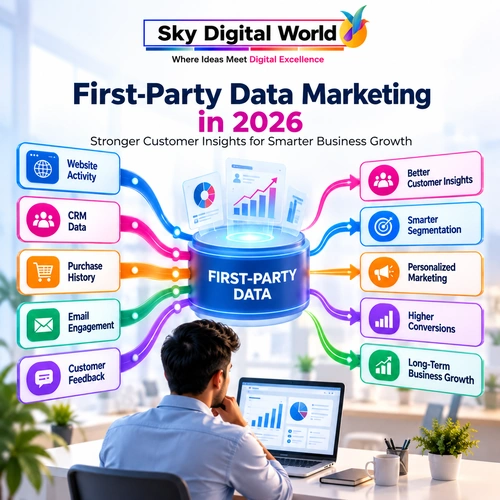
First-party data is information a business collects directly through its own customer interactions. It can come from website activity, purchases, enquiries, subscriptions, CRM records, customer feedback, app activity and other direct touchpoints.
In 2026, businesses should not think of first-party data simply as another analytics source. It can become the foundation for better customer understanding, segmentation, personalization, measurement and marketing decisions.
A simple way to understand the strategy is:
Customer Interaction → Consented Data → Customer Insight → Better Segmentation → Relevant Marketing → Stronger Relationships
What Is First-Party Data Marketing?
First-party data is information collected directly by a business from people interacting with its own channels.
For example, imagine an online store. A customer visits several product pages, joins the email list, purchases a product and later returns to buy something from a related category.
Each interaction can provide useful signals.
Depending on applicable consent and privacy requirements, first-party data may include:
- website and app interactions;
- purchase history;
- lead-form information;
- email subscriptions and engagement;
- CRM information;
- customer preferences;
- loyalty-program activity;
- customer-service interactions;
- and survey or feedback responses.
First-Party Data Marketing means responsibly using these direct customer insights to make marketing more relevant and measurable.
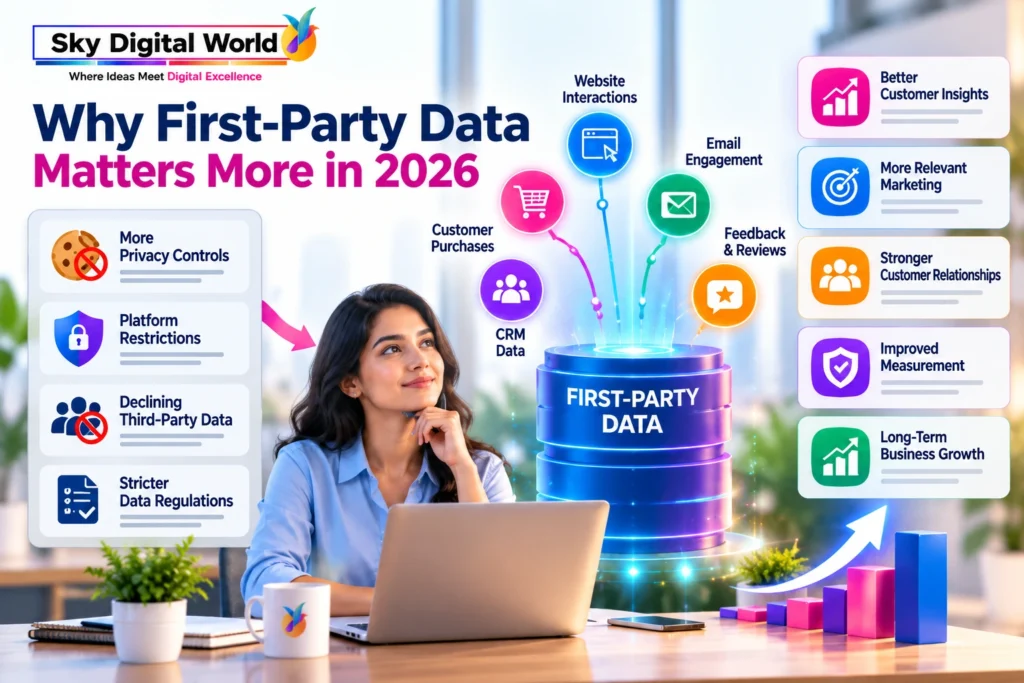
Why First-Party Data Matters More in 2026
The digital privacy environment has changed substantially.
It is important, however, not to repeat the outdated claim that “Google has eliminated third-party cookies from Chrome.” Google announced in 2025 that Chrome would maintain its existing approach of giving users third-party-cookie choices rather than introduce a new standalone prompt, and it subsequently changed the direction of several Privacy Sandbox technologies. Privacy Sandbox
The bigger trend remains clear: marketers operate in an environment where consent, privacy controls, platform restrictions and fragmented customer journeys matter more.
Google itself describes appropriately consented first-party data as unique to a business and says it can help companies understand valuable customers, improve audience strategies and inform business decisions.Google
For businesses, this creates a strategic shift:
Do not depend only on rented audience signals. Build customer intelligence you can responsibly develop through your own relationships.
1. First-Party Data Helps You Understand Real Customers
Marketing becomes expensive when businesses target people based mainly on assumptions.
Consider two customers.
Customer A visits once, reads a blog and leaves.
Customer B visits a service page three times, downloads a guide, opens two emails and submits an enquiry.
Both are website visitors, but their behaviour indicates very different levels of interest.
First-party data allows businesses to look beyond raw traffic numbers and understand patterns such as:
Who engages? → What interests them? → What actions do they take? → Who converts? → Who returns?
That is much more useful than celebrating an increase in website sessions without knowing whether those visitors are commercially relevant.
2. Better Customer Insights Create Better Segmentation
Not every customer should receive the same message.
A first-time visitor, repeat customer, high-value buyer and inactive customer are at different stages of the relationship.
First-party insights can help create useful segments such as:
New Prospects — recently discovered the business.
High-Intent Leads — interacted with important service or conversion pages.
Existing Customers — have already purchased.
High-Value Customers — demonstrate stronger purchase value or frequency.
Inactive Customers — previously engaged but have become less active.
Instead of one generic campaign for everyone, marketers can develop communication relevant to each segment.
This creates a better flow:
Collect → Understand → Segment → Personalize → Measure → Improve
3. First-Party Data Makes Personalization More Meaningful
Personalization should not mean inserting someone’s first name into every email.
Useful personalization is about relevance.
Suppose a digital agency provides SEO, social media marketing, website development and paid advertising.
If a potential client repeatedly explores SEO-related pages and downloads an SEO guide, sending that person information about technical SEO or organic visibility may be more relevant than immediately promoting every service the agency offers.
Similarly, an e-commerce business can use purchase history and customer preferences—where permitted—to improve product recommendations or communication.
The objective is not to collect as much information as possible.
It is to collect useful data for a clear purpose and use it responsibly.
4. Your CRM Can Become a Marketing Intelligence System
Many businesses use a CRM primarily as a digital contact book.
Name. Phone number. Email address. Follow-up date.
That misses much of its potential.
When properly designed and integrated, CRM data can help businesses understand:
Lead Source → Customer Interest → Sales Stage → Purchase → Customer Value → Repeat Business
Imagine discovering that social media produces many leads but organic search produces fewer leads with a higher qualification rate.
Or perhaps a specific service attracts many enquiries but rarely becomes a sale.
These insights can influence budget allocation, content strategy, sales processes and service positioning.
The CRM then becomes more than storage.
It becomes a customer intelligence layer.
5. First-Party Data Can Improve Marketing Measurement
One of the biggest marketing challenges is understanding which activities actually contribute to conversions.
A customer might:
Discover a Reel → Search the Brand → Read a Blog → Return Through Google → Submit a Form → Speak to Sales → Purchase
If systems are disconnected, teams may credit only the final interaction.
Better first-party data practices can connect more of this customer journey.
Google’s enhanced conversions, for example, can use hashed, user-provided first-party conversion information to improve conversion measurement. Google distinguishes between enhanced conversions for web and enhanced conversions for leads, including cases where a website lead later converts offline. Google
That makes stronger data infrastructure increasingly important alongside creative campaigns.
6. Customer Insights Can Improve More Than Advertising
First-party data should not live only inside the marketing department.
Imagine customer feedback repeatedly mentions the same product difficulty.
That is a product insight.
If sales data shows that leads from one service consistently convert better, that is a commercial insight.
If customers frequently search the website for something that is difficult to find, that is a user-experience insight.
First-party data can therefore support:
Marketing + Sales + Customer Service + Product Development + Website Experience + Business Strategy
This is where customer data becomes genuinely valuable.
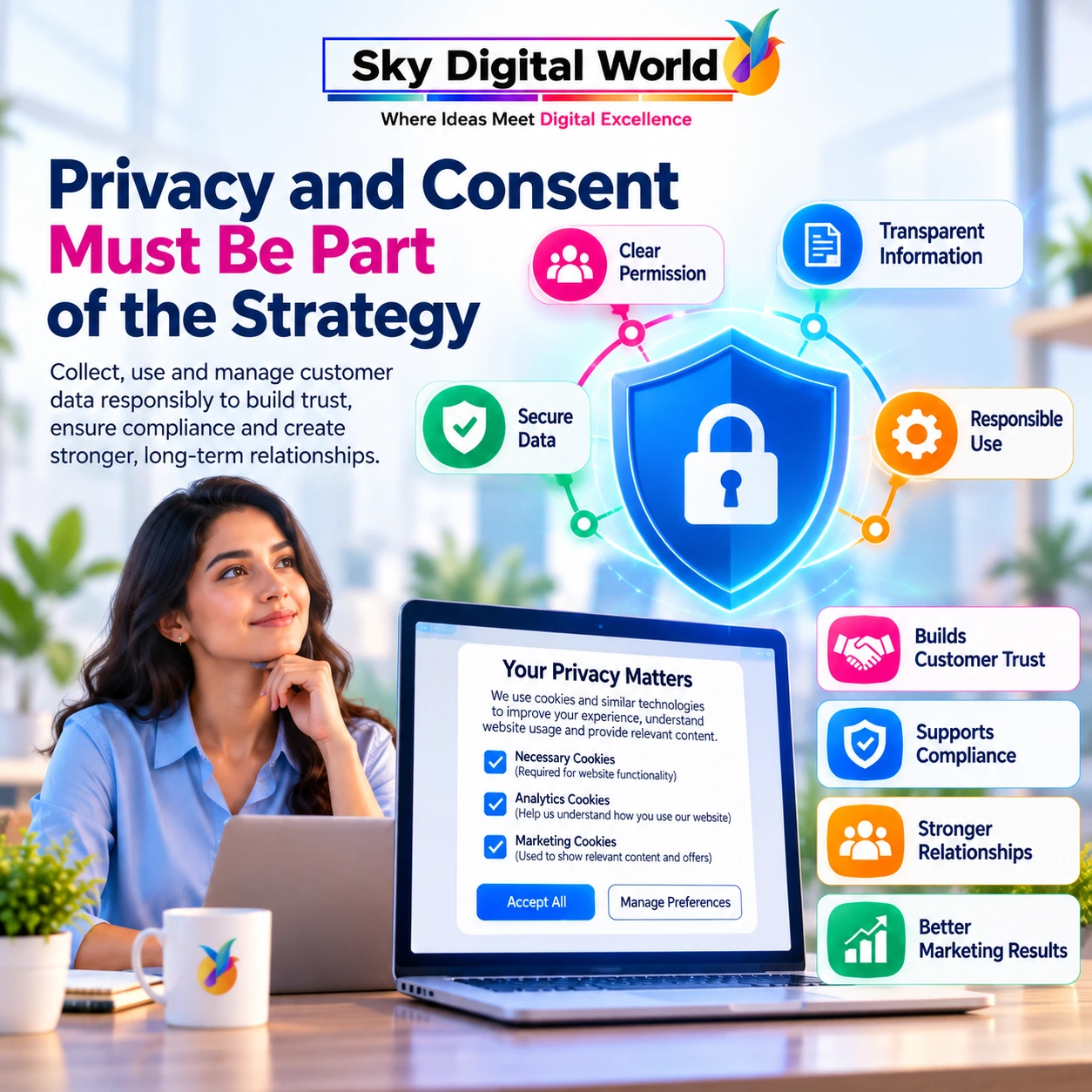
7. Privacy and Consent Must Be Part of the Strategy
More data is not automatically better marketing.
Businesses need to understand what they collect, why they collect it, how it is stored, who can access it and what permissions apply.
Google’s consent guidance emphasizes that consent requirements vary by jurisdiction and that businesses are responsible for understanding applicable laws. Its Consent Mode tools allow tags to adjust behaviour based on users’ consent choices. Google Help
Google also changed parts of its Analytics data-control framework in 2026, including greater reliance on Consent Mode settings for certain advertising-related data controls. Google Help
For businesses, the principle should be simple:
Clear Value + Clear Permission + Secure Data + Responsible Use = Stronger Customer Trust
Privacy should not be treated as a checkbox added after the marketing strategy is built.
It should be part of the architecture.
8. AI Makes Quality Customer Data More Valuable
AI can process large amounts of information quickly, but AI does not automatically make poor-quality data useful.
If your customer records contain duplicates, outdated information, inconsistent fields and unclear consent status, adding AI on top does not solve the underlying problem.
Businesses should first strengthen their data foundation.
Then AI can help identify patterns, summarize customer behaviour, assist with segmentation, support predictive analysis and make marketing workflows more efficient.
The future is not simply:
More AI = Better Marketing
A more useful equation is:
Quality First-Party Data + Responsible AI + Human Strategy = Better Decisions
How Businesses Can Build a First-Party Data Strategy
Businesses do not need to collect everything immediately.
Start with the customer journey.
Map important touchpoints such as:
Website → Forms → CRM → Email → Sales → Purchase → Support → Repeat Purchase
Then identify where useful information is generated and whether those systems communicate with one another.
A practical framework is:
Step 1: Define the business questions. What do you actually want to understand?
Step 2: Audit existing data. Identify what your website, CRM, analytics, email and sales systems already collect.
Step 3: Improve consent and transparency. Explain data collection clearly and follow applicable privacy requirements.
Step 4: Connect useful systems. Reduce unnecessary data silos.
Step 5: Build meaningful segments. Group customers based on useful behavioural or relationship signals.
Step 6: Activate insights. Use them to improve content, campaigns, follow-ups and customer experiences.
Step 7: Measure outcomes. Focus on qualified leads, conversion quality, retention and customer value—not data volume alone.
Final Thoughts
First-party data marketing in 2026 is not about collecting every possible customer detail.
It is about understanding customers better through information they knowingly and appropriately share through direct interactions with your business.
Companies that connect website behaviour, CRM information, purchases, enquiries, feedback and customer relationships can develop a clearer picture of what drives real business outcomes.
The strongest approach is:
Collect Responsibly → Connect Data → Understand Customers → Create Relevant Experiences → Measure Results → Improve Continuously
Technology will continue changing. Advertising platforms will evolve. AI will become more deeply integrated into marketing.
But one advantage remains especially valuable: a trusted, direct relationship with your own customers.
Frequently Asked Questions
What is first-party data in marketing?
First-party data is information a business collects directly through its own customer interactions, such as website activity, enquiries, purchases, subscriptions, CRM records and customer feedback.
Why is First-Party Data Marketing important in 2026?
It helps businesses build customer understanding from direct relationships while navigating increasing privacy expectations, consent requirements and fragmented digital journeys.
Is first-party data better than third-party data?
They serve different purposes. First-party data is particularly valuable because it comes from a company’s own customer relationships and can reflect actual interactions with its products, services and marketing.
Can first-party data improve advertising performance?
It can support audience strategies and measurement when collected and used appropriately. For example, Google offers enhanced conversions that use hashed first-party customer information to improve conversion measurement.
How should a small business start collecting first-party data?
Start with essential touchpoints such as website forms, analytics, CRM, email subscriptions, purchases and customer feedback. Define what information is genuinely useful, obtain appropriate consent, keep the data secure and connect it to clear business objectives.