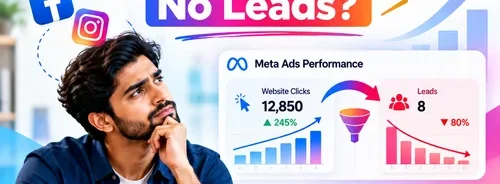





Why Are Your Meta Ads Getting Clicks but No Leads?
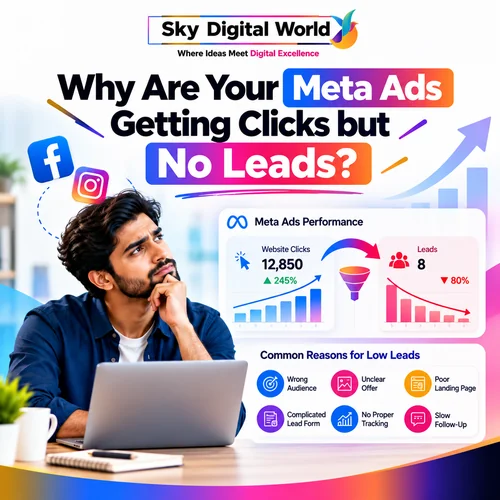
Why Are Your Meta Ads Getting Clicks but No Leads? 10 Common Reasons and How to Fix Them
Running Meta Ads can feel exciting when your campaign starts receiving clicks, impressions, and engagement. People are noticing your advertisements, clicking your offers, and visiting your website. Everything looks promising until you check your actual business enquiries.
Plenty of clicks. Very few leads. Sometimes, no leads at all.
This is a common challenge for businesses advertising on Facebook and Instagram.
Imagine spending ₹10,000 on a campaign that generates 500 link clicks but only two enquiries. Your ads are attracting attention, but something is preventing interested visitors from becoming potential customers.
Does this mean Meta Ads are not working?
Not necessarily.
The problem may be related to audience targeting, campaign objectives, ad messaging, landing page experience, lead forms, tracking, or follow-up processes.
This is where a well-planned Meta Ads Services India strategy becomes important. Instead of focusing only on clicks, businesses need to understand what happens after someone interacts with an advertisement.
Let’s explore why Meta Ads sometimes generate traffic without leads and what businesses can do to improve campaign performance.
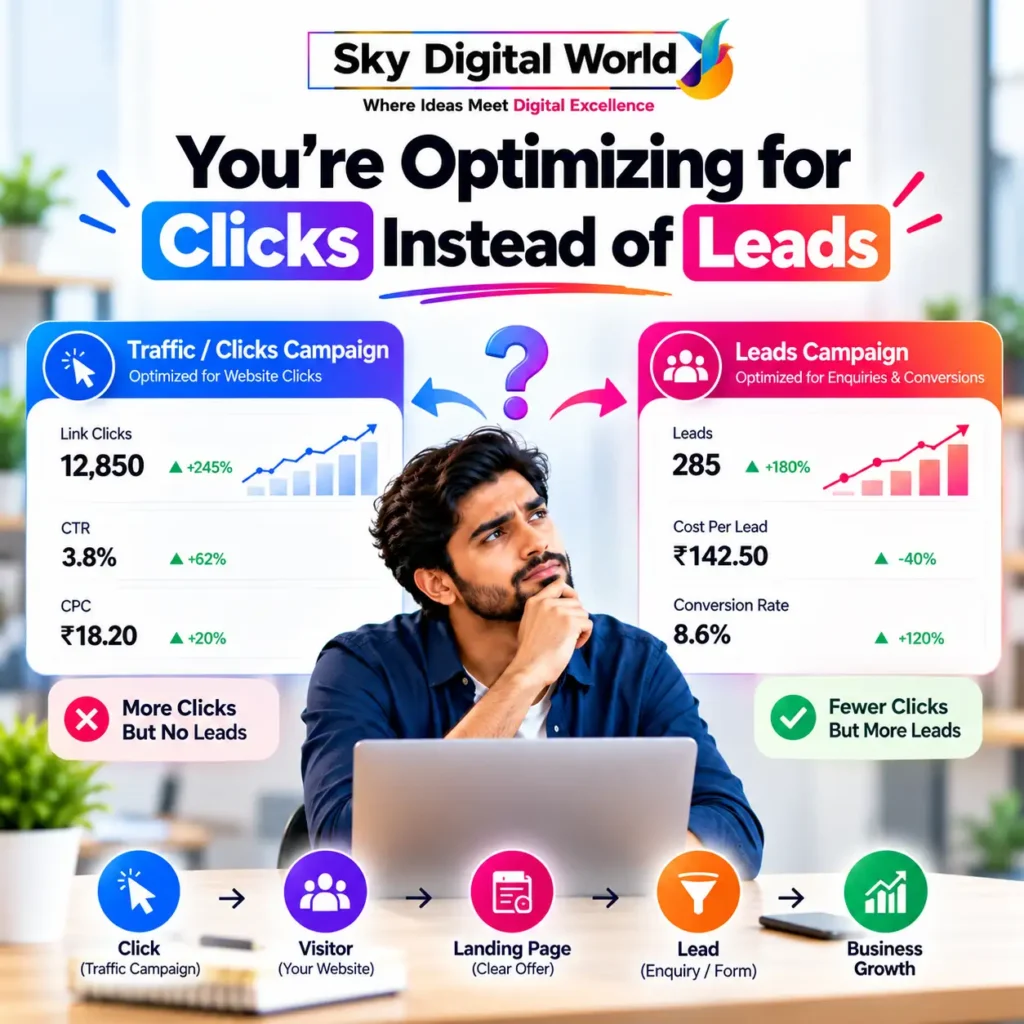
1. You’re Optimizing for Clicks Instead of Leads
One of the most common mistakes businesses make is choosing a campaign objective that doesn’t match their actual business goal.
Meta’s advertising system uses campaign objectives and optimization settings to help determine which people are more likely to complete the selected action.
For example, a Traffic campaign may be designed to generate website visits, while a Leads campaign is intended to encourage actions such as submitting an enquiry form or contacting a business.
These are different outcomes.
If your main objective is to generate sales enquiries, optimizing primarily for traffic may attract people who click advertisements but have little intention of contacting you.
How to Fix It
Start by defining the result your business actually needs.
- For website enquiries, consider a Leads campaign optimized for relevant conversion events.
- For instant enquiries, evaluate Meta Instant Forms.
- For WhatsApp conversations, use a suitable messaging-focused lead setup.
- For online purchases, consider a Sales campaign with appropriate purchase tracking.
Key takeaway: A campaign receiving more clicks is not necessarily performing better than one generating fewer clicks but more qualified enquiries.
2. Your Ads Are Reaching the Wrong Audience
Getting attention is relatively easy when your advertisement reaches a broad audience. Getting attention from people who genuinely need your service is more challenging.
Suppose a real estate company advertises residential properties in Indore.
The campaign receives hundreds of clicks, but many visitors are from locations where they have no intention of purchasing property.
The advertisement may look successful in Ads Manager, but those clicks have limited business value.
This is why Meta Ads audience targeting matters.
How to Fix It
Review your targeting strategy based on the business model.
Consider location relevance, customer characteristics, available audience signals, and the actual people who submit qualified enquiries.
For local businesses, ensure geographic targeting aligns with the service area. Remember that Meta’s location targeting is not a guarantee that every person reached is a permanent resident of the selected area.
Avoid unnecessarily restricting audiences or assuming that detailed targeting alone can identify buyers.
The goal is not simply to reach more people. It is to reach people who are more likely to become customers.
3. Your Ad Creative Attracts Curiosity but Not Buying Intent
A colorful image, attractive headline, or trending reel can generate impressive engagement.
But does your advertisement clearly communicate what you’re offering?
Consider these two examples.
Ad A: “Transform Your Business Today!”
Ad B: “Need Professional Social Media Management? Explore Reels, Creative Posts and Monthly Content Planning.”
The first advertisement may attract general curiosity. The second gives potential customers a clearer understanding of the service.
Both approaches have their place, but clarity is particularly important for lead generation.
How to Fix It
Create advertisements that answer three basic questions:
- What product or service are you offering?
- Who is it suitable for?
- What should an interested customer do next?
Use relevant visuals, realistic benefits, and a clear Call to Action (CTA).
Avoid exaggerated promises or misleading hooks that encourage clicks without attracting genuinely interested prospects.
4. Your Landing Page Is Not Converting Visitors
Your Meta advertisement may be performing well, but the page people visit after clicking can create problems.
Imagine clicking an advertisement about website development services.
Instead of finding service information, project examples, or a contact option, you arrive at a generic homepage with confusing navigation.
Would you immediately submit an enquiry?
Probably not.
This is a common landing page conversion optimization issue.
Common Landing Page Problems
- Slow page loading
- Poor mobile experience
- Unclear service information
- Difficult enquiry forms
- Missing trust signals
- Weak calls to action
- Different messaging between the advertisement and landing page
How to Fix It
Ensure your landing page closely matches the advertisement.
If the advertisement promotes a particular service, the landing page should explain that service directly.
Include a relevant headline, important benefits, clear service details, genuine testimonials where available, and an easily accessible enquiry option.
A strong advertisement creates interest. A useful landing page helps turn that interest into action.
5. Your Lead Form Is Too Complicated
Sometimes potential customers are interested in your offer but abandon the enquiry process.
Why?
Because the form asks for too much information.
Imagine someone clicking a Facebook advertisement and seeing a form requesting their full name, phone number, email, company name, address, monthly budget, business category, project timeline, and several additional details.
That may be excessive for an initial enquiry.
How to Fix It
Keep forms relevant to the sales process.
For many service businesses, the initial form may only need a name, contact information, and one or two qualifying questions.
Meta Instant Forms also provide options designed to balance convenience with lead quality.
For example, a business could ask:
“Which service are you interested in?”
This helps identify customer needs without making the form unnecessarily difficult.
However, shorter forms do not automatically mean better leads. Businesses should test the balance between form completion rate and lead quality.
6. Your Offer Is Not Clear or Compelling
Customers rarely submit an enquiry simply because a business says it provides excellent services.
They need a reason to take the next step.
Suppose two agencies advertise digital marketing services.
One says:
“We Provide Digital Marketing Services.”
The other says:
“Looking to Improve Your Business’s Online Presence? Explore Our Social Media Management and Content Creation Services.”
The second message provides a more specific reason to engage.
How to Fix It
Focus on communicating relevant value rather than making unsupported promises.
Your offer could include a consultation, product demonstration, service explanation, quotation, or another meaningful next step.
For example:
“Request a Website SEO Review”
“Get a Product Quotation”
“Schedule a Project Consultation”
“Explore Our Social Media Packages”
The offer should match the customer’s needs and the business’s ability to deliver.
7. You’re Not Tracking Leads Correctly
Sometimes campaigns appear to generate clicks without leads because conversion tracking is incomplete or inaccurate.
A customer might submit a website form, initiate a WhatsApp conversation, or call the business, but that action may not be properly recorded in Meta Ads Manager.
This creates confusion when evaluating campaign performance.
How to Fix It
Review your tracking setup.
For website campaigns, check whether the Meta Pixel is installed correctly and whether relevant events are configured.
Where appropriate, businesses can also evaluate the Conversions API (CAPI) to improve event data sharing.
Use tools such as Meta Events Manager to verify event activity and diagnose potential tracking problems.
Remember that browser restrictions, consent requirements, attribution settings, and other factors can affect measurement.
Accurate tracking helps businesses make better advertising decisions, but no tracking setup captures every customer interaction perfectly.
8. Your WhatsApp or Sales Follow-Up Is Too Slow
Getting an enquiry is only the beginning.
A potential customer might click your advertisement, send a WhatsApp message, and wait several hours for a response.
By that time, they may have contacted another business.
This is particularly relevant for service-based businesses where customers compare multiple providers.
How to Fix It
Develop a practical lead follow-up process.
Assign responsibility for responding to enquiries, set realistic response-time targets, and ensure customer questions receive useful answers.
Businesses receiving frequent WhatsApp enquiries may benefit from appropriate automation for initial responses and enquiry routing.
However, automation should not replace meaningful customer support when a human conversation is needed.
A good advertising campaign needs an equally effective enquiry-handling process.
9. You’re Judging Performance Only by CPC and CTR
Two popular advertising metrics are:
Cost Per Click (CPC): The average cost associated with a click.
Click-Through Rate (CTR): The percentage of eligible impressions that result in clicks, depending on the metric used.
Both are useful, but neither directly measures how many customers your business acquires.
Consider this illustrative comparison:
Campaign Metric | Campaign A | Campaign B |
Ad Spend | ₹10,000 | ₹10,000 |
Link Clicks | 500 | 250 |
Cost Per Link Click | ₹20 | ₹40 |
Leads Generated | 5 | 20 |
Cost Per Lead | ₹2,000 | ₹500 |
Lead Conversion Rate | 1% | 8% |
Campaign A generates more clicks at a lower cost.
However, Campaign B produces more leads at a substantially lower Cost Per Lead (CPL).
These figures are hypothetical examples, not industry benchmarks.
How to Fix It
Evaluate campaign results using metrics connected to actual business goals.
Monitor qualified leads, cost per qualified lead, lead-to-customer conversion rate, and customer acquisition cost where reliable data is available.
Do not automatically pause an advertisement because its CPC is higher. First examine whether it is generating better-quality business opportunities.
10. You’re Not Testing and Improving Your Campaigns
Meta advertising performance can change over time.
Audience response, creative fatigue, competition, seasonality, and customer behavior may affect results.
A campaign that worked previously may not continue delivering the same performance.
This is why Meta Ads campaign optimization should be an ongoing process.
How to Fix It
Test meaningful campaign elements such as advertising creatives, messaging, offers, landing pages, and form experiences.
Avoid changing multiple variables simultaneously when you want to understand what caused a performance difference.
Give campaigns sufficient time and data before drawing conclusions, especially when lead volumes are small.
Use the results to refine your approach rather than making decisions based on one day’s performance.
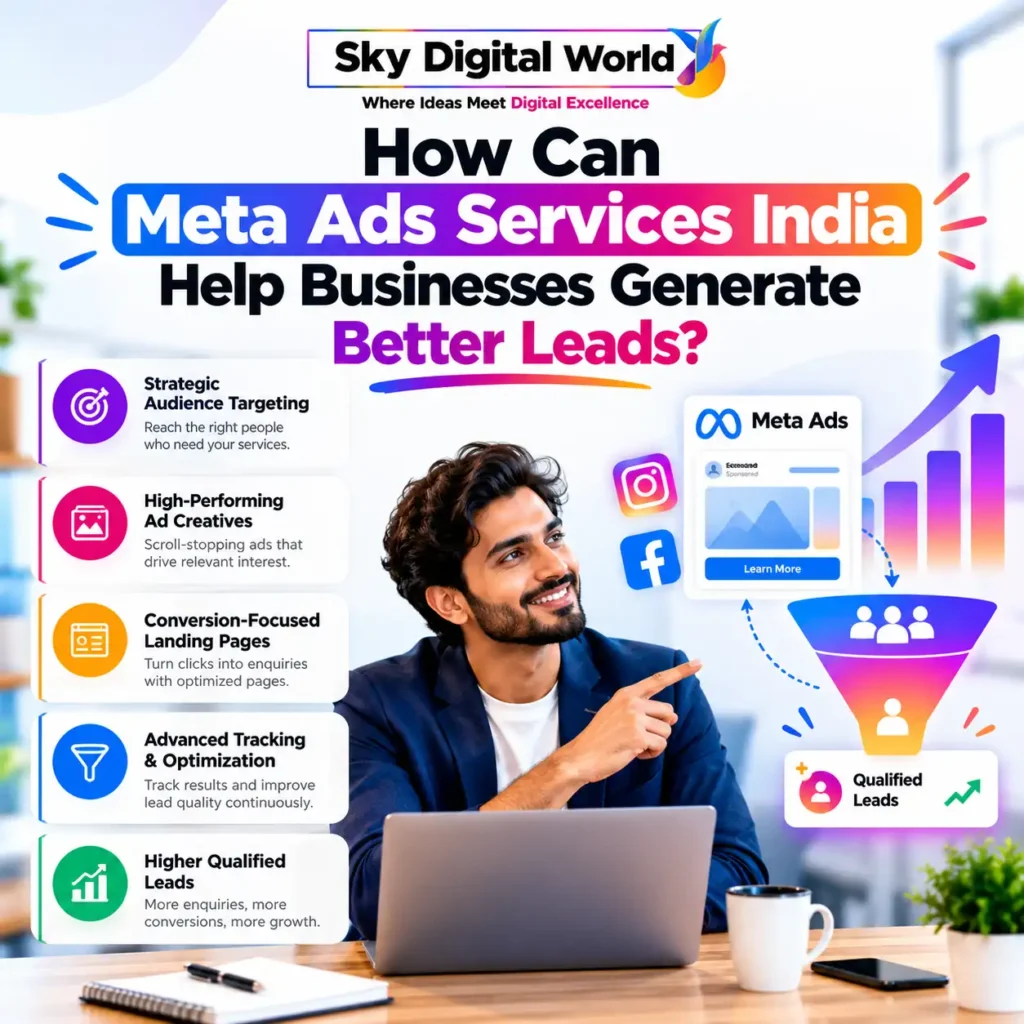
How Can Meta Ads Services India Help Businesses Generate Better Leads?
Professional Meta Ads Services India should involve more than launching advertisements and monitoring clicks.
A structured campaign strategy connects audience research, advertising creative, conversion experience, measurement, and lead follow-up.
The process generally includes:
Campaign Planning: Identify the business objective, target customers, advertising budget, and appropriate conversion action.
Audience Strategy: Develop targeting and audience-testing approaches based on customer needs and business geography.
Creative Development: Create advertisements that clearly communicate the offer and encourage relevant actions.
Conversion Optimization: Improve landing pages, enquiry forms, and messaging experiences to reduce unnecessary barriers.
Performance Tracking: Configure relevant measurement tools and review campaign results against business goals.
Ongoing Optimization: Evaluate lead quality, test improvements, and adjust campaigns based on reliable performance information.
The objective is to improve the relationship between advertising investment and meaningful business enquiries, not merely to increase website traffic.
How Do You Know Whether Your Meta Ads Are Actually Working?
A useful campaign report should connect advertising activity with customer outcomes.
Metric | What It Helps You Understand |
Reach | How many people saw the advertisement |
Link Clicks | How often people clicked a destination link |
CPC | Average cost per click |
CTR | How effectively the ad encourages clicks |
Landing Page Views | How often the destination page loaded after a click |
Leads | Number of recorded enquiries |
CPL | Advertising spend divided by recorded leads |
Qualified Leads | Enquiries that meet your business criteria |
Lead Conversion Rate | Percentage of relevant visitors or clicks generating leads |
Customer Acquisition Cost | Cost associated with acquiring a customer |
When possible, connect your advertising reports with CRM or sales records.
For example, if a campaign generates 50 leads but only five meet your qualification criteria, the business should investigate why the remaining enquiries are unsuitable.
This may reveal problems with targeting, ad messaging, form design, or the offer itself.
More leads are not always better. More relevant leads are often more valuable.
A Practical 30-Day Meta Ads Improvement Plan
If your Facebook and Instagram advertisements are receiving clicks but generating few enquiries, use the following framework.
Timeline | Focus Area | Recommended Action |
Week 1 | Campaign Audit | Review objectives, targeting, placements, creatives and conversion tracking |
Week 2 | Conversion Experience | Improve landing pages, lead forms, WhatsApp response processes and CTAs |
Week 3 | Creative Testing | Test clearer offers, new visuals, relevant messaging and qualifying questions |
Week 4 | Performance Review | Compare lead quality, CPL, conversion rates and sales follow-up results |
This framework provides a practical starting point. It does not guarantee results within 30 days, and campaigns with limited data may require longer testing periods.
Should You Increase Your Meta Ads Budget if You’re Not Getting Leads?
Increasing the budget is not always the right solution.
If your existing campaign generates clicks but fails to convert visitors into enquiries, additional spending may simply increase the number of unproductive clicks.
Before raising the budget, investigate the reason behind the low conversion rate.
Check whether the campaign objective matches your goal, whether visitors are relevant, whether the offer is clear, and whether the enquiry process works correctly.
Once you identify a campaign that generates suitable leads at an acceptable cost, gradual budget increases may become more reasonable.
Fixing conversion problems should generally come before scaling an underperforming campaign.
Final Thoughts: Focus on Leads, Not Just Clicks
Meta Ads can help businesses reach potential customers through Facebook and Instagram, but advertising performance should not be judged by clicks alone.
A campaign might receive thousands of impressions and hundreds of clicks without generating meaningful business results.
The real opportunity lies in understanding the complete customer journey, from the first advertisement impression to the final enquiry or purchase.
By improving campaign objectives, audience relevance, creative messaging, landing pages, lead forms, tracking, and follow-up, businesses can identify opportunities to improve lead generation performance.
At Sky Digital World, we focus on practical digital marketing strategies that connect advertising activity with business objectives.
If your campaigns are generating traffic but not enough enquiries, a structured review of your Meta Ads Services India strategy can help identify areas for improvement.
Ready to Improve Your Meta Ads Lead Generation?
Explore Sky Digital World and discover how professional campaign planning, creative development, and conversion optimization can support your advertising goals.
Frequently Asked Questions (FAQs)
Facebook Ads may generate clicks without leads because of mismatched campaign objectives, irrelevant audiences, unclear offers, weak landing pages, complicated enquiry forms, or tracking problems. Reviewing the complete customer journey can help identify the issue.
There is no single ideal cost per lead for every business. CPL varies by industry, location, competition, audience, offer, and lead quality. Businesses should evaluate CPL alongside qualified leads and actual customer acquisition costs.
If your main objective is generating enquiries, a Leads campaign is generally a more appropriate starting point. A Traffic campaign may be useful for website visits, but it is not primarily optimized for lead submissions.
4. Can Meta Ads Services India help small businesses?
Yes. A structured Meta Ads strategy can help small businesses plan campaigns, reach relevant audiences, improve conversion experiences, and evaluate advertising performance. Results depend on the offer, market conditions, budget, and execution.
5. How can I improve Meta Ads lead quality?
Start with clear advertising messages, relevant targeting, suitable lead forms, meaningful qualifying questions, accurate conversion tracking, and effective sales follow-up. Review which enquiries become genuine business opportunities rather than focusing only on total lead volume.
Yes. A structured Meta Ads strategy can help small businesses plan campaigns, reach relevant audiences, improve conversion experiences, and evaluate advertising performance. Results depend on the offer, market conditions, budget, and execution.
Start with clear advertising messages, relevant targeting, suitable lead forms, meaningful qualifying questions, accurate conversion tracking, and effective sales follow-up. Review which enquiries become genuine business opportunities rather than focusing only on total lead volume.