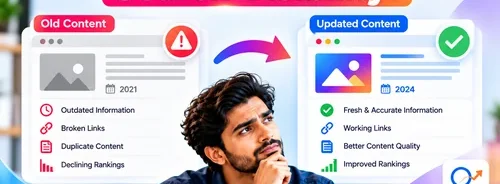





Can Old Website Content Hurt Your Search Visibility?

Can Old Website Content Hurt Your Search Visibility? A Complete Guide for Businesses
Publishing quality content is an important part of building a strong online presence. Businesses regularly create blogs, service pages, product descriptions, and website updates to attract potential customers through Google.
But what happens to that content after one, two, or even five years?
Many businesses focus on publishing new articles while ignoring their existing website pages. Over time, information becomes outdated, links stop working, customer expectations change, and previously useful content may lose its relevance.
The result? Declining organic traffic, weaker keyword rankings, and missed business opportunities.
However, old content is not automatically bad for SEO. A well-written article can remain valuable for years if it continues to answer relevant questions accurately.
The real concern is outdated, inaccurate, duplicated, or unhelpful content.
This is why SEO Content Optimization should include maintaining existing pages, not simply publishing new ones.
Let’s explore how old website content can affect search visibility and what businesses can do to improve their content performance.
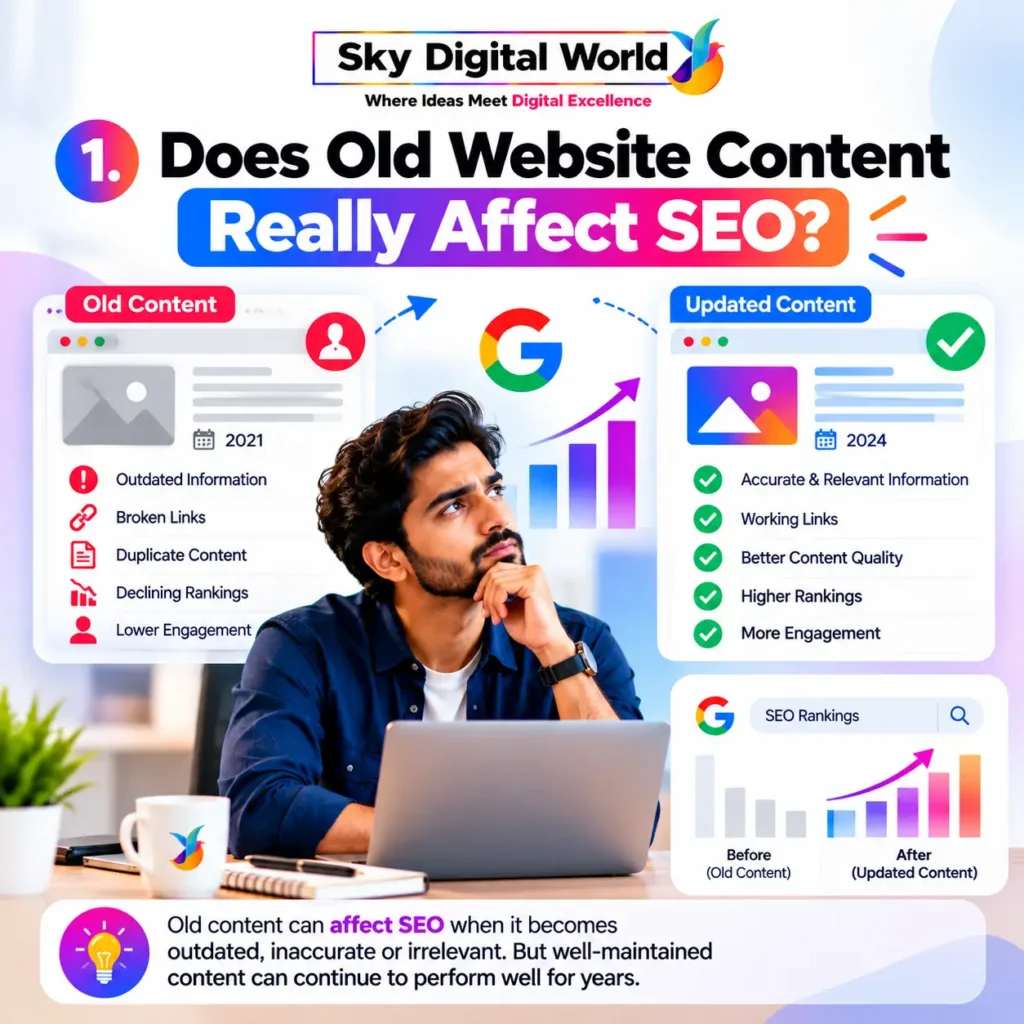
1. Does Old Website Content Really Affect SEO?
Yes, outdated website content can affect SEO performance, but content age alone is not a Google ranking penalty.
Search engines aim to present relevant, useful information that meets the searcher’s needs.
An article published several years ago may continue performing well if its information remains accurate and helpful.
However, problems can develop when the content no longer reflects current products, services, industry practices, or customer questions.
For example, a digital marketing article explaining advertising features from 2021 may no longer be useful if those features have changed significantly.
Similarly, a manufacturing company may lose relevant enquiries if its website displays discontinued products or incorrect technical specifications.
Key takeaway: The problem is not how old your content is. The problem is whether it still provides accurate and useful information.
2. Your Content Contains Outdated Information
One of the biggest risks of old website content is outdated information.
Businesses frequently change their services, product ranges, policies, technologies, and operating processes.
When website pages continue displaying old details, visitors may receive incorrect information.
This can reduce trust and create confusion.
How to Fix It
Review important pages regularly and update information that has genuinely changed.
Focus on product specifications, service details, contact information, pricing where applicable, and industry guidance.
Avoid changing publication dates merely to make an article appear fresh.
Meaningful updates are more valuable than cosmetic changes.
3. Your Old Content No Longer Matches Search Intent
Search intent describes what someone wants to achieve when entering a query into a search engine.
Over time, the type of information people expect from a search result may change.
For example, a page targeting “best digital marketing tools” may have performed well several years ago.
Today, readers may expect updated features, AI integrations, pricing considerations, and practical comparisons.
If the article does not address those expectations, users may find other resources more useful.
How to Fix It
Review the page’s current search queries using Google Search Console.
Compare the content with the questions your intended audience is asking today.
Add relevant explanations, examples, comparisons, or FAQs where they improve the article.
The objective is to match current user needs without unnecessarily rewriting useful information.
4. Your Website Has Multiple Pages Covering the Same Topic
As websites grow, businesses sometimes publish several articles targeting similar questions.
For example:
- How to Improve Website SEO
- Ways to Optimize Your Website for Google
- Best Website SEO Improvement Tips
These articles may overlap significantly.
This can make it difficult for visitors to identify the most useful resource and may divide internal links and engagement across multiple pages.
However, similar topics are not automatically harmful. Different pages can be valuable when they serve distinct search intents.
How to Fix It
Conduct a content audit to identify overlapping articles.
Where pages serve essentially the same purpose, consider combining their strongest information into one comprehensive resource.
Use appropriate redirects when permanently replacing URLs.
Keep separate pages when they provide genuinely different information or serve different audiences.
5. Broken Links Are Affecting the User Experience
Older blog posts often contain links to external websites, discontinued products, or internal pages that no longer exist.
When visitors encounter broken links, they may struggle to find the information they need.
Broken links do not automatically cause a sitewide ranking penalty, but they can reduce usability and make website maintenance more difficult.
How to Fix It
Review internal and external links on important pages.
Replace outdated destinations with relevant working resources.
Remove links that no longer provide value.
If an important internal page has moved permanently, implement an appropriate redirect.
A well-maintained website makes information easier to discover and navigate.
6. Your Content Lacks Depth and Practical Value
Some older articles were written mainly to target keywords rather than solve customer problems.
These pages may contain repetitive paragraphs, vague statements, or limited practical information.
For example, a blog titled “How to Generate More Business Leads” should explain useful methods, common challenges, and relevant examples.
Simply repeating phrases such as best lead generation services does not make the article helpful.
How to Fix It
Improve thin or generic pages with original insights.
Include practical steps, accurate examples, useful comparisons, and clear explanations.
Remove unnecessary repetition and unsupported claims.
Where appropriate, add genuine business experience or case studies.
The priority should be content quality and usefulness, not simply increasing word count.
7. Your Old Pages Have Poor Internal Linking
Internal links help visitors move between related pages and help search engines discover website content.
Older articles may become disconnected from newer service pages, product categories, or recently published resources.
This can reduce their usefulness within the overall website structure.
How to Fix It
Review relevant internal linking opportunities.
Connect older articles to updated resources and important service pages using natural anchor text.
For example, an article discussing website traffic could link to a relevant guide about website conversion optimization.
Avoid adding links only to manipulate keyword rankings.
Internal links should help users find useful next steps.
8. Your Website Still Uses Outdated SEO Practices
SEO practices have evolved significantly.
Older website content may contain excessive keyword repetition, unnatural anchor text, misleading headings, or pages created mainly for search engines.
These approaches can reduce readability and may conflict with modern search quality guidance.
How to Fix It
Review content for unnecessary keyword stuffing and misleading optimization tactics.
Write natural headings that explain the page clearly.
Use primary and secondary keywords where they fit the subject.
Prioritize people-first content that provides genuine value.
Do not assume that adding more keywords automatically improves rankings.
9. Should You Update, Merge, Redirect, or Delete Old Content?
Not every old page requires the same action.
The correct decision depends on its usefulness, traffic, backlinks, business relevance, and search intent.
Content Condition | Recommended Action |
Accurate and performing well | Keep and monitor |
Useful but outdated | Update important information |
Thin but relevant | Improve content quality |
Multiple pages with overlapping intent | Consider merging |
Permanently replaced page | Redirect to a relevant replacement |
Irrelevant page with no useful replacement | Consider removal |
Valuable historical information | Preserve with appropriate context |
Important: Deleting content simply because it receives little traffic is not a reliable SEO strategy.
Some pages serve important customers or business purposes even when search volume is low.
Evaluate each page before making permanent changes.
10. How Does SEO Content Optimization Improve Existing Website Pages?
SEO Content Optimization involves reviewing and improving existing pages so they remain useful, accurate, accessible, and relevant.
A structured process generally includes the following activities.
Content Performance Review: Identify pages experiencing declining impressions, clicks, or conversions.
Search Intent Analysis: Check whether existing information still answers the questions users are searching for.
Content Accuracy Review: Update outdated facts, product details, service information, and references.
On-Page SEO Improvements: Review titles, headings, descriptions, image alt text, and internal links.
Technical Checks: Identify broken links, indexing problems, duplicate URLs, and mobile usability issues.
Conversion Improvements: Ensure relevant pages provide clear next steps, such as enquiries, product information, or service consultations.
The goal is to make existing content more useful while preserving elements that already perform well.

11. How Can Businesses Identify Content That Needs Updating?
Start with tools such as Google Search Console and Google Analytics 4.
Look for important pages showing declining organic clicks, reduced engagement, outdated information, or weak conversion performance.
Compare performance over meaningful periods and consider seasonal changes.
A traffic decline does not always mean the content is outdated. Competition, technical issues, changing demand, and search result changes may also contribute.
Prioritize pages that have strong business relevance and clear opportunities for improvement.
12. A Practical 30-Day Website Content Refresh Plan
Businesses can begin improving existing content without rebuilding their entire website.
Timeline | Main Activity | Recommended Action |
Week 1 | Content Audit | Identify outdated pages, declining traffic and broken links |
Week 2 | Content Updates | Refresh important information, examples and headings |
Week 3 | SEO Improvements | Improve internal links, metadata and relevant page structure |
Week 4 | Performance Review | Check indexing, engagement, enquiries and organic performance |
This plan establishes a starting point. Search visibility improvements may take longer than 30 days and are not guaranteed.
13. How Often Should You Update Website Content?
There is no universal rule requiring businesses to update every blog monthly or annually.
The right schedule depends on the topic.
Fast-changing subjects, such as advertising platforms, software features, and regulations, may need frequent reviews.
Evergreen topics, such as basic product explanations or established industry concepts, may remain useful for longer periods.
Review content when information changes, performance signals indicate a problem, or customers need better answers.
Avoid unnecessary updates simply to change the publication date.
Final Thoughts: Old Content Isn’t the Problem—Outdated Value Is
Old website content can affect search visibility when it becomes inaccurate, irrelevant, repetitive, or difficult to use.
However, older articles can also become valuable long-term resources when businesses maintain them properly.
Instead of continuously publishing new blogs, consider improving the content your website already has.
A practical SEO Content Optimization strategy helps businesses identify weaknesses, refresh useful information, improve website navigation, and create better experiences for potential customers.
At Sky Digital World, we focus on practical digital marketing strategies that connect website visibility with meaningful business opportunities.
Is Your Old Website Content Still Helping Your Business?
Explore Sky Digital World to learn how a structured content audit and SEO improvement strategy can help you identify opportunities to strengthen your website.
Frequently Asked Questions (FAQs)
Yes, outdated or unhelpful content can perform poorly in search results. However, Google does not automatically penalize content simply because it was published several years ago. maintain useful pages that can support organic search visibility.
Not necessarily. First evaluate their relevance, accuracy, backlinks, and business value. Updating, merging, or preserving the content may be more appropriate than deleting it.
Updating old content can improve its relevance and usefulness, which may support better search performance. However, updating a page does not guarantee higher rankings.
Review frequency depends on how quickly the topic changes. Important service pages and time-sensitive articles should be reviewed when information becomes outdated or performance indicates a need for improvement. that can support organic search visibility.
SEO Content Optimization is the process of improving website content for relevance, accuracy, readability, search intent, internal linking, and user experience. It helps businesses maintain useful pages