



Does Your Business Need SEO, GEO or Both?
Does Your Business Need SEO, GEO or Both? A Practical Guide for 2026
Businesses have spent years improving their Google rankings, publishing blogs, and optimizing websites to attract customers through search engines. But the way people discover businesses online is changing.
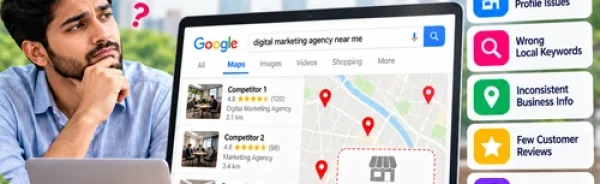
Today, potential customers may search Google for “best digital marketing agency near me” or ask an AI assistant, “Which digital marketing services should a small business invest in?”
Both searches reflect a business opportunity, but they may lead customers through different discovery journeys.
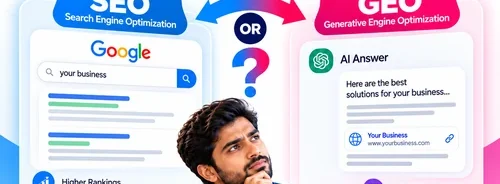
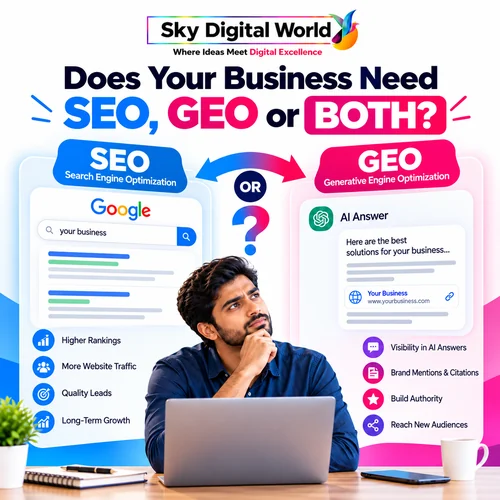
This is where Search Engine Optimization (SEO) and Generative Engine Optimization (GEO) become important.
SEO helps your website become more visible in traditional search results. GEO focuses on making your business information easier for AI-powered search and answer systems to discover, understand, evaluate, and potentially reference.
So, should your business invest in SEO, GEO, or both?
The answer depends on your customers, business goals, existing online presence, and how people search for your products or services.
In this guide, we’ll explain the differences, benefits, limitations, and practical strategies behind SEO GEO Services India, helping businesses decide where to focus their digital marketing efforts.
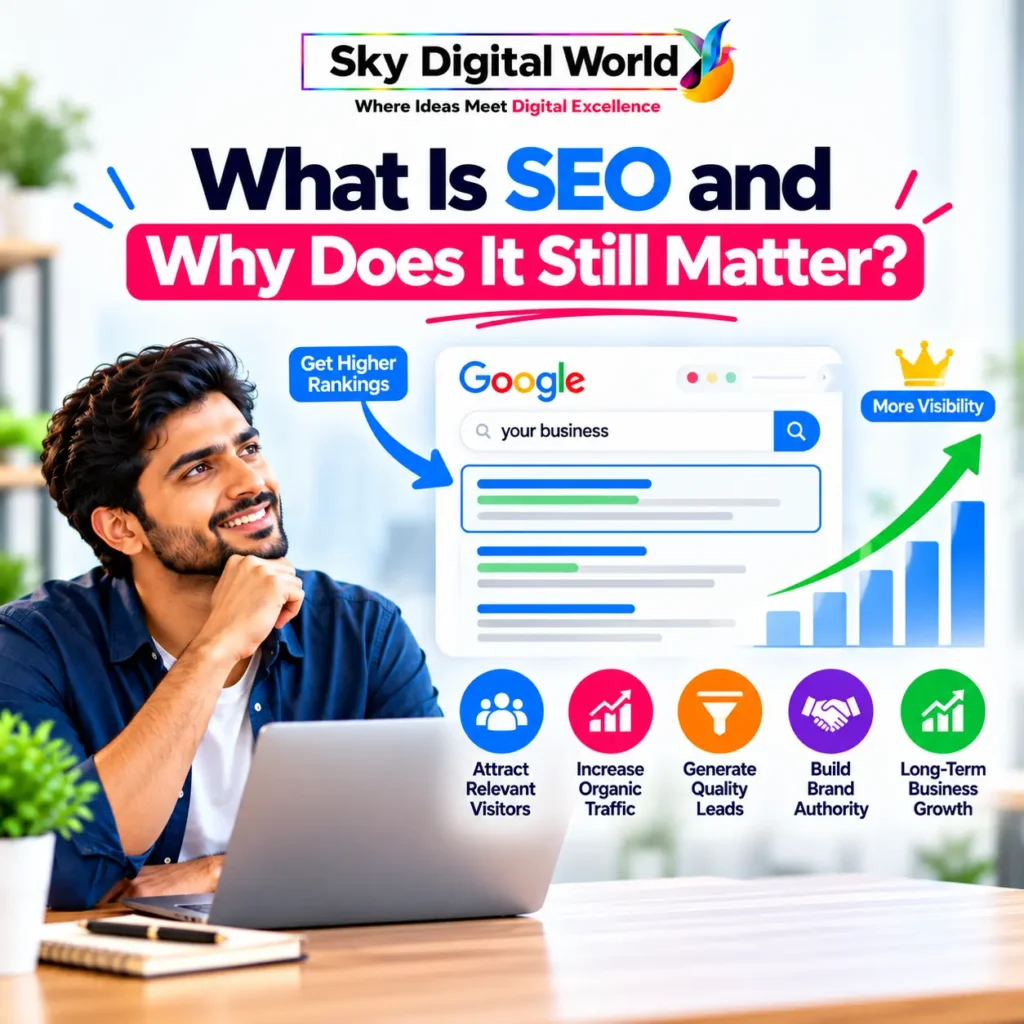
What Is SEO and Why Does It Still Matter?
Search Engine Optimization (SEO) is the process of improving your website’s content, structure, technical performance, and authority to increase its visibility in organic search results.
When someone searches Google for a product, service, or solution, search engines evaluate relevant pages to determine which results may best answer the query.
For example, a manufacturing company might want to appear for searches such as:
- Scaffolding manufacturer in Madhya Pradesh
- Industrial pipe suppliers in India
- Best construction material supplier near me
- Steel fabrication services for commercial projects
A well-planned SEO strategy helps the business create useful pages that match these searches.
How SEO Helps Businesses Grow
SEO can support several important business objectives.
- Attract relevant website visitors
Optimizing for appropriate search queries can bring visitors who are already interested in your products or services.
- Generate organic enquiries
Clear service pages, product information, and contact options can help turn relevant search traffic into enquiries.
- Improve local visibility
Local SEO helps eligible businesses become more discoverable through Google Search and Maps.
- Build long-term website value
Useful content and a technically accessible website can continue attracting visitors over time, although rankings and traffic are never guaranteed.
- Support customer research
Detailed guides, comparisons, FAQs, and service pages help customers understand their options before making decisions.
Key takeaway: SEO remains important because traditional search results, local listings, product searches, and business websites continue to play major roles in online discovery.
What Is GEO and How Is It Different From SEO?
Generative Engine Optimization (GEO) refers to practices intended to improve how accurately and effectively a business, website, or its content can be understood and potentially referenced by generative AI search and answer systems.
These systems may generate direct answers, summarize information from multiple sources, or provide links and citations that help users explore a topic.
For example, instead of searching for individual articles about marketing strategies, a business owner might ask:
“What is the most practical digital marketing strategy for a small manufacturing business in India with a limited budget?”
An AI-powered system may provide a summarized answer covering SEO, local search, website improvements, and other marketing activities.
Businesses naturally want their expertise and relevant content to be discoverable during this process.
However, GEO does not guarantee that an AI platform will mention, recommend, or cite a particular company. Different systems retrieve and present information differently.
How GEO Can Support Business Visibility
Clear, useful answers: Well-structured content makes it easier for readers and machine systems to identify relevant information.
Demonstrated expertise: Accurate explanations, original research, real examples, and clear authorship can strengthen the credibility of your content.
Consistent business information: Accurate details across your website and relevant external sources help reduce confusion about your business.
Question-based content: Articles answering genuine customer questions can be useful for both search engines and AI-assisted research.
Accessible website content: Important information should be available in readable text rather than hidden in inaccessible interfaces or images.
Key takeaway: GEO is not simply about adding AI-related keywords. It involves creating reliable, understandable, accessible information that can be useful within AI-driven discovery experiences.
SEO vs GEO: What Is the Main Difference?
Although SEO and GEO share many principles, they emphasize different ways of reaching potential customers.
Comparison | SEO | GEO |
Full Form | Search Engine Optimization | Generative Engine Optimization |
Main Focus | Organic search visibility | Discoverability in AI-generated answers |
Discovery Experience | Search listings, local results, website links | AI summaries, generated responses, source citations |
Content Approach | Search intent, useful pages, technical SEO | Clear answers, evidence, identifiable expertise |
Common Content | Service pages, blogs, product pages | Detailed explanations, comparisons, FAQs, research |
Measurement | Rankings, impressions, clicks, leads | Available AI citations, referrals, brand visibility |
Primary Challenge | Ranking for relevant searches | Being selected or referenced in AI responses |
Best Approach | Build a strong website foundation | Extend and strengthen that foundation |
One important point: SEO and GEO are not completely separate systems.
Google states that established SEO practices remain relevant for AI Overviews and AI Mode, with no special additional technical requirements for eligibility. Microsoft’s Bing guidance similarly connects search fundamentals with AI citations and grounding.
Does Your Business Need SEO, GEO or Both?
The best choice depends on where your customers search and how they make purchasing decisions.
1. Choose SEO First if Your Website Has Limited Organic Visibility
If your website is new, has indexing issues, lacks relevant service pages, or receives little organic traffic, SEO should be your first priority.
For example, a local furniture manufacturer may need properly optimized product pages, accurate business details, and relevant location-based content before considering advanced AI visibility activities.
Start with keyword research, technical improvements, on-page SEO, internal linking, and useful content.
A strong SEO foundation also supports discoverability in search-connected AI experiences.
2. Add GEO if Customers Research and Compare Solutions
GEO becomes particularly relevant when customers ask detailed questions before choosing a business.
Consider a software company selling accounting solutions to Indian businesses.
Potential customers might ask an AI assistant:
“What features should a small Indian business compare before choosing accounting software?”
A company that publishes a detailed, accurate comparison of software features, compliance considerations, limitations, and customer requirements may provide useful source material for such research.
The goal is not to force the AI to recommend the company. It is to publish credible information that deserves consideration.
3. Use Both if Your Business Depends on Multiple Discovery Channels
For many established businesses, a combined strategy makes sense.
Imagine a real estate company in Indore.
A customer might search Google for “residential plots in Indore” and later ask an AI assistant to explain important factors when comparing different residential locations.
SEO can help the company become discoverable through relevant property and location searches.
GEO-focused content improvements can help its educational resources communicate accurate information about property comparisons, documentation, infrastructure, and buyer considerations.
Together, these approaches support customers at different stages of their decision-making journey.
Which Businesses Can Benefit From SEO GEO Services India?
Different industries have different search patterns. Here are some practical examples.
Business Type | SEO Opportunity | GEO Opportunity |
Local service providers | Location and service searches | Service selection questions |
E-commerce stores | Product and category searches | Product comparisons and buying guides |
Manufacturers | Product specifications and supplier searches | Technical explanations and material comparisons |
Real estate companies | Property and location searches | Homebuying research and comparison guides |
Healthcare providers | Local services and educational searches | Accurate general health information |
B2B companies | Industry-specific commercial keywords | Complex solution research and evaluation |
Educational businesses | Courses and training searches | Learning pathways and course comparisons |
Important: A business does not need to pursue GEO simply because AI search is popular. The investment should reflect actual customer behavior, available resources, and measurable business objectives.
How Can SEO GEO Services India Help Businesses Improve Online Visibility?
An integrated strategy combines proven search optimization with content improvements designed for modern information discovery.
1. Build a Technically Accessible Website
Before search engines or AI-connected retrieval systems can use website information, that information must be discoverable and accessible.
Businesses should review:
- Crawlability and indexing
- XML sitemaps and internal linking
- Mobile usability and page experience
- Canonical URLs and duplicate content
- Clear navigation and readable page text
Technical SEO supports both traditional search visibility and eligibility for search-based AI experiences.
2. Create Content Around Real Customer Questions
A common mistake is publishing articles simply because a keyword has high search volume.
Instead, identify questions customers genuinely ask.
For a digital marketing agency, these could include:
“How much should a small business invest in SEO?”
“Should a new business start with SEO or Google Ads?”
“Why is my website getting traffic but no enquiries?”
Each question represents a different customer concern.
Content should provide a useful answer first, followed by relevant examples, explanations, and next steps.
This approach supports search intent optimization, improves readability, and creates content that may also be useful in AI-assisted research.
3. Demonstrate Experience and Credibility
Publishing generic content is rarely enough to differentiate a business.
Instead, include information that reflects genuine expertise.
For example, a manufacturing company can publish original product specifications, material comparisons, installation guidance, and clearly explained quality processes.
A marketing agency can share anonymized case studies, practical methods, and properly contextualized campaign results.
Original information is often more valuable than repeatedly rewriting what other websites already say.
Avoid fabricated statistics, fake testimonials, unsupported claims, and misleading credentials.
4. Structure Information Clearly
Good content should be easy to navigate.
Use descriptive headings, short paragraphs, relevant tables, concise explanations, and FAQs where helpful.
For example, a blog explaining SEO and GEO can include a comparison table so readers can quickly understand the difference.
Google and Bing both emphasize clear, useful, accessible content. Accurate structured data can help systems interpret information, but there is no special schema markup that guarantees inclusion in AI answers.
5. Strengthen Your Brand’s Digital Presence
Your website should clearly communicate who you are, what you offer, and which customers you serve.
Maintain consistent business information across relevant online profiles, industry listings, and your own website.
Where appropriate, include an About page, genuine customer reviews, contact details, author information, and evidence supporting important claims.
This can improve user confidence while reducing ambiguity about your business.
Can GEO Replace Traditional SEO?
No. GEO should generally complement SEO rather than replace it.
Consider what happens when a potential customer needs to contact a business.
Even after receiving an AI-generated recommendation or explanation, they may still visit the business website to review its services, pricing information, credentials, portfolio, or contact details.
If the website is slow, confusing, outdated, or poorly organized, AI visibility alone will not solve those problems.
Similarly, a business with strong traditional search visibility should not assume it will automatically appear in every AI-generated response.
The two approaches overlap, but their results and measurement methods differ.
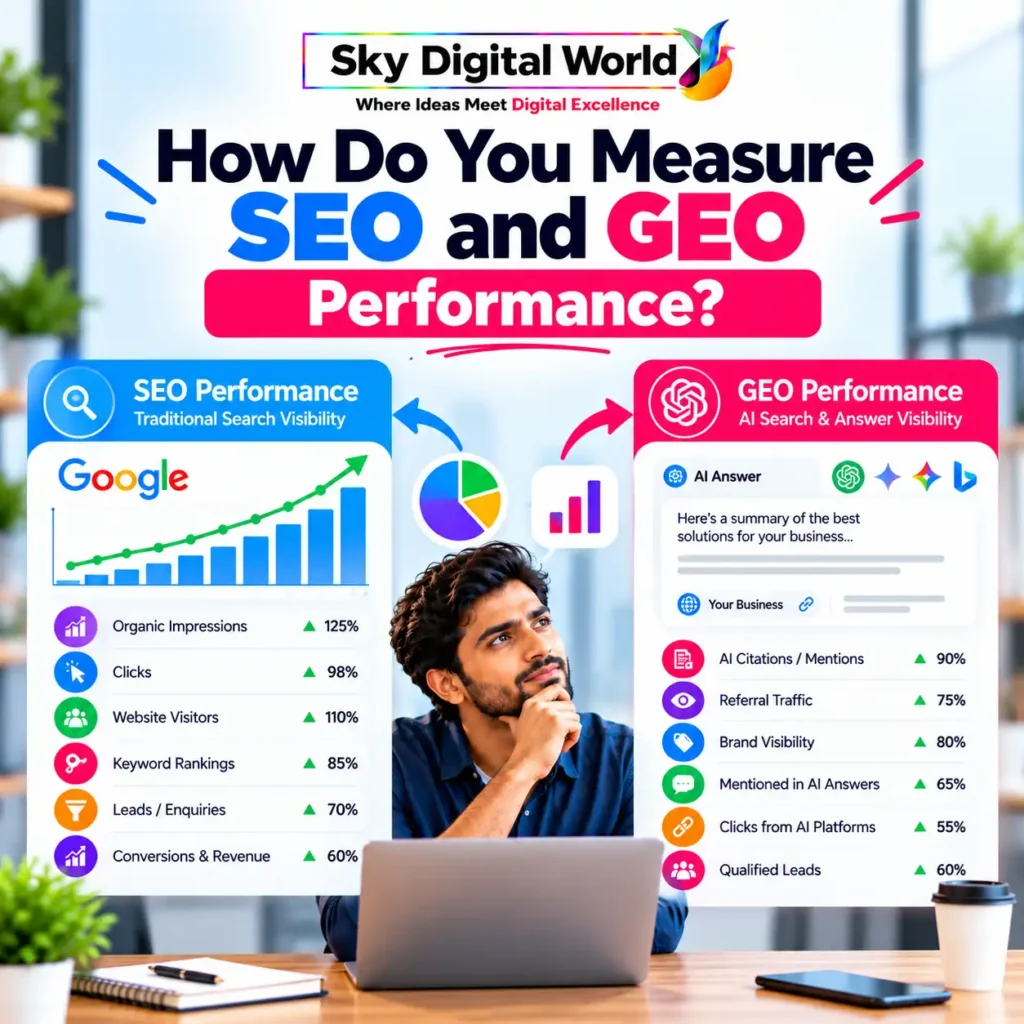
How Do You Measure SEO and GEO Performance?
Measuring results is essential because visibility without meaningful business outcomes can create misleading impressions of success.
SEO Performance Metrics
Track organic impressions, clicks, relevant landing-page visits, keyword visibility, enquiries, conversion rates, and revenue where attribution is available.
GEO Performance Metrics
Review available AI citation data, referral traffic from AI platforms, brand mentions in relevant research experiences, and enquiries that customers attribute to AI-assisted discovery.
For example, Microsoft introduced an AI Performance report in Bing Webmaster Tools in February 2026, providing information about citations and referenced pages across supported AI experiences. Citation counts do not necessarily represent website visits or sales.
A practical measurement approach combines visibility, engagement, lead quality, and business outcomes rather than treating citations or rankings as the final goal.
A Practical 30-Day SEO and GEO Improvement Plan
Businesses do not need to rebuild their entire digital strategy immediately.
A structured first month can help identify opportunities.
Timeline | Main Activity | Expected Deliverable |
Week 1 | Audit technical SEO, search visibility, website content and customer questions | SEO and AI discovery baseline |
Week 2 | Improve important service pages, headings, internal links and business information | Clearer, more accessible website |
Week 3 | Publish or update useful comparisons, FAQs, case studies and expert content | Stronger topic coverage |
Week 4 | Review organic performance, available AI citations, referrals and enquiries | Initial performance report and next priorities |
This is a starting framework, not a promise of measurable growth within 30 days. Search and AI visibility can take longer to develop.
What Mistakes Should Businesses Avoid When Combining SEO and GEO?
Ignoring SEO fundamentals: Publishing AI-focused content will not compensate for inaccessible pages or serious website issues.
Writing only for AI systems: Content should primarily serve real people, not attempt to manipulate generated answers.
Repeating the same keywords: Excessive use of phrases such as SEO GEO Services India can make content unnatural and reduce its usefulness.
Publishing unsupported claims: Accuracy and credibility matter, especially for financial, medical, legal, and technical subjects.
Expecting guaranteed AI recommendations: No legitimate optimization strategy can ensure a particular AI platform will cite or recommend a business.
Measuring only visibility: Organic clicks and AI citations are useful signals, but qualified enquiries and customer outcomes remain important.
How to Choose the Right SEO GEO Services India Strategy
Before selecting an agency or creating an internal plan, businesses should ask several practical questions.
Does the strategy address existing technical SEO problems? Does it identify genuine customer search behavior? Does it improve original content rather than simply increasing publication volume? Are the reporting methods transparent? Does it explain what can and cannot be measured?
A reliable approach should also connect website improvements with lead generation, customer trust, and conversion optimization.
For businesses with limited marketing budgets, prioritizing high-impact SEO improvements and gradually testing GEO-related content enhancements may be more practical than purchasing two completely separate services.
Final Thoughts: SEO, GEO or Both?
The question is not simply whether SEO or GEO is better.
It is how your business can become useful and discoverable wherever potential customers research their needs.
SEO remains the foundation for building organic search visibility, creating accessible websites, and attracting relevant visitors.
GEO adds an important perspective by considering how clear, credible, well-structured information may be discovered and referenced in AI-generated answers.
For most businesses, the practical approach is to start with strong SEO and expand into GEO where customer behavior and business opportunities justify it.
At Sky Digital World, we focus on practical digital marketing strategies that connect online visibility with meaningful business opportunities.
Whether your business needs technical SEO improvements, content optimization, local search visibility, or a combined SEO and GEO strategy, the objective should remain consistent: help the right customers find reliable information and make informed decisions.
Ready to improve your business’s search visibilitay?
Explore Sky Digital World and discover how a structured SEO and GEO strategy can support your digital growth.
Frequently Asked Questions (FAQs)
SEO focuses on improving visibility in traditional organic search results. GEO focuses on improving the discoverability and usefulness of content in generative AI search and answer experiences. Both rely heavily on clear, credible, accessible website content. outcomes.
Not every small business needs a separate GEO campaign immediately. Businesses should first evaluate their website performance, customer search behavior, and marketing goals. A strong SEO foundation with relevant AI-discovery improvements is often a sensible starting point.
GEO-related practices may improve the clarity, accessibility, and usefulness of business content, but they cannot guarantee mentions or citations in ChatGPT, Google AI Overviews, or other AI systems. Eligibility and source selection vary by platform.
Yes. SEO continues to support organic search visibility, website accessibility, relevant traffic, and lead generation. Search engine guidance also confirms that established SEO fundamentals remain relevant to AI-powered search experiences.
Results depend on website condition, competition, content quality, industry, and search platform behavior. SEO improvements often require sustained work over months, while GEO visibility can be variable and difficult to attribute. Neither approach offers