





What Is GEO Optimization and Why Does It Matter?
What Is GEO Optimization and Why Does It Matter?
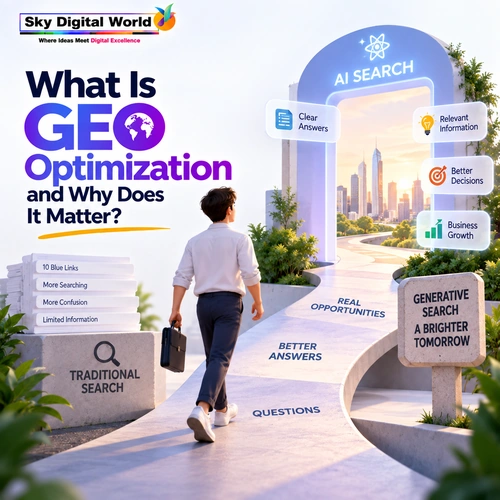
Search is no longer limited to typing a keyword into Google, opening ten blue links, and visiting websites one by one. People increasingly use AI-powered search experiences and conversational tools to ask detailed questions, compare options, understand complex topics, and discover businesses.
This shift has introduced a growing area of digital marketing known as Generative Engine Optimization (GEO).
For businesses, GEO is not simply about chasing another marketing trend. It is about making online information clear, useful, credible, well-structured, and easy for modern search and AI systems to understand.
Businesses exploring GEO Optimization Services in India should therefore think beyond conventional rankings. The broader goal is to create a digital presence that communicates expertise clearly wherever customers may be searching.
What Is GEO Optimization?
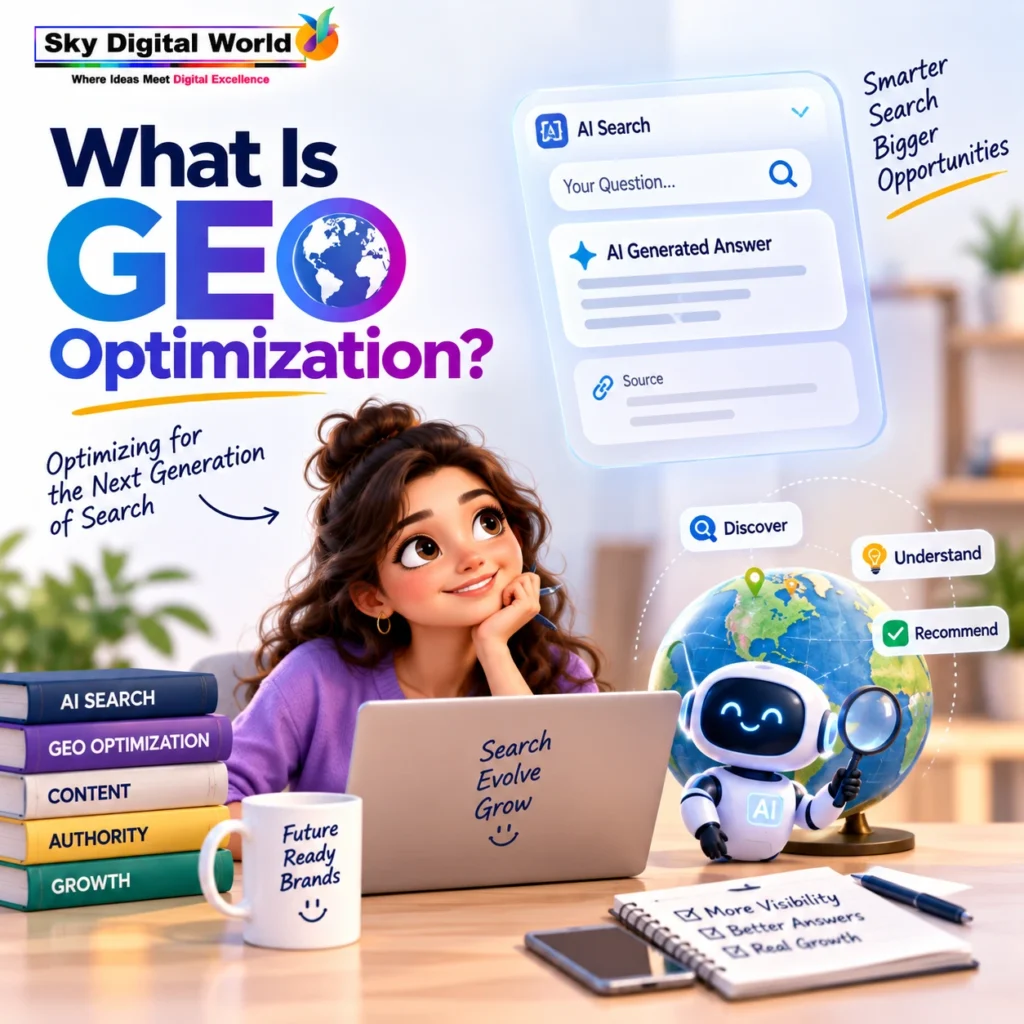
GEO, or Generative Engine Optimization, is the practice of improving digital content so that it is easier for AI-powered search and generative systems to understand, interpret, and potentially use when producing answers.
Traditional SEO primarily focuses on improving visibility in search engine results.
GEO looks at another question:
“Can an AI-powered search experience clearly understand what our business knows, offers, and represents?”
That difference matters.
A conventional search result may give users a list of websites. A generative search experience may instead synthesize information into a direct response.
This means businesses increasingly need content that does more than contain keywords. Their information should be understandable in context.
A simple way to look at it is:
SEO → Help people find your pages
AEO → Help answer specific questions clearly
GEO → Help make your information understandable and useful within generative search experiences
These approaches overlap significantly rather than operating as completely separate marketing channels.
Why Is GEO Becoming Important?
Customer search behaviour is becoming more conversational.
Instead of searching:
“SEO agency India”
someone might ask:
“Which type of SEO agency is suitable for a manufacturing company planning international expansion?”
That is a much richer query.
To respond effectively, an AI system needs to understand relationships between topics, industries, services, expertise, locations and user intent.
This is why businesses need to move beyond pages written around isolated keywords.
Modern content needs context.
If your website explains what you do, who you help, how your process works, where you operate and what expertise supports your recommendations, it becomes more useful to both human readers and machine systems.
GEO Is Not About Adding More Keywords
One of the biggest mistakes businesses can make is treating GEO like another keyword-density exercise.
Adding phrases such as “AI search optimization” repeatedly does not automatically make content more suitable for generative search.
Good GEO content should provide useful information in a format that is easy to understand.
For example, instead of writing:
“We provide the best GEO services with professional GEO solutions for every business.”
A useful page could explain:
“GEO focuses on making a brand’s online information clearer and more useful for AI-powered discovery. This can involve improving content structure, strengthening topical coverage, clarifying brand information and supporting important claims with credible evidence.”
The second version communicates actual meaning.
Clarity beats repetition.
How Does GEO Optimization Work?
There is no single GEO button, plugin, schema type or guaranteed formula.
A strong strategy combines several areas of digital visibility.
1. Start With Clear, Direct Information
Generative systems need to understand what a page is actually about.
Long introductions that avoid answering the user’s question can weaken the usefulness of a page.
A stronger structure is:
Question → Direct Answer → Explanation → Evidence → Examples → Related Questions
For instance, if the heading asks “What Is GEO Optimization?”, provide a concise definition immediately before moving into detailed explanation.
This approach also improves the experience for human readers.
2. Build Topical Depth Instead of Isolated Articles
Publishing dozens of unrelated articles does not necessarily demonstrate expertise.
A better strategy is to develop connected content around important business topics.
Suppose a digital marketing company wants to build authority around generative search. Its content cluster might include:
Pillar Topic: Generative Engine Optimization
Supporting Topics:
- GEO vs SEO
- GEO vs AEO
- How AI search works
- Content optimization for AI discovery
- Brand authority and AI search
- Structured data and GEO
- AI search visibility measurement
- Generative search readiness
Internal links can then connect these resources naturally.
The result is a clearer knowledge structure rather than a collection of disconnected posts.
3. Demonstrate Real Expertise
Generic content is becoming easier than ever to produce.
That makes genuine expertise more valuable.
Businesses should add information that reflects real knowledge, such as original explanations, practical examples, expert observations, methodologies, case studies, research, statistics where appropriate, and clearly explained processes.
If everyone publishes the same generic definition, there is little reason for any particular source to stand out.
Your content needs to answer:
“What useful information are we adding that readers cannot get from another rewritten article?”
That is an important question for both SEO and GEO.
4. Strengthen Brand and Entity Clarity
Your website should make basic business information easy to understand.
That includes your business name, services, industry, location or markets served, team expertise, contact information and relationships between important pages.
An incomplete or inconsistent digital identity can create ambiguity.
Useful areas to strengthen include the homepage, About page, service pages, author profiles, contact information and relevant business listings.
The objective is straightforward:
Make it easy to understand who you are and what you do.
5. Support Important Claims With Evidence
Credibility becomes particularly important when discussing technical, financial, medical, legal or other information where accuracy matters.
Avoid unsupported claims such as:
“GEO guarantees AI visibility.”
No responsible GEO strategy can promise that a business will always be cited or recommended by a particular generative system.
Instead, strengthen content with appropriate primary sources, original research, transparent methodology, expert attribution, accurate dates and reputable references where relevant.
Strong GEO Optimization Services in India should focus on improving readiness and discoverability rather than selling guaranteed AI mentions.
6. Keep Technical SEO Strong
GEO does not eliminate technical SEO.
Your content still needs a technically healthy foundation.
Important considerations include crawlability, indexability, mobile usability, page speed, canonicalization, internal linking, HTTPS, clean site architecture and relevant structured data.
Think of technical SEO as building the road that allows systems to reach your information.
Excellent content hidden behind technical problems can still struggle to perform.
7. Structure Content for Humans First
Good structure does not mean writing robotic content.
Use descriptive headings, short paragraphs, meaningful lists where appropriate, comparison tables when genuinely useful, direct definitions, FAQs and logical internal links.
The reader should be able to scan the page and quickly understand its structure.
The same clarity also makes information easier for automated systems to process.
GEO vs SEO: Do Businesses Need Both?
In most cases, businesses should not view GEO and SEO as competitors.
SEO remains fundamental because search engines continue to be major discovery channels. GEO expands the strategy to account for increasingly generative and conversational discovery experiences.
SEO | GEO |
Search-engine visibility | Generative-search readiness |
Keywords and search intent | Topics, context and entities |
Organic search pages | AI-assisted discovery experiences |
Technical + content optimization | Clear + credible + structured information |
Rankings and organic traffic | Broader generative visibility signals |
The strongest strategy often begins with good SEO fundamentals and then improves content quality, topical depth, brand clarity and generative-search readiness.
In other words:
Strong SEO creates the foundation. GEO extends the opportunity.
Why Does GEO Matter for Businesses in India?
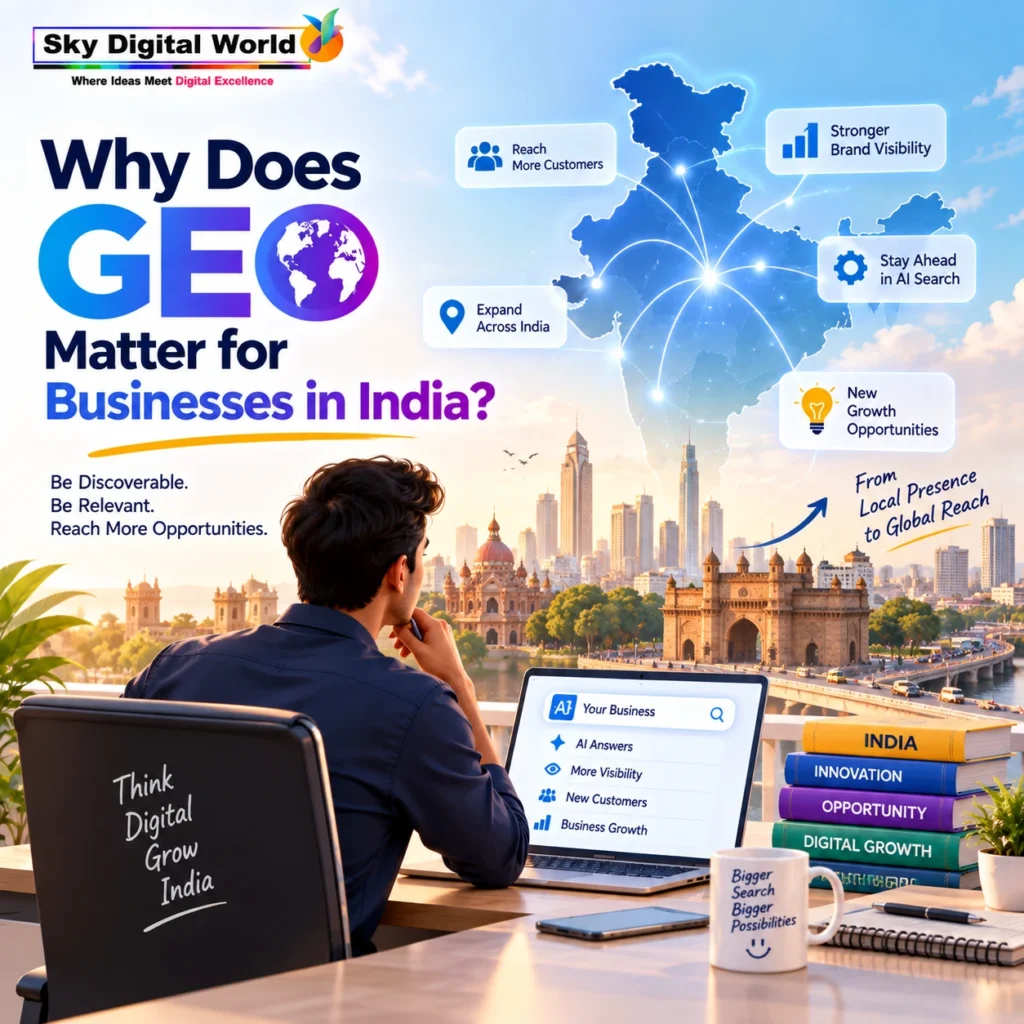
Indian businesses increasingly compete beyond local search results.
A software company in Indore may serve customers across India. A manufacturer in Gujarat may target international distributors. An e-commerce company may compete nationally. A consulting company may work with customers in several countries.
As discovery becomes more fragmented, businesses need visibility across more than one type of search experience.
This is where GEO Optimization Services in India can support a broader strategy.
GEO may be especially relevant for B2B companies, SaaS businesses, manufacturers, professional services, e-commerce brands, healthcare organizations, educational businesses and companies targeting international audiences.
The objective is not simply “getting into AI.”
It is building a digital presence that remains understandable, credible and discoverable as search behaviour evolves.
How Can You Make Your Website More GEO-Ready?
Start with your existing website rather than immediately producing hundreds of new articles.
Audit your most important pages.
Ask whether each page clearly explains its topic, answers the user’s main question, demonstrates genuine expertise, connects naturally to related content, identifies the business or author, provides accurate information and offers a logical next step.
Then improve weak areas systematically.
A practical workflow is:
Audit → Understand Intent → Improve Content → Build Topic Depth → Strengthen Authority → Improve Technical Foundation → Connect Related Pages → Measure → Update
GEO should be an ongoing improvement process rather than a one-time optimization project.
What Should GEO Optimization Services in India Include?
A professional GEO strategy can include search and audience research, existing-content audits, topical mapping, entity and brand clarity, answer-focused content optimization, technical SEO, structured data where appropriate, internal linking, authority development, digital PR, content updating and performance analysis.
Most importantly, the strategy should connect to actual business objectives.
Getting mentioned somewhere is not automatically valuable.
The better question is:
Is increased discoverability helping the right audience understand, trust and eventually choose the business?
That keeps GEO connected to marketing outcomes rather than vanity metrics.
How Should GEO Performance Be Measured?
GEO measurement is still developing, so businesses should avoid relying on a single metric.
Instead, monitor a combination of indicators such as organic visibility, branded searches, referral patterns, important page performance, conversions, engagement, mentions, citations where measurable and visibility across relevant search experiences.
Also track whether customers are discovering the brand through new channels.
Measurement should ultimately connect back to:
Visibility → Trust → Engagement → Enquiries → Revenue
Not every useful interaction will appear as a traditional organic click.
The Future Is Search Visibility, Not Just Rankings
Businesses should not abandon Google rankings. Rankings still matter.
But digital discovery is becoming broader.
Customers may encounter a business through Google Search, maps, videos, social platforms, review sites, AI-generated responses, industry publications or branded searches.
That changes the question businesses should ask.
Instead of only:
“Where do we rank?”
Start asking:
“Where can our customers discover us, and is our information strong enough to earn their trust?”
That is the larger opportunity behind GEO.
Final Thoughts
Generative Engine Optimization is an evolution in how businesses prepare content for a changing search environment.
Effective GEO is not about tricking AI systems, flooding websites with AI-generated articles or stuffing pages with new keywords.
It is about making information clearer, more useful, better connected, credible and easier to understand.
Businesses investing in GEO Optimization Services in India should build on strong SEO foundations while developing deeper topical expertise, better brand clarity, reliable information and content designed around genuine customer questions.
Search technology will continue changing.
Businesses do not need to predict every change.
They need to build digital information that remains worth discovering.
Faqs
What is GEO optimization?
GEO stands for Generative Engine Optimization. It focuses on making digital content clearer, more credible, structured and useful for AI-powered and generative search experiences while maintaining a strong user experience.
Is GEO different from SEO?
Yes, although they overlap. SEO primarily focuses on traditional organic search visibility, while GEO considers how information may be understood and surfaced within generative search experiences. Strong technical SEO and high-quality content remain valuable foundations for both.
Does GEO replace traditional SEO?
No. GEO should generally complement SEO rather than replace it. Crawlability, indexing, useful content, search intent, internal linking, website quality and authority remain important foundations.
Can GEO guarantee that my business appears in AI-generated answers?
No credible strategy can guarantee inclusion in a specific AI-generated response. GEO can improve the clarity, quality, credibility and accessibility of your digital information, but individual generative systems determine what they surface.
What should GEO Optimization Services in India include?
A comprehensive service may include content audits, topic and intent research, entity optimization, answer-focused content, technical SEO, structured data where appropriate, internal linking, brand authority development, content updates and performance measurement.