




How Can Businesses Generate High-Quality Leads Online?
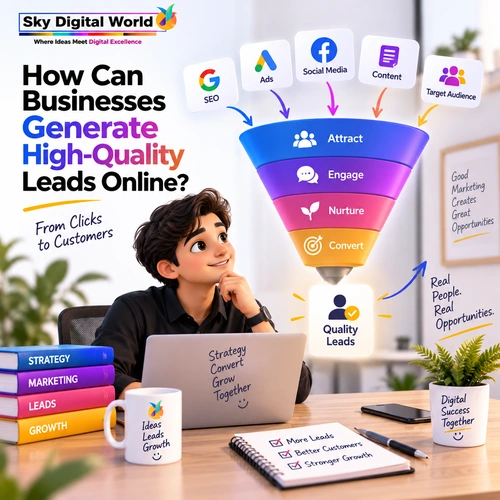
How Can Businesses Generate High-Quality Leads Online?
Getting more leads sounds like the obvious goal of digital marketing. But for most businesses, more leads are not automatically better leads.
A company may receive 100 enquiries and still generate very little business if most people are outside its target market, have no real requirement, cannot afford the service, or are simply comparing prices.
That is why modern lead generation should focus on quality, relevance, trust and buying intent.
Businesses using Online Lead Generation Services in India need a strategy that attracts the right audience, answers their questions, builds confidence and creates an easy path from first interaction to genuine enquiry.
The real objective is not simply:
Traffic → Leads
A stronger approach is:
Right Audience → Relevant Message → Trust → Qualified Enquiry → Follow-Up → Customer
Here is how businesses can build that process.
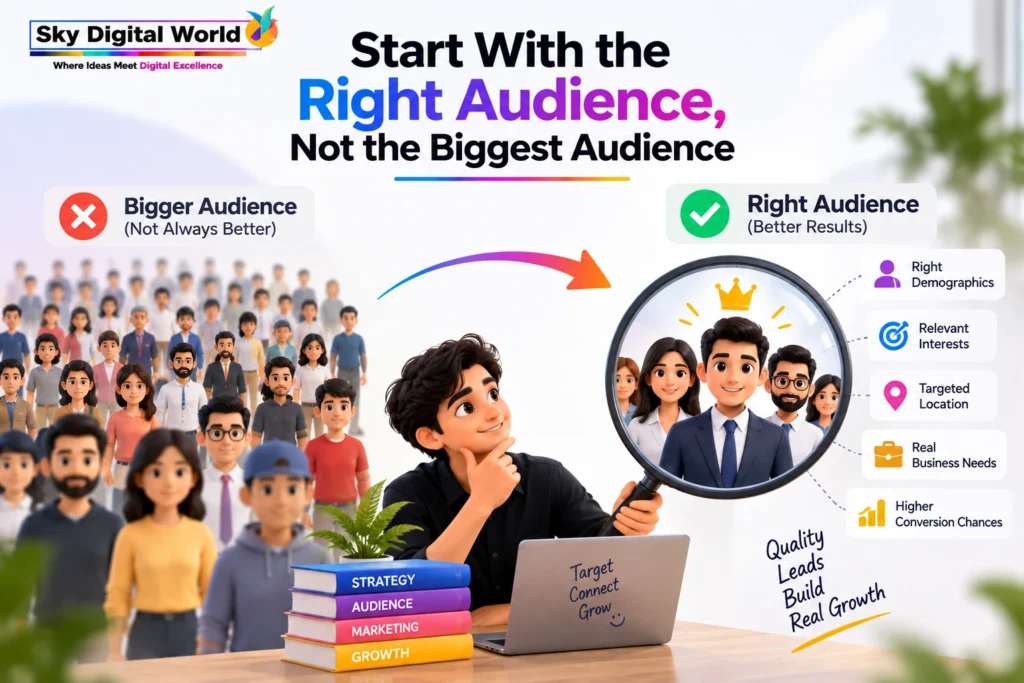
1. Start With the Right Audience, Not the Biggest Audience
One of the most common online lead generation mistakes is trying to reach everyone.
A broader audience may generate more impressions and clicks, but it can also create irrelevant enquiries.
Before launching SEO, Google Ads, Meta Ads or content campaigns, define your ideal customer clearly.
Understand their industry, location, business size, requirement, challenges, decision-making process and reasons for choosing a provider.
For example, a company selling industrial equipment does not simply need “business owners.”
It may need:
Plant managers, procurement teams or manufacturers in specific industries and locations.
Better audience clarity improves almost everything that follows—from keywords and ad targeting to landing-page copy and sales qualification.
2. Target Search Intent, Not Just Popular Keywords
A keyword with thousands of searches is not necessarily better than a smaller keyword with strong commercial intent.
Consider these searches:
“What is digital marketing?”
versus
“digital marketing agency for manufacturing companies India”
The first may bring someone looking for information.
The second provides much stronger clues about what the searcher actually needs.
A high-quality SEO strategy therefore targets different stages of customer intent.
Informational Intent
The customer is learning.
Example:
“How does SEO generate leads?”
Commercial Investigation
The customer is comparing solutions.
Example:
“SEO agency vs in-house SEO team”
Transactional Intent
The customer may be closer to taking action.
Example:
“SEO services for B2B company India”
Your content should support the complete journey rather than targeting only high-volume keywords.
This is an important part of effective Online Lead Generation Services in India because ranking for the wrong searches can increase traffic without meaningfully improving sales opportunities.
3. Create Landing Pages Around Real Customer Needs
Sending every visitor to your homepage is rarely the strongest lead-generation strategy.
If someone searches for a specific service, the page they land on should clearly address that requirement.
A strong landing page should quickly communicate:
What you offer, who it is for, what problem it solves, why the visitor should trust you and what they should do next.
Avoid opening with generic statements such as:
“We are a leading company providing innovative solutions.”
That tells the visitor very little.
Instead, make the value proposition specific.
For example:
“Generate qualified B2B enquiries through SEO, paid advertising and conversion-focused digital campaigns.”
The visitor should understand the page before needing to scroll through several sections.
4. Build Trust Before Asking for the Lead
People rarely submit serious enquiries simply because a website says, “Contact Us.”
They look for reasons to trust the company first.
Trust can be developed through genuine client testimonials, relevant case studies, transparent service information, team expertise, certifications where applicable, original insights, detailed About pages, professional website design and clear contact information.
For B2B or high-value services, this becomes even more important because customers may research multiple providers before speaking with anyone.
Your website should answer the silent question:
“Why should I trust this company with my requirement?”
The stronger your answer, the easier lead generation becomes.
5. Use SEO to Capture Existing Demand
SEO can be particularly valuable for lead generation because it allows businesses to appear when people are already searching for information, products or services related to what they offer.
A strong SEO strategy may include service pages, location pages where genuinely relevant, problem-solving blogs, comparison content, technical SEO, internal linking, local SEO and authority development.
But traffic should never become the only objective.
Suppose one article attracts 10,000 monthly visitors but generates almost no business enquiries, while a specialized service page receives 300 relevant visitors and produces regular qualified leads.
The smaller page may be commercially more valuable.
That is why SEO performance should connect visibility and traffic with business outcomes.
6. Use Paid Advertising for Faster, Controlled Reach
SEO can build long-term organic visibility, while paid advertising can help businesses reach targeted audiences more quickly.
Google Ads can be useful for capturing existing search demand.
Meta Ads can help businesses reach audiences based on suitable targeting signals and creative messaging.
LinkedIn may be relevant for certain B2B audiences.
However, advertising alone does not guarantee high-quality leads.
A successful campaign requires alignment between:
Audience + Offer + Creative + Landing Page + Form + Follow-Up
If one part is weak, lead quality can suffer.
For example, an attractive ad promising something broad such as “Get More Sales Today” may produce clicks but also attract unrealistic expectations.
Clear messaging often generates fewer but more relevant responses.
7. Qualify Leads Through Better Forms
Many businesses make one of two mistakes.
Their forms are either so long that serious prospects abandon them, or so short that the sales team receives almost no useful information.
A good lead form asks only what is genuinely needed to begin qualification.
Depending on the business, that might include:
- Name and contact information
- Service required
- Business type
- Location
- Approximate requirement or project scope
- Suitable budget range, where appropriate
The exact questions should depend on the sales process.
The purpose is not to create friction unnecessarily. It is to help both the business and potential customer determine whether there is a reasonable fit.
8. Use Content to Turn Research Into Enquiries
Not everyone is ready to contact a business on their first visit.
Some customers need time to understand the problem, evaluate alternatives and build confidence.
Useful content supports this process.
Instead of publishing random blogs only to increase website activity, build content around questions customers ask before purchasing.
Examples include:
“How much does the service cost?”
“How long does it take?”
“Which option is suitable for my business?”
“What should I check before choosing a provider?”
“What mistakes should I avoid?”
This type of content can attract relevant search traffic while helping potential customers make informed decisions.
A good blog should naturally lead readers toward a relevant service—not force them into an aggressive sales pitch.
9. Make Your CTA Match the Customer’s Stage
“Buy Now” or “Contact Us” is not the right call to action for every visitor.
Someone researching a complex B2B solution may prefer:
Discuss Your Requirement
A potential SEO client might respond better to:
Request an SEO Audit
Someone comparing solutions may prefer:
Talk to a Specialist
The CTA should feel like the logical next step in the visitor’s journey.
Also avoid overwhelming users with five different actions on one page.
A clear primary CTA usually creates a simpler experience.
10. Improve the Follow-Up Process
Lead generation does not finish when a form is submitted.
A high-quality prospect can still be lost through poor follow-up.
Businesses should define what happens after an enquiry arrives.
Who receives it?
How quickly is it reviewed?
What information does the sales team receive?
What happens when the customer does not answer the first call?
How are warm prospects followed up later?
Marketing and sales should work together.
If marketing generates qualified opportunities but the follow-up process is inconsistent, campaign performance will appear weaker than it actually is.
11. Use Retargeting Without Becoming Repetitive
Many customers visit a website and leave without taking immediate action.
That does not always mean they are uninterested.
They may be comparing companies, discussing the purchase internally or simply not be ready.
Retargeting can help businesses reconnect with these audiences through relevant advertising.
Instead of repeatedly showing the same “Contact Us” message, use different information.
One ad might show a case study.
Another could explain a service benefit.
Another could answer a common objection.
The goal should be to continue the conversation—not chase the visitor around the internet with identical advertisements.
12. Measure Lead Quality, Not Just Lead Volume
This is where many digital marketing campaigns lose direction.
Imagine:
Campaign A: 120 leads at ₹300 each
Campaign B: 45 leads at ₹600 each
Campaign A initially appears better.
But suppose Campaign A produces only three serious opportunities while Campaign B produces fifteen.
The interpretation changes completely.
Businesses should therefore monitor metrics such as qualified lead rate, cost per qualified lead, sales opportunities, conversion rate, customer acquisition cost and revenue generated.
This connects marketing performance with actual business performance.
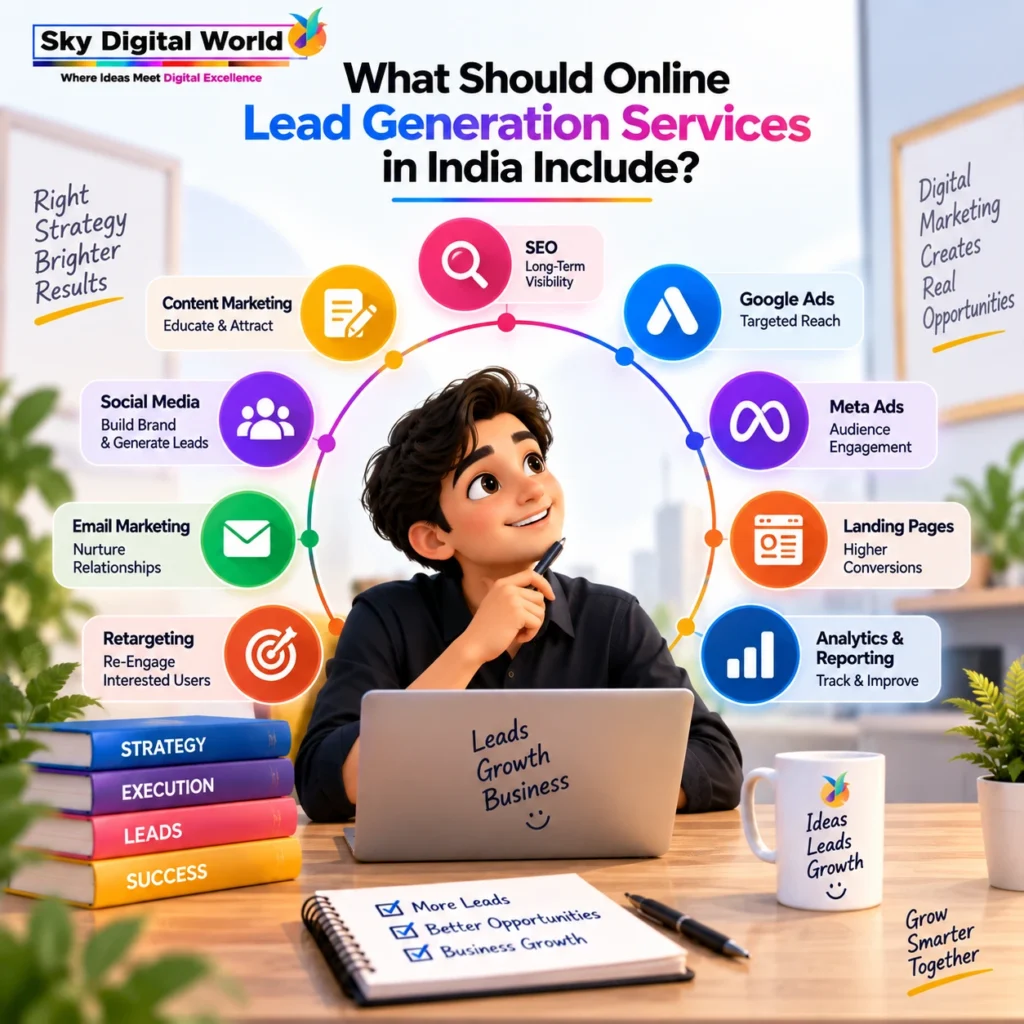
What Should Online Lead Generation Services in India Include?
A professional lead-generation strategy should not depend on a single channel.
Depending on the business, it may combine:
SEO + Content + Google Ads + Meta Ads + Landing Pages + Conversion Optimization + Retargeting + Analytics + Lead Qualification
For local businesses, Google Business Profile and local SEO may also play an important role.
For B2B companies, industry-specific content, LinkedIn, search marketing and strong service pages may be more relevant.
For e-commerce businesses, product discovery, remarketing, shopping campaigns, email and conversion optimization may matter more.
There is no universal channel mix.
The right strategy depends on where your ideal customers search, what influences their decisions and how they prefer to contact a business.
A Better Lead Generation Framework
Instead of thinking only about campaigns, think about the complete customer journey:
Attract → Educate → Build Trust → Qualify → Convert → Follow Up → Measure → Improve
This framework helps businesses identify exactly where leads are being lost.
High traffic but few enquiries?
Review the offer and conversion experience.
Many enquiries but poor quality?
Review targeting, keywords and messaging.
Qualified leads but few customers?
Review sales follow-up, pricing, positioning and the overall buying experience.
This approach turns lead generation from guesswork into an improvement process.
Final Thoughts
Generating high-quality leads online is not about collecting the largest possible database of names and phone numbers.
It is about creating meaningful opportunities with people who have a genuine reason to consider your business.
Effective Online Lead Generation Services in India should bring marketing, content, search visibility, advertising, trust, conversion optimization and sales qualification together.
Start by understanding the customer. Reach them at the right moment. Give them useful information. Make your value clear. Remove unnecessary friction. Then measure what happens after the lead arrives.
Because ultimately, the best digital marketing campaign is not the one that generates the most leads.
It is the one that helps create more of the right business opportunities.
Online lead generation is the process of attracting potential customers through digital channels and encouraging interested users to share their details or contact a business. Channels can include SEO, paid advertising, social media, content marketing, email and landing pages.
Start with clear audience targeting, high-intent keywords, relevant landing pages and honest messaging. Businesses should also qualify enquiries through appropriate form questions and measure how many leads progress into genuine sales opportunities.
SEO can support lead generation by helping businesses appear when potential customers search for relevant information, products or services. Results depend on factors such as search demand, competition, website quality, content relevance and conversion experience.
They serve different purposes. Paid advertising can provide faster targeted exposure, while SEO can develop longer-term organic visibility. Many businesses use both, with the appropriate mix depending on goals, budget, competition and customer behaviour.
Do not measure success only by the total number of leads. Track qualified lead rate, cost per qualified lead, conversion rate, sales opportunities, customer acquisition cost and revenue where attribution is reasonably available.