




How AI Tools Are Changing Content Marketing Strategies for Businesses
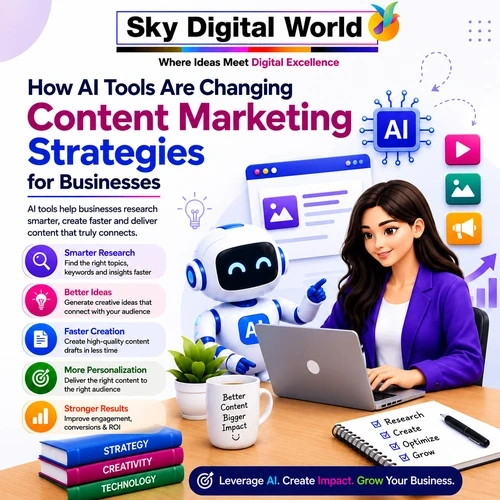
Content marketing has always been about understanding what people need and creating useful content around those needs. What is changing is how quickly businesses can research, create, personalize, distribute, and improve that content.
Artificial intelligence is becoming part of everyday marketing workflows. Businesses can use AI to study search behaviour, organize ideas, identify content gaps, create first drafts, repurpose existing material, analyze performance, and support personalization.
But there is an important distinction: using AI to produce more content is not the same as building a better content strategy.
The businesses gaining the most value from AI are combining automation with human expertise, original knowledge, customer understanding, and strong editorial control.
For companies exploring AI Content Marketing Services India, the real opportunity is not replacing marketers with AI. It is building a smarter content system where technology handles repetitive work while people remain responsible for strategy, experience, creativity, and trust.
What Is AI Content Marketing?
AI content marketing means using artificial intelligence tools to support different parts of the content marketing process.
Depending on the business and workflow, AI may assist with:
- Audience and topic research
- Keyword clustering
- Content ideation
- Content briefs
- Draft creation
- Headline variations
- Content optimization
- Personalization
- Social media repurposing
- Email content
- Video scripts
- Performance analysis
The goal should not be to press a button and publish whatever AI generates.
Instead, AI should help marketing teams work more efficiently while improving the usefulness and relevance of their content.
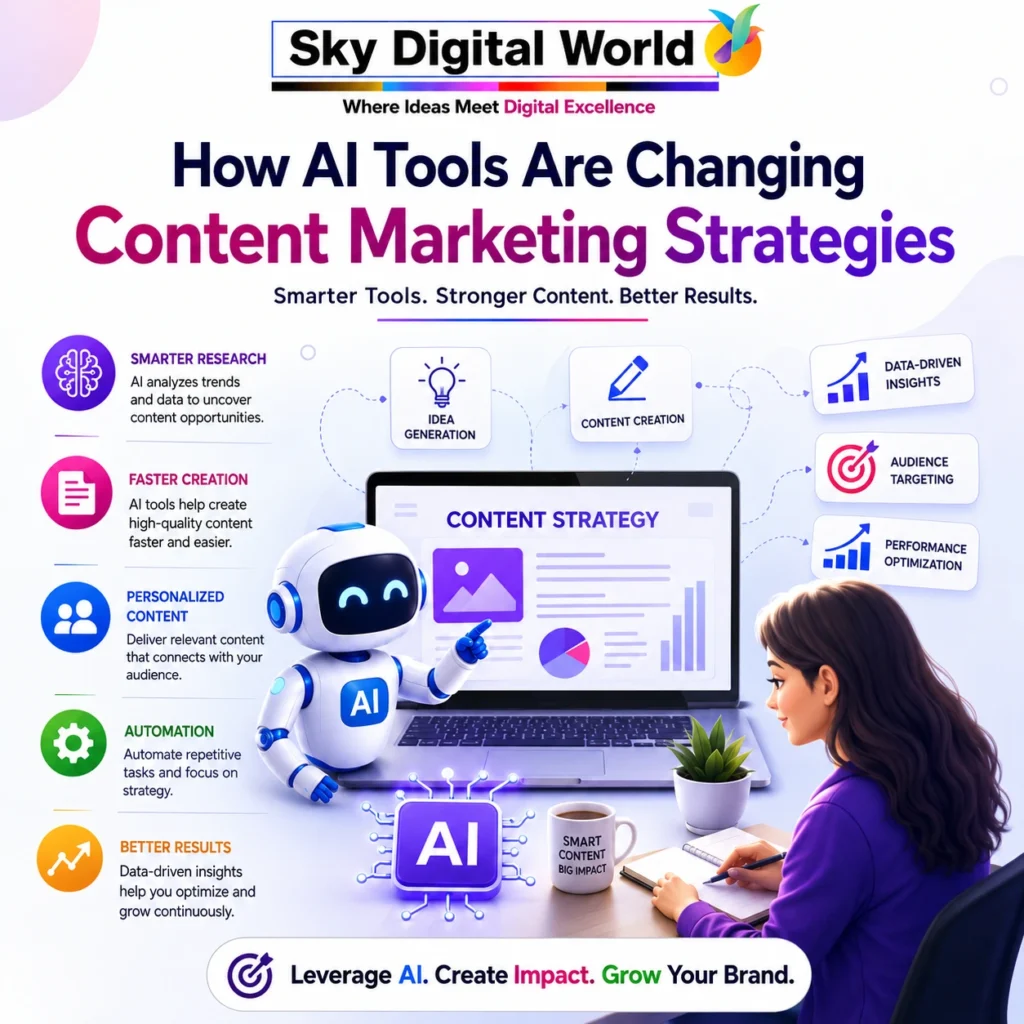
1. Content Research Is Becoming Faster
Good content starts long before writing.
Marketers need to understand what customers are searching for, what questions they ask, what problems they face, and what information competitors already provide.
Traditionally, this research could require hours of manual work.
AI tools can help organize large amounts of information and reveal patterns more quickly. A marketing team might use AI to group similar customer questions, categorize keyword themes, summarize research notes, or identify topics that deserve deeper investigation.
The benefit is not simply speed.
It gives marketers more time to focus on the harder question:
“What can our business contribute that is genuinely useful?”
2. AI Is Moving Content Strategy Beyond Individual Keywords
SEO content was once heavily focused on targeting one keyword with one page.
Modern search behaviour is much broader.
A person searching for digital marketing help might ask:
- How can I generate more leads?
- Why is my website getting traffic but no enquiries?
- Should I use SEO or Google Ads?
- How can AI improve my marketing?
- How do I measure campaign ROI?
These questions are connected.
AI can help businesses organize related questions into topic clusters and customer journeys rather than treating every keyword as an isolated opportunity.
For an AI Content Marketing Services India strategy, this can mean building connected content around a central service instead of publishing disconnected articles simply to target keywords.
3. Content Creation Is Becoming More Efficient
One of the most obvious uses of generative AI is drafting.
AI can help create outlines, suggest headlines, restructure paragraphs, summarize information, generate variations, and turn research into an initial draft.
This can significantly reduce production time.
However, an AI-generated first draft should usually be treated as exactly that—a first draft.
Human review remains important for checking:
Accuracy → Context → Brand voice → Original insights → Examples → Claims → Readability → Search intent
Without this layer, businesses risk publishing generic content that sounds similar to hundreds of other websites.
Efficiency matters, but quality still determines whether the content deserves attention.
4. One Strong Idea Can Become Multiple Content Assets
Businesses often create valuable content and use it only once.
AI makes content repurposing much easier.
For example, a detailed article about conversion optimization could become:
Blog Article → LinkedIn Post → Instagram Carousel → Short Video Script → Email → FAQ → Sales Talking Points
The core idea remains consistent while the presentation changes according to the platform.
This is especially valuable for smaller marketing teams that cannot create completely new content for every channel every day.
The result is not necessarily “more content.”
It is more value from the content you already create.
5. AI Can Support Better Content Personalization
Different customers care about different things.
A startup founder, marketing manager, local retailer, e-commerce owner, and B2B company may all visit the same website but have very different needs.
AI-supported marketing systems can help businesses analyze audience behaviour and create more relevant content experiences.
For example, different audience segments may receive different:
- Email messages
- Product recommendations
- Landing-page content
- Follow-up communication
- Educational resources
- Offers
Personalization should still be handled carefully. Businesses need appropriate data practices and should avoid creating experiences that feel invasive.
The objective is relevance, not surveillance.
6. AI Is Helping Marketers Understand Content Performance
Publishing content is only half the job.
Businesses also need to understand what happens afterward.
Which articles attract relevant visitors?
Which pages generate enquiries?
Where do users leave?
Which topics contribute to conversions?
Which content should be updated?
AI can help marketers analyze large datasets and identify patterns that might otherwise be overlooked.
Instead of simply saying:
“This article received 5,000 visits.”
A stronger analysis asks:
“What did those visitors do next?”
That change moves content marketing away from vanity metrics and toward measurable business outcomes.
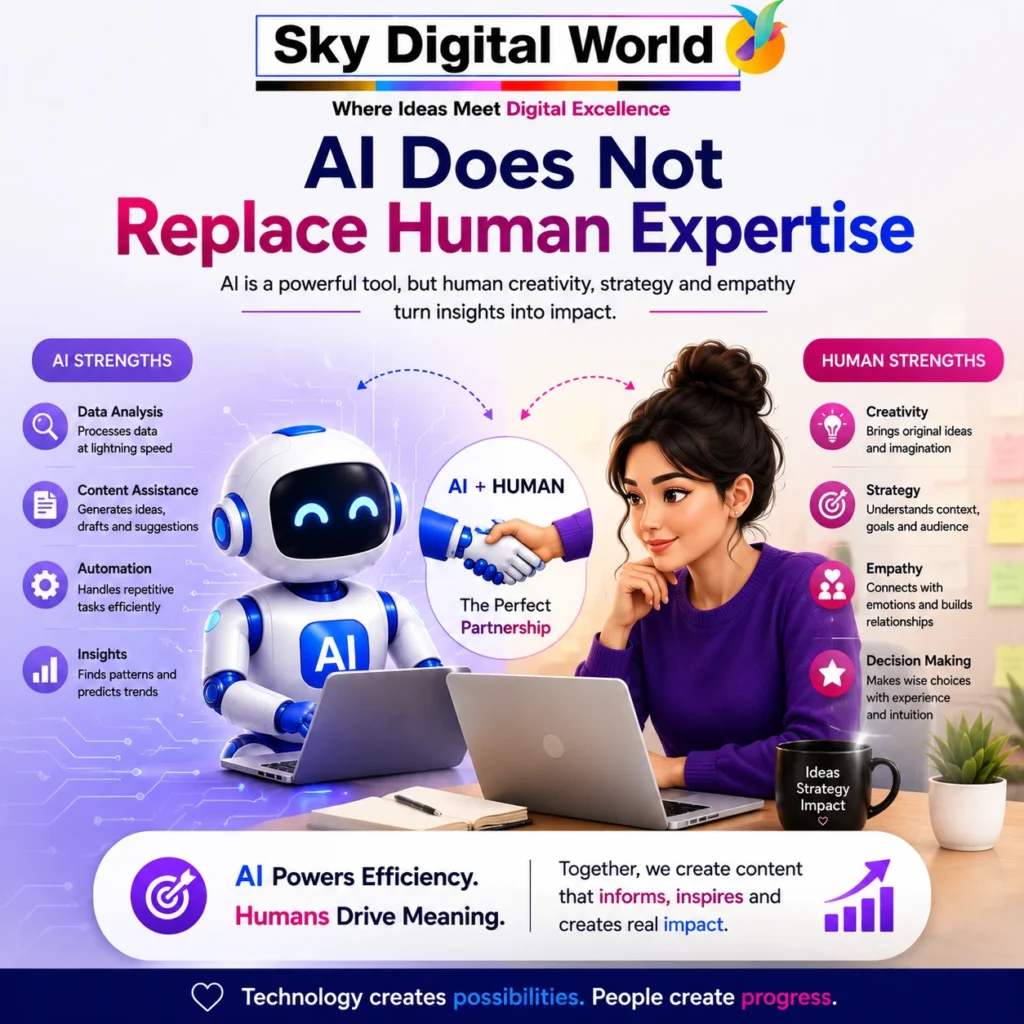
AI Does Not Replace Human Expertise
This is one of the most important points for businesses adopting AI.
AI can assist with language and information processing, but it does not automatically understand your customers the way an experienced business owner, salesperson, customer-support representative, or subject-matter expert can.
Your team knows:
- Why customers hesitate
- What objections appear during sales calls
- Which questions prospects repeatedly ask
- What makes your service different
- Which solutions have worked in real situations
- What mistakes customers commonly make
That information is extremely valuable.
An effective AI content workflow combines machine efficiency with real human experience.
What Businesses Should Avoid With AI Content
AI makes content production easier, which also makes it easier to produce large amounts of weak content.
Businesses should avoid publishing content simply because it can be generated quickly.
Common problems include generic articles, unsupported claims, incorrect statistics, excessive keyword repetition, duplicated ideas, artificial examples, inconsistent brand voice, and publishing without editorial review.
Before publishing AI-assisted content, ask:
Is it accurate?
Is it genuinely useful?
Does it answer the reader’s question?
Does it contain something specific to our expertise?
Would we confidently put our company name behind it?
If the answer is no, the content needs more work.
A Smarter AI Content Marketing Workflow
Businesses do not need to automate everything.
A practical workflow can look like this:
Step 1 – Understand the audience: Identify customer problems, questions, objections and search intent.
Step 2 – Research the topic: Collect reliable information, internal expertise, customer insights and keyword opportunities.
Step 3 – Use AI for assistance: Generate ideas, organize research, develop outlines or create an initial draft.
Step 4 – Add human expertise: Include real examples, experience, brand perspective and practical recommendations.
Step 5 – Edit carefully: Check accuracy, clarity, tone, repetition and claims.
Step 6 – Optimize naturally: Improve headings, internal links, metadata and content structure without keyword stuffing.
Step 7 – Repurpose: Adapt strong content for social media, email, video and other relevant channels.
Step 8 – Measure: Track engagement, leads, conversions and other meaningful outcomes.
Step 9 – Improve: Update content based on performance and changing customer needs.
This creates a repeatable system rather than a one-time content-generation exercise.
Where AI Content Marketing Services India Can Help
Businesses often have access to AI tools but lack a structured strategy for using them.
Professional AI Content Marketing Services India can help connect AI capabilities with broader marketing goals.
Services may include content strategy, SEO research, editorial planning, AI-assisted content workflows, blog creation, website content, social media repurposing, content optimization, analytics, and performance improvement.
The important part is integration.
AI content should connect with your:
SEO + Social Media + Paid Ads + Website + Email + Lead Generation + Conversion Strategy
When these channels work together, content becomes part of the complete customer journey rather than an isolated marketing activity.
What Will Successful Content Marketing Look Like in the AI Era?
The competitive advantage will probably not come from simply having access to AI tools.
Most businesses can access similar technology.
The difference will come from how those tools are used.
Brands that combine AI efficiency with original expertise, strong positioning, customer understanding, useful information, consistent quality, and measurable strategy will be better positioned than businesses that simply generate content at scale.
AI can make content creation faster.
Human insight makes that content worth reading.
Final Thoughts
AI is changing content marketing, but it has not changed the fundamental reason content exists: to help people make better decisions.
Businesses should therefore view AI as a marketing assistant rather than a replacement for strategy and expertise.
Use AI to research faster. Use it to organize information. Use it to create drafts, discover patterns, repurpose ideas, and improve workflows.
But let people provide the experience, judgment, creativity, accountability, and perspective that make the content valuable.
For businesses considering AI Content Marketing Services India, the strongest strategy is not to create the highest volume of AI content.
It is to build a smarter system that produces useful content for the right audience at the right stage of the customer journey.
FAQs
1. What is AI content marketing?
AI content marketing is the use of artificial intelligence to support content research, planning, creation, optimization, personalization, repurposing, and performance analysis. It helps marketers work more efficiently while human expertise guides strategy and quality.
2. How are AI tools changing content marketing strategies?
AI tools help businesses identify relevant topics, understand audience interests, organize research, create initial drafts, personalize content, repurpose existing assets, and analyze marketing performance more efficiently.
3. What are AI Content Marketing Services India?
AI Content Marketing Services India typically combine artificial intelligence with human-led content strategy. Services may include SEO research, content planning, blog creation, website content, social media content, content optimization, repurposing, and performance analysis.
4. Can AI-generated content rank on Google?
AI-assisted content can perform in search when it is useful, accurate, relevant, original, and created to satisfy users rather than manipulate rankings. Simply generating large amounts of AI content does not guarantee better visibility.
5. Will AI replace content writers and marketers?
AI can automate or speed up repetitive tasks, but human marketers remain important for strategy, creativity, fact-checking, brand voice, customer understanding, original experience, and editorial judgment.