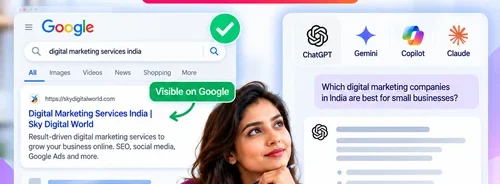




Why Is Your Website Visible on Google but Missing From AI Answers?
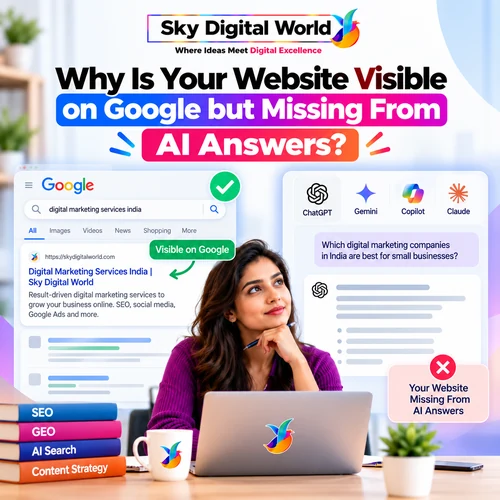
Why Is Your Website Visible on Google but Missing From AI Answers?
Your website appears on Google. Your pages are indexed, your keywords are performing, and people can find your business through traditional search results.
But there’s a new challenge.
When someone asks ChatGPT, Google AI Overviews, Gemini, or another AI-powered search platform for recommendations, your business is nowhere to be found.
Meanwhile, competitors may appear in AI-generated responses, even when their websites don’t always rank above yours in traditional search.
So, what’s happening?
The answer lies in understanding the difference between search engine visibility and AI search visibility.
Traditional SEO helps search engines discover, understand, and rank website pages. Generative Engine Optimization (GEO) focuses on improving how clearly your business and content can be understood, retrieved, and potentially referenced by AI-powered answer systems.
However, appearing on Google doesn’t automatically mean your business will appear in AI-generated answers.
Let’s explore why this happens and what businesses can do to improve their chances of being discovered.
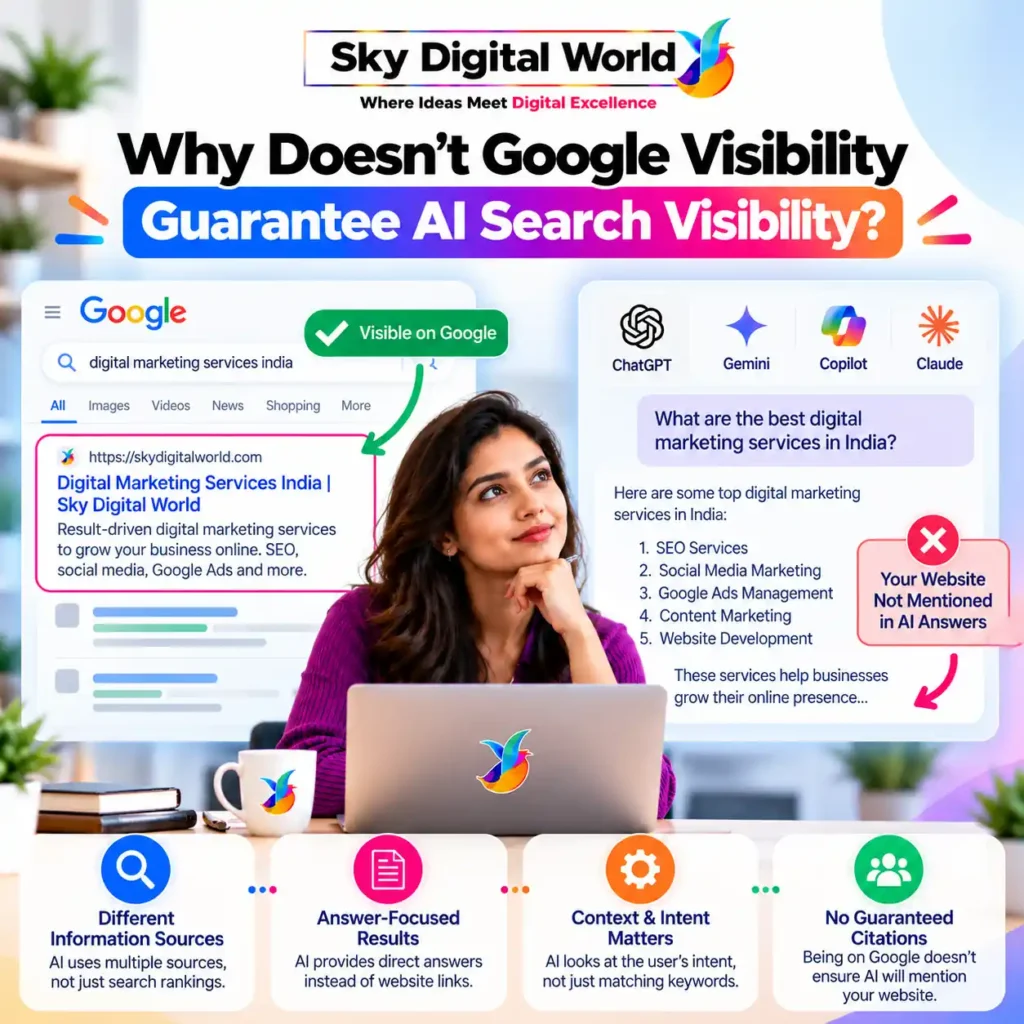
1. Why Doesn’t Google Visibility Guarantee AI Search Visibility?
Google search results and AI-generated answers don’t always work in the same way.
Traditional search engines typically present links to relevant webpages. AI-powered search experiences may combine information from multiple sources to create a direct response.
For example, someone searching Google for “best digital marketing services for small businesses” may see several agency websites.
But if they ask an AI assistant:
“Which digital marketing services should a small business invest in first?”
The response might explain SEO, content marketing, local search, and paid advertising without recommending any particular agency.
That’s because the user is asking for advice rather than a list of businesses.
The important difference: Ranking for a keyword and being selected as a source for an AI-generated answer are not the same outcome.
AI systems also vary in how they retrieve information, use search indexes, and select citations.
2. What Is Generative Engine Optimization (GEO)?
Generative Engine Optimization (GEO) is an approach to improving the clarity, credibility, accessibility, and usefulness of online information for AI-powered search and answer experiences.
It builds on established SEO practices while considering how AI systems interpret and summarize information.
A practical GEO strategy focuses on:
- Creating clear answers to relevant customer questions.
- Publishing accurate and genuinely useful content.
- Demonstrating expertise through examples and evidence.
- Making website information accessible to search systems.
- Maintaining consistent business information across relevant platforms.
- Structuring content so important details are easy to understand.
Businesses exploring GEO Services India should look for strategies that combine technical SEO, content quality, business credibility, and measurable performance rather than promises of guaranteed AI recommendations.
GEO is not a replacement for SEO. Both approaches work toward improving online discoverability.
3. Your Website Has Keywords but Doesn’t Answer Real Questions
Many websites are built around keywords rather than customer needs.
A business might create pages targeting phrases such as:
Digital Marketing Services India
Best SEO Agency
Website Development Company
These phrases may be commercially relevant, but they don’t necessarily answer the questions people ask AI assistants.
For example:
“Should a small business invest in SEO or Meta Ads first?”
“How long does SEO take to produce measurable results?”
“What should I check before hiring a digital marketing agency?”
These questions require explanations, comparisons, and practical guidance.
How Can You Improve?
Create content around genuine customer questions.
Start each relevant section with a direct answer, then explain the reasoning through examples and useful details.
Instead of writing another generic article about SEO benefits, consider publishing:
“SEO vs Paid Ads: Which Is Better for a New Business?”
This type of content can help customers understand their options while making your website more useful.
4. Your Content Is Too Promotional and Not Informative Enough
Imagine asking an AI assistant:
“How do I choose a reliable website development company?”
Now imagine it finding a page that says:
“We are the leading website development company offering world-class solutions and unmatched customer satisfaction.”
Does that statement help answer the question?
Not really.
Many business websites rely heavily on promotional claims without providing meaningful information.
AI-generated responses generally aim to address the user’s request. Unsupported marketing statements may contribute little to an informative answer.
What Should Businesses Do?
Replace vague claims with useful explanations.
Describe your process, deliverables, service limitations, timelines, and the factors customers should consider.
Where appropriate, include genuine project examples and clearly attributed testimonials.
Helpful information builds more credibility than repeatedly claiming to be the best.
5. Your Business Information Is Inconsistent Across the Internet
Your website is not the only place where information about your business may appear.
Customers may discover your company through business directories, professional profiles, review platforms, industry websites, and other public sources.
Suppose your website lists one business name while several directory listings use an older name.
Or your contact details, location, and service descriptions are inconsistent.
These differences can create confusion for both people and systems attempting to understand your business.
How to Improve Business Consistency
Review your important public business profiles.
Make sure your business name, website address, contact details, and service information are accurate wherever you maintain a presence.
Update outdated profiles and remove incorrect information when possible.
Consistency alone does not guarantee AI mentions, but it supports clearer business identification and customer trust.
6. Your Website Doesn’t Demonstrate Enough Experience or Credibility
AI search visibility isn’t simply about publishing more articles.
The quality and reliability of information matter.
For example, two companies might publish content about improving website conversions.
The first company provides generic advice:
“Improve your website design and add better buttons.”
The second explains how to review conversion events, evaluate landing pages, test calls to action, and compare results.
The second article offers more practical value.
How to Strengthen Content Credibility
Include relevant examples, explain your methodology, identify authors or reviewers where appropriate, and support factual claims with reliable sources.
If you publish statistics, make sure they are accurate and properly attributed.
Avoid presenting invented case studies or hypothetical performance figures as actual customer results.
Useful expertise should be demonstrated through the content itself.
7. Technical SEO Problems May Limit AI Discoverability
A website may appear in Google search results but still have technical issues affecting how different systems access its content.
Some AI-powered search experiences rely on web retrieval or search indexes, while others use different sources and mechanisms.
Potential issues include blocked crawlers, inaccessible page content, restrictive server configurations, and important information hidden behind scripts.
Technical Areas to Review
Website Element | What to Check |
Robots.txt | Whether relevant crawlers are permitted |
Page Accessibility | Whether important content can be retrieved |
HTML Content | Whether essential information is available in readable text |
Canonical Tags | Whether preferred page versions are identified correctly |
Internal Links | Whether important pages are discoverable |
Structured Data | Whether applicable markup accurately describes the page |
Server Performance | Whether pages respond reliably |
Not every AI provider uses the same crawler or retrieval system. Allowing a crawler also doesn’t guarantee that a page will be used in an AI answer.
Technical accessibility is an important foundation, but content relevance and source selection still matter.
8. Your Website Content May Be Too Generic
Consider two articles about local SEO.
One says:
“Local SEO helps businesses improve online visibility and attract more customers.”
The other explains how a business can audit its Google Business Profile, review relevant search queries, improve location information, and measure enquiries.
Both discuss local SEO, but the second provides more actionable information.
AI-generated answers may draw on sources that contain details useful for answering a particular question.
How to Create More Useful Content
Focus on specific problems, practical steps, meaningful comparisons, and real customer concerns.
For a construction material supplier, this could mean publishing guidance on selecting scaffolding systems, comparing product specifications, or understanding appropriate applications.
For a digital marketing agency, it might mean explaining advertising budgets, lead quality, conversion tracking, or campaign evaluation.
Original, specific information gives readers a stronger reason to use your website.
9. Your Content Isn’t Structured for Easy Understanding
A webpage can contain useful information but still be difficult to navigate.
Long paragraphs, vague headings, and poorly organized sections make it harder for visitors to locate answers.
Clear content structure can also help retrieval and indexing systems interpret important information.
A Practical Content Structure
Start with a descriptive question-based heading.
Provide a concise answer immediately below it.
Then expand with explanations, examples, and relevant comparisons.
For instance:
Question: What Is the Difference Between SEO and GEO?
Answer: SEO focuses on improving website visibility in organic search results. GEO focuses on making content and business information useful and accessible for AI-powered search and answer experiences. Both approaches overlap, and businesses can benefit from using them together.
A clear answer like this helps readers understand the main point without searching through several paragraphs.
10. You’re Measuring Google Rankings but Ignoring AI Discovery
Many businesses track keyword rankings, impressions, organic clicks, and website traffic.
These remain important SEO metrics.
However, they don’t provide a complete picture of how people may encounter your business through AI-powered experiences.
Businesses should consider additional observations.
Traditional SEO Metrics | AI Discovery Indicators |
Keyword Rankings | Presence in relevant AI answers |
Organic Search Clicks | Identifiable AI referral traffic |
Search Impressions | Frequency of relevant brand mentions in sampled AI responses |
Organic Leads | Enquiries attributed to AI referral sources where measurable |
Indexed Pages | Accessibility and relevance of important content |
AI visibility measurement has limitations.
Responses can change based on the question, platform, location, personalization, and retrieval conditions.
Some AI interactions may not generate website visits, while some referral traffic may be difficult to attribute accurately.
Use repeated, documented tests rather than treating one AI response as definitive evidence of visibility.
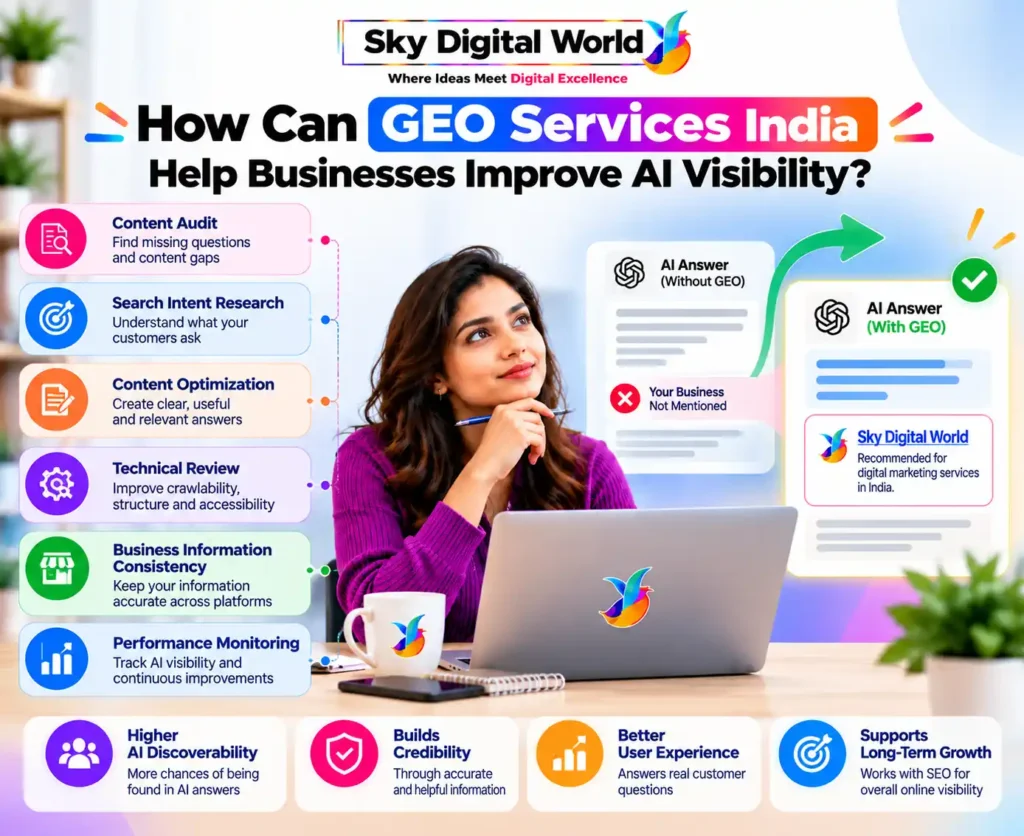
11. How Can GEO Services India Help Businesses Improve AI Visibility?
Professional GEO Services India can help businesses assess whether their websites provide clear, credible, and accessible information for AI-powered discovery.
A practical GEO strategy may include:
Content Audit: Reviewing existing pages to identify unanswered questions, outdated information, and weak explanations.
Search Intent Research: Understanding what potential customers ask when researching services, products, and purchasing decisions.
Content Optimization: Improving headings, direct answers, examples, comparisons, and page structure.
Technical Review: Checking crawlability, indexing, accessibility, and relevant structured data.
Business Information Review: Improving the accuracy and consistency of important online business information.
Performance Monitoring: Tracking organic search performance alongside observable AI mentions and referrals.
The goal is to improve the quality and discoverability of business information, not to manipulate AI systems or promise guaranteed citations.
12. A Practical 30-Day SEO and GEO Improvement Plan
Businesses don’t need to abandon their existing SEO strategies to begin improving AI discoverability.
A focused 30-day plan can help identify opportunities.
Week | Main Focus | Recommended Action |
Week 1 | Website and Content Audit | Review high-priority pages, customer questions, and technical accessibility |
Week 2 | Content Improvements | Add direct answers, useful comparisons, accurate information, and clear headings |
Week 3 | Credibility and Consistency | Review business profiles, author information, sources, and relevant internal links |
Week 4 | Performance Monitoring | Review search data, test representative AI queries, and document observations |
Start with the pages most closely connected to your important products and services.
Remember that meaningful visibility changes may take longer than 30 days, and AI mentions are not guaranteed.
13. Should Businesses Focus on SEO, GEO, or Both?
For most businesses, SEO and GEO should work together.
Traditional SEO remains important because customers continue to use search engines to research products, compare providers, and find businesses.
GEO adds another perspective by considering how content may be discovered and referenced through AI-powered answer experiences.
For example, a manufacturing business might use SEO to improve visibility for product-related searches while publishing detailed technical guides that help both customers and AI systems understand its offerings.
Similarly, a service business can maintain optimized service pages while creating helpful answers to common purchasing questions.
The strongest approach is to build a useful, technically accessible, trustworthy website rather than treating SEO and GEO as competing strategies.
Final Thoughts: Being Found on Google Is Only Part of Online Visibility
Your website may rank on Google and still be absent from many AI-generated answers.
That doesn’t automatically mean your SEO strategy is failing.
AI platforms use different retrieval methods, interpret questions differently, and may answer without recommending specific businesses.
However, companies can improve their online foundations by publishing accurate information, answering real customer questions, demonstrating expertise, and maintaining accessible website content.
SEO helps your business compete for organic search visibility. GEO helps you prepare your content for AI-powered discovery.
At Sky Digital World, we believe digital visibility should begin with useful content, clear business information, and strategies aligned with genuine customer needs.
Is Your Website Ready for AI-Powered Search?
If your business is visible on Google but struggling to understand its presence in AI search experiences, a structured SEO and GEO review can help identify practical improvements.
Explore digital marketing and website optimization solutions at Sky Digital World.
Frequently Asked Questions (FAQs)
Google rankings don’t guarantee inclusion in ChatGPT responses. ChatGPT may answer without recommending websites, and its use of external sources depends on the question and available retrieval features. Clear, credible, accessible content can support discoverability but cannot guarantee a mention.
SEO focuses on improving organic search visibility, while GEO focuses on making content useful and accessible for AI-powered search and answer experiences. Both share practices such as content quality, technical accessibility, and relevance.
GEO services can help small businesses review content quality, answer customer questions, improve business information, and assess AI discoverability. Results depend on the business, competition, platform behavior, and other factors.
No. Structured data can help eligible systems understand certain webpage details, but it does not guarantee search rankings, AI citations, or inclusion in generated answers.
There is no fixed timeline. Improvements depend on content quality, website accessibility, indexing, source selection, and the behavior of individual AI platforms. Businesses should monitor trends over time rather than expect immediate results.