



Why Is Your Website Getting Traffic but No Leads?
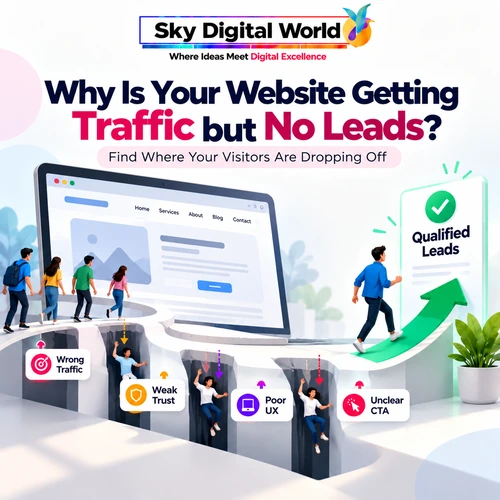
Why Is Your Website Getting Traffic but No Leads?
Getting more website traffic feels like progress. Your SEO rankings may be improving, Google is sending visitors to your pages, and people are discovering your business through search, social media, or paid campaigns.
But there is one problem:
The traffic is coming in, but the enquiries are not.
This is one of the most frustrating situations for a business. The website may receive hundreds or even thousands of visitors, yet the contact form remains quiet, WhatsApp conversations are limited, and sales opportunities do not increase.
The issue is often not traffic itself. It is the gap between visitor interest and conversion.
A simple way to understand it is:
Traffic → Relevance → Trust → Clear Value → Action → Lead
If any step in this journey is weak, visitors can leave without contacting your business.
This is where Website Conversion Optimization India becomes important. Instead of concentrating only on attracting more visitors, conversion optimization focuses on making the existing traffic more useful for business growth.
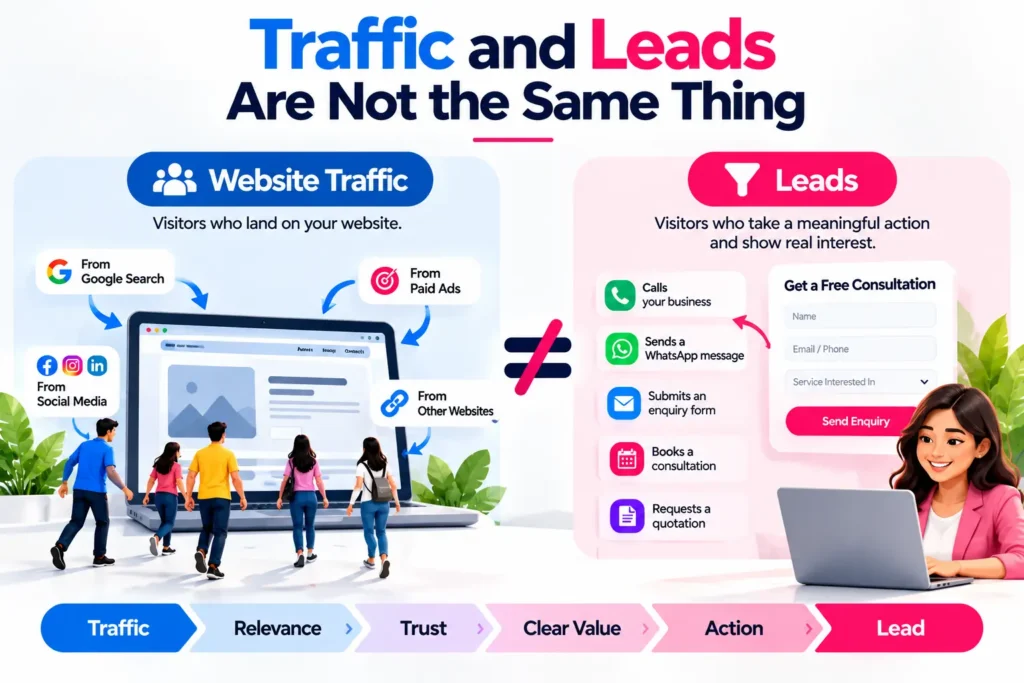
Traffic and Leads Are Not the Same Thing
A website visitor is simply someone who arrives on your website.
A lead is someone who takes a meaningful action, such as:
- submitting an enquiry form,
- calling your business,
- sending a WhatsApp message,
- requesting a quotation,
- booking a consultation,
- signing up for a demo,
- or starting a purchase.
This distinction matters because a website can generate impressive traffic numbers without producing meaningful business results.
Imagine two websites.
Website A: 10,000 visitors → 40 qualified enquiries
Website B: 3,000 visitors → 90 qualified enquiries
Website A has more traffic, but Website B may be creating significantly more business value.
That is why businesses should stop asking only:
“How much traffic are we getting?”
A better question is:
“What percentage of the right visitors are taking the next step?”
1. You May Be Attracting the Wrong Traffic
Not every visitor is a potential customer.
Suppose a digital marketing company wants enquiries from business owners but publishes articles that attract mostly students looking for free courses, definitions, templates, or job information.
The website traffic can grow significantly, but the number of potential customers may remain almost unchanged.
This happens when SEO focuses too heavily on search volume instead of search intent.
For example:
“What is SEO?”
This is mainly informational.
“SEO company for small business in India”
This shows stronger commercial intent.
“Hire SEO agency in India”
This indicates even stronger buying intent.
A good SEO strategy should attract visitors at different stages, but there needs to be a clear path from informational content to commercial pages.
Search Keyword → Search Intent → Relevant Page → Useful Information → Next Step
Traffic becomes valuable when it brings people who are genuinely relevant to your business.
2. Your Landing Page Does Not Match the Visitor’s Intent
Imagine someone searches for:
“Website redesign services for small businesses”
They click your result and reach a generic homepage talking about ten different services.
SEO. Social media. Branding. Video production. Mobile apps. Paid advertising.
The visitor now has to figure out whether you actually provide the service they searched for.
That creates unnecessary friction.
A better landing page would immediately communicate:
Website Redesign Services for Growing Businesses
followed by what you improve, who the service is for, examples of your work, your process, and a clear enquiry option.
The closer the page matches the visitor’s original search intent, the easier it becomes for them to continue.
Google itself recommends creating useful, people-first content that helps visitors achieve their goal rather than creating pages primarily to attract search traffic.
3. Your Website Does Not Build Enough Trust
People rarely enquire just because a website says:
“We are the best.”
Before contacting an unfamiliar company, visitors naturally look for evidence.
They want to know:
Can this business actually solve my problem?
Trust can be strengthened through genuine customer testimonials, detailed case studies, real project examples, client logos where permission exists, team information, business contact details, clear service processes and credible expertise.
Instead of writing:
We deliver outstanding digital marketing solutions.
show something meaningful:
See how we improved qualified enquiries for a service business by restructuring its landing pages and campaign journey.
Specific evidence is usually more convincing than generic marketing claims.
This also aligns with Google’s people-first content guidance, which emphasizes original information, demonstrated experience, expertise and trust.
4. Your Value Proposition Is Too Generic
Open your homepage and ask:
Within five seconds, can a new visitor understand what we do, who we help and why they should continue?
If not, the messaging needs work.
Statements such as:
“We provide innovative solutions.”
or
“Your trusted partner for growth.”
sound professional but communicate very little.
A stronger value proposition answers three questions:
What do you offer? → Who is it for? → What outcome does it support?
For example:
“Performance-focused digital marketing for businesses that want more qualified leads from search, social and paid campaigns.”
The message is clearer because visitors can quickly decide whether the service is relevant to them.
5. Your CTA Is Either Missing or Everywhere
Calls-to-action are essential, but adding ten different buttons does not necessarily improve conversions.
A page with:
Contact Us | Learn More | Get Started | Book Now | Download | Subscribe | Call | Explore | Chat
can create decision fatigue.
Instead, each important page should have one primary action.
For a service page, that might be:
Request a Consultation
A secondary option could be:
View Our Work
This creates a simpler journey:
Understand → Trust → Decide → Act
Your CTA should also appear at natural decision points instead of being randomly repeated throughout the page.
6. Your Contact Form Is Asking for Too Much
Someone interested in a first conversation may not want to complete a twelve-field form.
Company registration number. Full address. Annual revenue. Ten service selections. Detailed budget. Long project description.
Every additional requirement can create friction.
For many service businesses, an initial enquiry may only require:
Name + Phone/Email + Service Needed + Short Message
Additional qualification can happen later.
The objective of the first form is not to collect every possible detail.
It is to make starting a conversation easy.
7. Your Website Experience Is Slowing People Down
Conversion problems are not always caused by copy.
Sometimes the website itself gets in the way.
Slow loading, poor mobile layouts, buttons that are difficult to tap, intrusive pop-ups, confusing navigation and unexpected layout movement can all make visitors leave before taking action.
Google recommends looking at page experience holistically, including Core Web Vitals, secure delivery, mobile display and avoiding intrusive experiences.
For Core Web Vitals, Google’s current recommended targets include LCP within 2.5 seconds, INP below 200 milliseconds, and CLS below 0.1 for a good user experience.
A simple conversion principle is:
Less Friction → Easier Journey → Greater Opportunity to Convert
8. Your Content Answers the Question but Gives No Next Step
This is especially common with SEO blogs.
A visitor searches a question, finds your article, reads the answer and leaves.
The content did its informational job—but it never connected that information to the next stage of the customer journey.
Suppose you publish:
“Why Is My Website Not Ranking on Google?”
At the end of the article, the visitor could naturally be directed toward:
Technical SEO Audit → SEO Service → Consultation
Internal linking should therefore do more than help search engines understand pages.
It should help users continue their journey.
Blog → Related Guide → Service Page → Case Study → Enquiry
That turns isolated content into a conversion ecosystem.
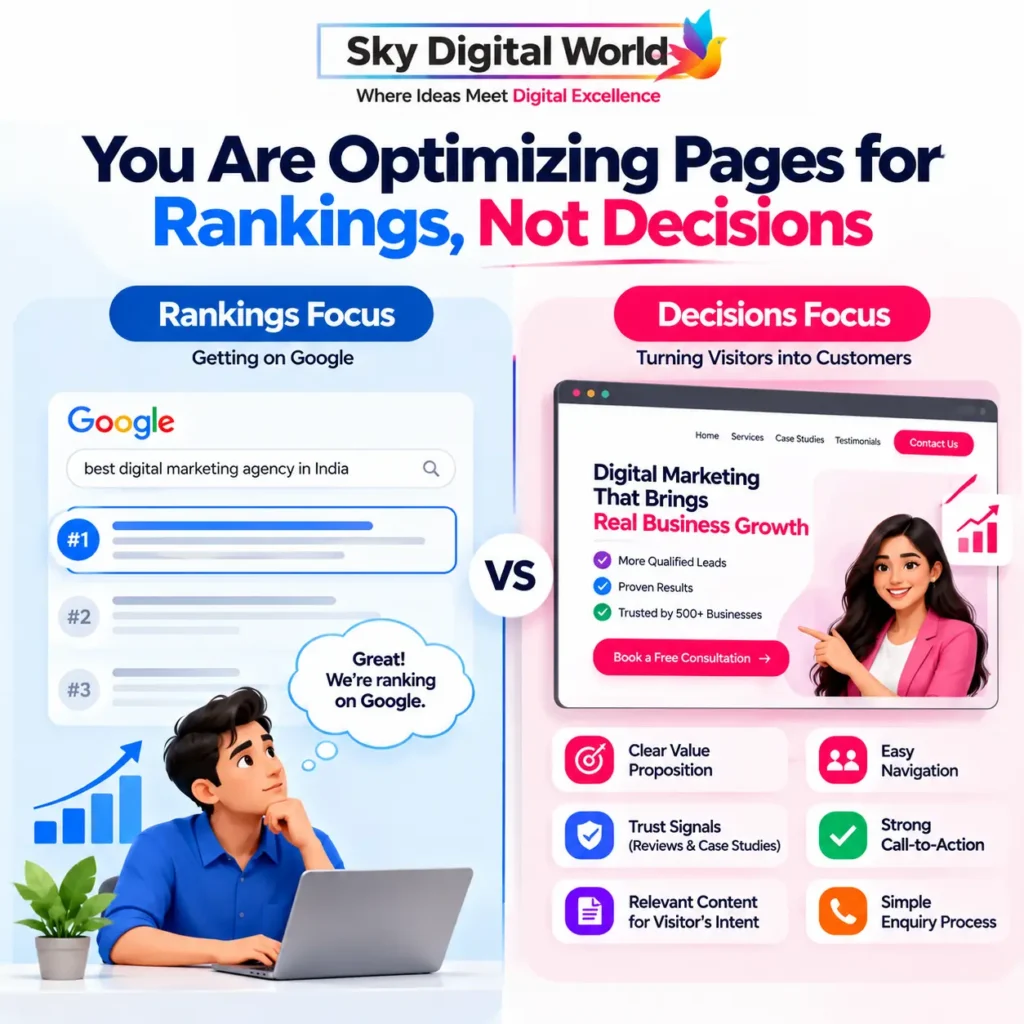
9. You Are Optimizing Pages for Rankings, Not Decisions
Ranking a page and converting a visitor require overlapping but different thinking.
SEO asks:
Can the right audience discover this page?
Conversion optimization asks:
Once they arrive, what will persuade them to act?
This is why Website Conversion Optimization India should work alongside SEO rather than after it.
A strong commercial page needs relevant keywords, useful content and crawlable structure, but it also needs clear positioning, benefits, proof, objection handling, intuitive navigation and a meaningful CTA.
Google’s Search Essentials similarly recommends helpful, reliable, people-first content while using the terms people actually search for in prominent places such as titles and headings.
So the objective should not be:
Keyword → Ranking → Traffic
It should become:
Search Intent → Ranking → Relevant Visitor → Trust → Action → Qualified Lead
10. You Are Measuring the Wrong Numbers
Traffic is useful, but it is not enough to judge business performance.
Businesses should look beyond sessions and pageviews.
Measure:
Traffic → Engaged Visitors → CTA Clicks → Form Starts → Enquiries → Qualified Leads → Customers → Revenue
This helps identify exactly where the journey is breaking.
For example, if traffic is high but CTA clicks are low, the problem may be messaging or offer clarity.
If CTA clicks are high but forms are rarely completed, the form may have too much friction.
If enquiries are high but qualified leads are low, the website may be attracting the wrong audience.
If qualified leads are strong but sales remain low, the issue may be happening after the website—in sales follow-up, pricing or qualification.
Conversion optimization works best when decisions are based on the complete journey rather than assumptions.
A Better Website Conversion Framework
Instead of redesigning random sections every few weeks, use a structured approach:
Attract the Right Visitor → Match Search Intent → Communicate Value → Establish Trust → Remove Friction → Present Clear CTA → Measure Behaviour → Test → Improve
This is the real purpose of Website Conversion Optimization India.
It is not simply about changing button colours or adding more pop-ups.
It is about understanding why people visit, what information they need before making a decision, what stops them from acting and how the website can make that decision easier.
Final Thoughts
More traffic is not always the solution to poor lead generation.
If your website already attracts visitors, increasing traffic without fixing conversion problems can simply mean sending more people into the same broken journey.
Start by examining the entire path:
Where did visitors come from?
What were they searching for?
Which page did they land on?
Did the page answer their question?
Was there enough trust?
Was the next action obvious?
Where did they leave?
The strongest digital strategy connects SEO and conversion instead of treating them as separate activities.
Relevant Traffic + Strong User Experience + Clear Value + Trust + Easy Action = Better Lead Generation
A website should not exist only to receive visits.
It should help the right visitor confidently take the next step.
FAQs
Common reasons include irrelevant traffic, poor search-intent alignment, unclear messaging, weak trust signals, confusing navigation, slow performance, complicated forms and unclear calls-to-action. Analyse the full visitor journey before simply trying to increase traffic.
Website conversion optimization is the process of improving website pages and user journeys so that more relevant visitors complete meaningful actions such as submitting an enquiry, requesting a quote, booking a consultation or making a purchase.
SEO can attract relevant visitors, but rankings alone do not guarantee conversions. Better results usually come from combining SEO with strong landing pages, useful content, trust signals, clear CTAs and a low-friction user experience.
Start with your highest-traffic commercial landing pages. Check search intent, traffic source, mobile experience, page speed, headline clarity, service information, trust signals, CTA visibility and enquiry-form friction.
For businesses already investing in SEO, paid ads or social media, conversion optimization can help make better use of existing traffic. Instead of focusing only on generating more visits, it improves the journey from visitor to qualified enquiry.