



How Can Businesses Reduce Dependence on Paid Ads?
How Can Businesses Reduce Dependence on Paid Ads?
Paid advertising can be an effective way to generate visibility, website traffic, and leads quickly. Google Ads, Meta Ads, LinkedIn Ads, and other advertising platforms can put a business in front of potential customers almost immediately.
But there is a challenge.
What happens when you stop paying?
In most cases, the paid traffic slows down or stops with the campaign. If advertising is the only reliable source of enquiries, a business may find itself continuously increasing its marketing budget just to maintain the same flow of opportunities.
The better approach is not necessarily to stop paid advertising.
It is to build enough organic visibility, useful content, brand authority, and direct customer demand that paid ads become one part of the marketing strategy rather than the entire strategy.
This is where Organic Marketing Services India can play an important role.
A sustainable digital marketing model can be understood as:
Search Visibility + Helpful Content + Brand Trust + Audience Relationships + Consistency = Stronger Organic Growth
Let’s explore how businesses can gradually reduce their dependence on paid advertising without sacrificing growth.
Why Do Businesses Become Too Dependent on Paid Ads?
Paid campaigns are attractive because they can generate results faster than many organic channels.
Launch a campaign, select an audience, set a budget, and traffic can start arriving.
Because of this speed, businesses sometimes keep increasing advertising budgets without developing other marketing assets.
The journey starts looking like this:
Ad Budget → Traffic → Leads → Sales
But when the budget stops:
No Ad Budget → Less Paid Visibility → Less Traffic → Fewer Leads
That creates dependency.
A stronger marketing system adds channels that can continue helping people discover the business beyond an individual advertising campaign.
SEO + Content + Local Search + Social Presence + Brand Demand + Email/CRM + Paid Ads
The objective is diversification, not simply replacing one channel with another.
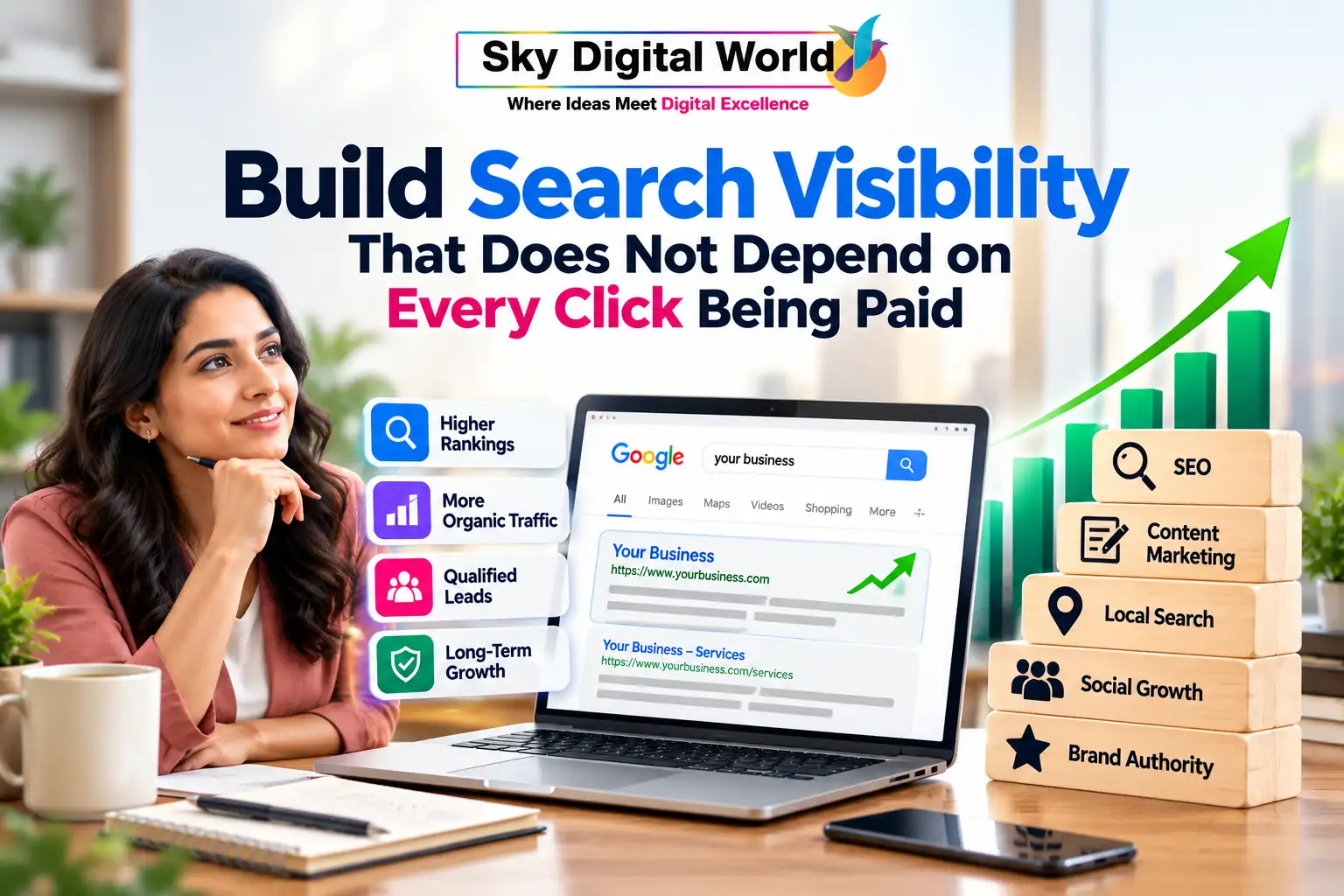
1. Build Search Visibility That Does Not Depend on Every Click Being Paid
Search engine optimization is one of the most important foundations of organic marketing.
When potential customers search for a product, service, problem, or solution, your website should have relevant pages that can be discovered naturally.
For example, a digital marketing agency might target searches such as:
Digital marketing services for small businesses
SEO services in India
How to generate leads online
Website conversion optimization
Local SEO services
Each search represents a different level of customer intent.
Instead of creating pages only around high-volume keywords, businesses should build content around real customer needs and questions.
A useful framework is:
Customer Problem → Search Query → Helpful Page → Trust → Next Step
Organic search usually requires more time than switching on an advertising campaign, but the content and website improvements you create can continue supporting visibility over time.
2. Create Content That Solves Real Customer Problems
Publishing blogs simply because “SEO needs content” is not enough.
Useful content should answer the questions potential customers ask before they make a decision.
Suppose you provide website development services.
Instead of publishing only:
“Benefits of Website Development”
you could answer more specific questions:
Why Is My Website Getting Traffic but No Leads?
How Much Should a Business Website Cost?
Should I Redesign My Website or Improve the Existing One?
Why Is My Website Slow on Mobile?
These topics are closer to real customer concerns.
A strong content strategy can follow:
Question → Useful Answer → Expertise → Related Service → Enquiry
When content genuinely helps users, it can support search visibility while also introducing potential customers to your expertise.
3. Build Topic Authority Instead of Publishing Random Blogs
One common mistake is publishing unrelated articles simply because certain keywords appear popular.
A better approach is to build content clusters around the services you actually want to grow.
For example, if SEO is an important service:
SEO Services
↓
Technical SEO
↓
Local SEO
↓
AI Search Optimization
↓
Keyword Strategy
↓
SEO Content
↓
Google Search Visibility
↓
SEO Case Studies
These connected resources help users explore a subject more deeply and make the website easier to navigate.
The same strategy can be used for web development, social media marketing, lead generation, branding, or other services.
Core Service → Customer Problems → Supporting Guides → Proof → Conversion Page
This creates a stronger organic marketing ecosystem than publishing disconnected articles.
4. Turn Your Website Into a Marketing Asset
Many businesses treat their website as an online brochure.
It contains a homepage, About page, Services page, and Contact page—but does very little to move visitors toward a decision.
An effective organic strategy requires more.
Your website should clearly communicate:
Who you help
What problem you solve
What services you provide
Why customers should trust you
What they should do next
Strong service pages, case studies, FAQs, testimonials, useful blogs, internal links, and clear calls-to-action can make organic traffic more valuable.
Because generating visitors is only half the job.
The real journey is:
Discovery → Website Visit → Understanding → Trust → Action → Lead
This is one reason Organic Marketing Services India should not focus only on increasing traffic. Organic marketing should also improve what happens after visitors arrive.
5. Strengthen Your Google Business Profile and Local Visibility
For businesses serving specific cities or locations, local search can become an important source of organic discovery.
Potential customers frequently search using location-based queries such as:
“digital marketing agency near me”
“SEO company in Indore”
“website development company near me”
A well-maintained Google Business Profile can support your visibility across Google Search and Maps.
Keep your business information accurate, select appropriate categories, add genuine photos, respond to reviews, maintain relevant business details, and make sure your website supports the same local positioning.
Local visibility works especially well when it connects:
Google Business Profile + Local Website Pages + Reviews + Consistent Business Information + Useful Local Content
For service-based businesses, this can reduce the need to pay for every local visitor.
6. Use Social Media to Build Recognition, Not Just Reach
Organic social media is sometimes judged only by likes and followers.
That misses its broader role.
Social platforms can help businesses repeatedly expose potential customers to their expertise, work, team, customer results, ideas, and point of view.
Instead of posting only promotional graphics, create a balanced mix:
Educational Content → Real Work → Customer Questions → Case Studies → Behind the Scenes → Industry Insights → Brand Stories
Someone may see your Instagram Reel today, read your blog next week, search your company name later, and contact you after reviewing your website.
That journey may not look like a direct social media conversion, but organic brand exposure contributed to the decision.
7. Build an Audience You Can Reach Again
One of the weaknesses of relying entirely on paid platforms is that the audience often belongs to the platform.
Businesses should also create ways to maintain direct relationships with interested prospects and existing customers.
Depending on the business, this could include:
Email subscribers, CRM leads, WhatsApp opt-ins, existing customers, community members, or registered users.
The goal is not to collect contacts and immediately send constant promotions.
Instead, provide useful updates, educational content, product information, relevant offers, or industry insights.
The journey becomes:
Visitor → Subscriber/Lead → Relationship → Trust → Opportunity
This means every future interaction does not necessarily require buying another advertising impression.
8. Build Brand Search Demand
One of the strongest signs of a growing brand is when people stop searching only for a category and start searching specifically for the company.
Instead of:
“digital marketing agency”
they may eventually search:
Brand demand can develop through consistent content, social visibility, referrals, customer experiences, PR, offline activity, video, community engagement, and word of mouth.
This matters because competitors can bid on broad advertising keywords, but they cannot easily recreate genuine customer familiarity with your brand.
A useful progression is:
Unknown Brand → Repeated Exposure → Recognition → Trust → Branded Search → Direct Enquiry
Building a recognizable brand is therefore an important part of reducing long-term paid media dependency.
9. Use Case Studies to Turn Expertise Into Proof
Businesses often say:
“We deliver great results.”
Potential customers naturally want to know:
“Can you prove it?”
Case studies answer that question.
A useful case study can explain:
Challenge → Strategy → Work Completed → Result → Learning
For example:
A local service business was receiving website visitors but very few qualified enquiries. The landing page was restructured around customer intent, trust signals were improved, and the enquiry journey was simplified.
Real examples make marketing more credible.
They can also support sales conversations, website conversions, organic search content, social media, email marketing, and proposals.
One successful project can therefore become several organic marketing assets.
10. Improve Conversion Before Chasing More Traffic
Businesses sometimes assume that they need more visitors when the bigger problem is that existing visitors are not converting.
Imagine:
5,000 Visitors → 25 Leads
Instead of immediately trying to generate 10,000 visitors, investigate why so few visitors are taking action.
Check:
- whether traffic matches your target customer,
- whether the landing page matches search intent,
- whether your value proposition is clear,
- whether sufficient trust signals are present,
- whether the CTA is easy to find,
- whether forms are unnecessarily complicated,
- and whether mobile users have a smooth experience.
A stronger conversion journey can make every marketing channel more valuable—including SEO, social media, referrals, and paid ads.
Better Traffic + Better Experience + Better Conversion = More Efficient Growth
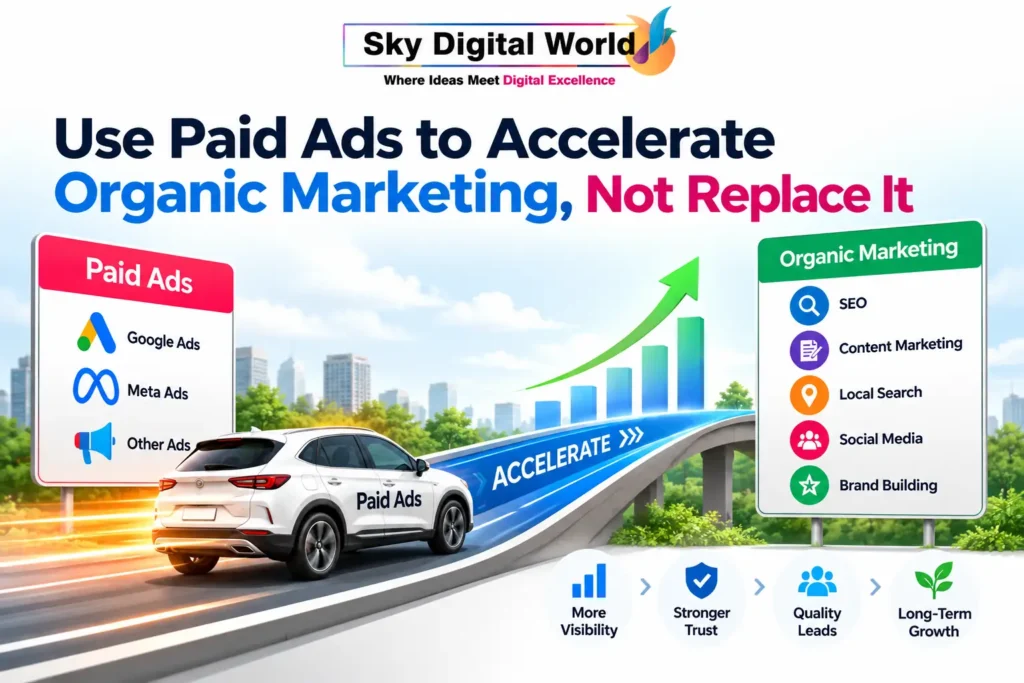
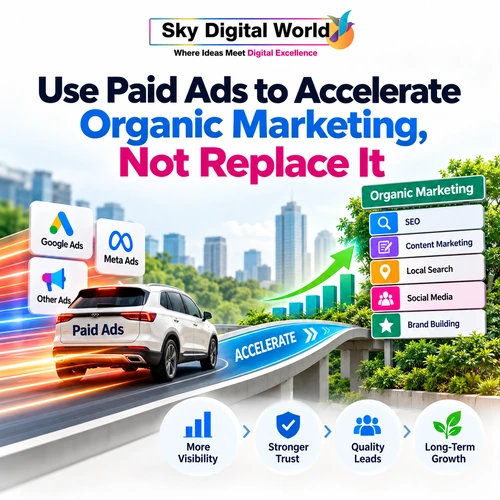
11. Use Paid Ads to Accelerate Organic Marketing, Not Replace It
Reducing dependence on paid advertising does not mean paid ads are bad.
Paid advertising can be extremely useful for launches, competitive keywords, retargeting, promotions, testing offers, reaching new audiences, and generating immediate demand.
The problem occurs when ads are expected to do everything.
A healthier strategy can look like:
Paid Ads = Immediate Reach
SEO = Search Visibility
Content = Education
Social Media = Awareness
Email/CRM = Relationship
Website = Conversion
Brand = Trust
When these channels work together, the business becomes less vulnerable to changes in one advertising platform.
12. Repurpose One Good Idea Across Multiple Organic Channels
Creating completely new content every day can become expensive and difficult.
Instead, businesses can build a content repurposing system.
For example, start with one detailed blog:
“How Can Businesses Reduce Dependence on Paid Ads?”
Then transform it into:
Blog → LinkedIn Post → Instagram Carousel → Short Reel → Email → FAQ → Google Business Profile Post
One strong idea can support several channels.
This makes organic marketing more manageable and helps reinforce the same expertise across different customer touchpoints.
How Can Organic Marketing Services India Help?
A professional Organic Marketing Services India strategy should not simply promise “free traffic.”
Organic marketing still requires investment in strategy, content, SEO, creative work, website improvements, analytics, and consistent execution.
The difference is that the investment is focused on building marketing assets and visibility that are not entirely dependent on paying for every click.
A comprehensive organic strategy may combine:
SEO + Content Marketing + Local SEO + Organic Social Media + Website Optimization + Brand Building + Email/CRM + Analytics
The exact combination depends on the business model, customer journey, competition, location, and growth goals.
A Practical Organic Growth Framework
Businesses looking to reduce paid-ad dependency can follow this process:
Understand Customer Demand → Improve Website → Build SEO Foundations → Create Useful Content → Strengthen Local Visibility → Build Social Presence → Capture Audience → Establish Trust → Measure Leads → Improve Continuously
Do not expect organic marketing to replace paid advertising overnight.
The transition should be gradual.
As organic channels become stronger, businesses can make more deliberate decisions about where paid advertising provides the greatest additional value.
Final Thoughts
The goal should not be:
“How do we stop spending money on ads?”
A better question is:
“How do we build a marketing system that can grow without depending entirely on ads?”
Paid advertising can provide speed. Organic marketing can build discoverability, authority, relationships, and brand recognition over time.
Businesses that combine both can create a more balanced acquisition strategy:
Paid Reach + Organic Visibility + Helpful Content + Brand Trust + Strong Conversion = Sustainable Digital Growth
With the right Organic Marketing Services India strategy, paid advertising can become a growth accelerator rather than the only source keeping the marketing engine running.
FAQs
It depends on the business model, competition, growth targets, and existing organic visibility. Many businesses benefit from combining paid and organic marketing rather than eliminating advertising completely.
SEO can help relevant pages become discoverable for searches potential customers already make. Over time, stronger organic visibility can provide another source of website traffic and enquiries alongside paid campaigns.
There is no universal timeline. Results depend on website condition, competition, market demand, content quality, existing authority, location, and execution. Organic growth is generally a long-term strategy rather than an instant traffic source.
Depending on the provider and business requirements, services may include SEO, content marketing, local SEO, organic social media, website optimization, brand development, email marketing, audience building, and performance analysis.
No. Organic marketing does not usually involve paying for every click or impression, but it still requires resources for strategy, SEO, content creation, website improvements, design, tools, analytics, and ongoing optimization.