



Search Is Changing: How Businesses Can Stay Visible Beyond Traditional Google Rankings in 2026
For years, digital visibility was often discussed in one simple way:
“Where does my website rank on Google?”
That question still matters—but in 2026, it is no longer enough on its own.
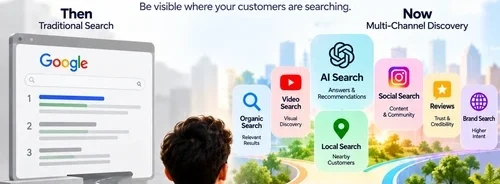
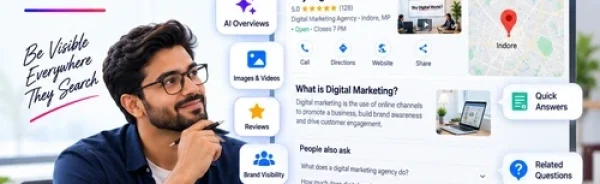
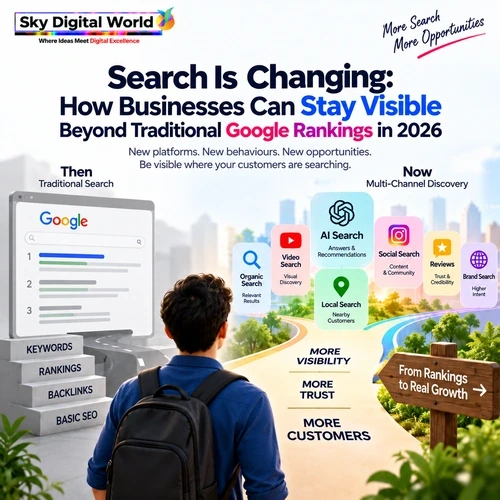
People now discover businesses through a much wider mix of digital experiences. They may see a brand in a traditional search result, encounter it in an AI-generated response, find a helpful video, notice a local business profile, read customer reviews, discover a social post or search directly for the brand after seeing it somewhere else.
The customer journey has become less like a straight road and more like a network of connected discovery points.
For businesses, this creates both a challenge and an opportunity.
The challenge is that being number one for a handful of keywords cannot represent your entire online presence.
The opportunity is that businesses now have more ways to become discoverable.
This is why modern Search Visibility Services India should look beyond individual keyword positions and focus on building a broader digital presence that helps a business become findable, recognizable and trustworthy wherever relevant customers are searching.
What Does Search Visibility Mean in 2026?
Search visibility is broader than website rankings.
It describes how easily a business, its expertise, products, services and useful information can be discovered when people search for relevant topics.
That visibility may come from:
- Traditional organic search results
- Local search and business profiles
- AI-assisted search experiences
- Featured or direct-answer formats
- Images and videos
- Maps and location-based discovery
- Branded searches
- Helpful third-party mentions
- Relevant social content
- Reviews and reputation signals
This does not mean traditional SEO has become irrelevant.
SEO remains an important foundation.
The difference is that businesses should stop thinking:
SEO = Ranking
and start thinking:
SEO + Content + Brand + AEO + Local + Reputation + User Experience = Search Visibility
That is a much more useful model for 2026.
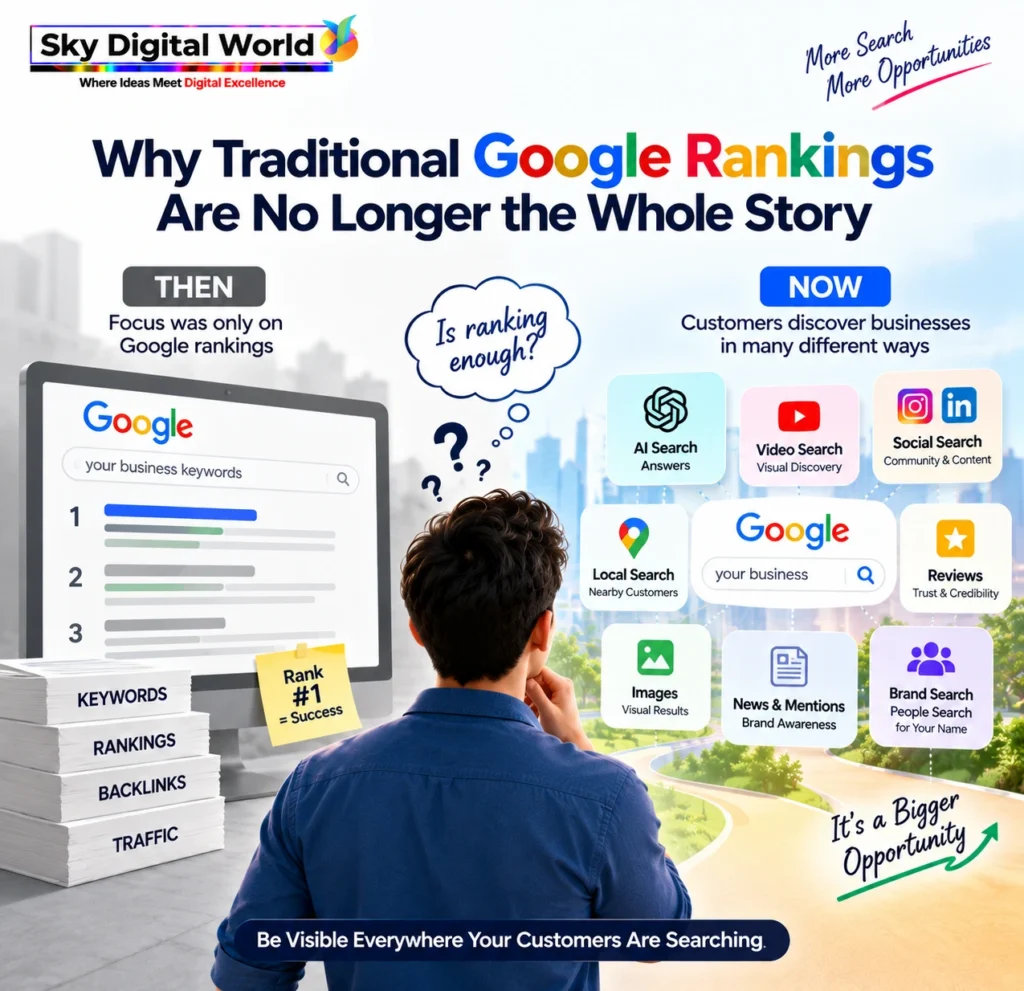
Why Traditional Google Rankings Are No Longer the Whole Story
Imagine that your business ranks third for an important keyword.
That sounds positive.
But what happens before the user reaches your result?
They may see a direct answer.
They may explore a local result.
They may watch a video.
They may refine their question.
They may search for reviews.
They may encounter another brand repeatedly across several touchpoints and eventually search for that company by name.
A ranking report showing “Position 3” cannot fully explain this journey.
Modern search performance therefore needs a broader question:
How often does our business appear in useful places during the customer’s research and decision-making journey?
That is the heart of modern search visibility.
1. Search Behaviour Is Becoming More Conversational
People increasingly search using complete questions.
Instead of:
someone might ask:
“How do I choose an SEO company for a manufacturing business?”
Instead of:
“digital marketing cost”
they may ask:
“What digital marketing budget should a growing business start with?”
This matters because longer, conversational searches reveal more about what the person actually needs.
Businesses should therefore build content around:
Questions → Problems → Intent → Decisions
not just keyword variations.
The goal is to understand the person behind the query.
2. AI-Powered Discovery Is Changing How Information Is Consumed
AI-assisted search can help users explore a subject without following the traditional pattern of opening ten different pages individually.
For businesses, this means content needs to do more than simply contain a target keyword.
It should be:
Clear – Can the main idea be understood quickly?
Accurate – Are the claims reliable and current?
Structured – Is information logically organized?
Useful – Does it genuinely solve the reader’s problem?
Specific – Does it provide meaningful detail rather than generic statements?
Credible – Is there a trustworthy business, author or source behind it?
AI may change the interface through which people find information, but the underlying value of good information remains extremely important.
3. Zero-Click Searches Change the Meaning of Visibility
Not every search results in a website visit.
Sometimes people get enough information directly from the search experience to make their next decision.
That might sound negative for businesses focused entirely on traffic.
But consider another possibility.
A customer repeatedly encounters your:
- Business name
- Expert explanation
- Product
- Review
- Local listing
- Video
- Useful content
They may not click immediately.
Later, they search directly for your company.
This means marketers should distinguish between:
Traffic visibility and brand visibility.
Traffic remains valuable, but discovery can also contribute to recognition and future demand.
4. Brand Authority Is Becoming Part of Search Visibility
Consider two websites publishing similar information.
One belongs to a recognizable business with:
- Consistent branding
- Clear company information
- Experienced authors or team members
- Useful resources
- Genuine customer reviews
- Industry mentions
- Strong service pages
- A maintained digital presence
The other is anonymous, generic and offers little evidence of real-world expertise.
Which one would you feel more comfortable contacting?
Visibility without trust has limited commercial value.
That is why Search Visibility Services India should not treat branding as something completely separate from SEO.
A stronger search strategy should help customers answer two questions:
“Can I find this business?”
and
“Can I trust this business?”
5. Your Website Is Still the Digital Foundation
With AI search, social platforms and other discovery channels receiving attention, some businesses may wonder whether websites are becoming less important.
A strong website remains extremely valuable.
Your website is one of the few digital spaces where you can organize your complete business story.
It can explain:
- Who you are
- What you offer
- Who you serve
- Where you operate
- Why customers should consider you
- What expertise you have
- What questions you can answer
- How someone can contact you
Think of your website as the digital headquarters of your brand.
Other platforms can introduce people to you.
Your website should help them understand you.
6. Build Content Around Customer Problems, Not Just Keywords
Traditional keyword research is useful, but it should not become the only source of content ideas.
Talk to the people closest to your customers.
Ask your sales team:
What questions come up before someone buys?
Ask customer support:
What confuses customers most often?
Ask your business development team:
What objections repeatedly delay decisions?
Then create useful resources around those questions.
For example, instead of publishing:
“Best SEO Services India”
a digital marketing company could create:
“SEO vs Google Ads: Which Should a Growing Business Invest in First?”
Instead of:
“Website Development Company”
create:
“What Should a Business Check Before Redesigning an Old Website?”
These topics are closer to real customer decisions.
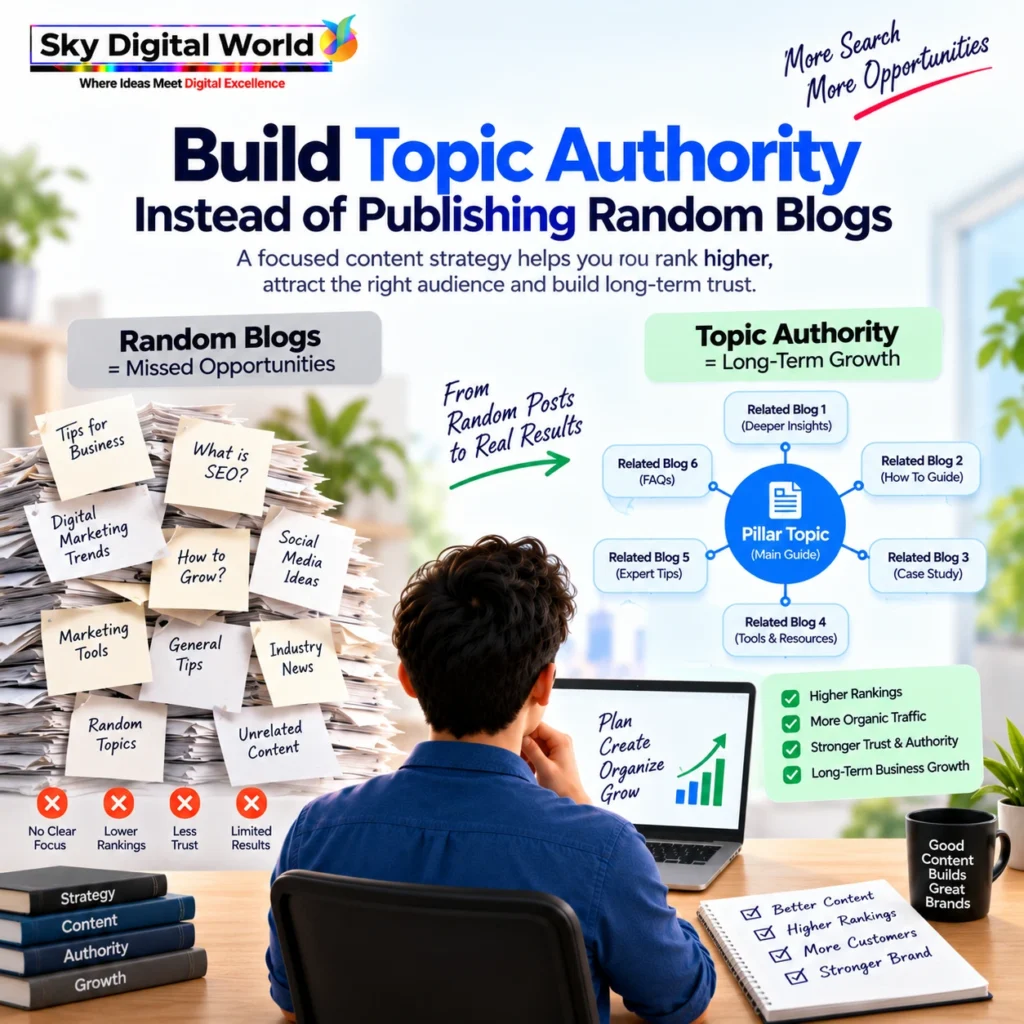
7. Build Topic Authority Instead of Publishing Random Blogs
One common SEO mistake is publishing unrelated articles simply because individual keywords show search volume.
A stronger approach is to build topic clusters.
Suppose your main subject is:
Search Visibility
You could build supporting content around:
- Search Engine Optimization
- Answer Engine Optimization
- Generative Engine Optimization
- Google AI Search
- Zero-Click Search
- Local SEO
- Brand Authority
- Search Intent
- Content Strategy
- Technical SEO
- Digital PR
- Online Reputation
- Conversion Optimization
Each page answers a specific question while connecting naturally to related resources.
Over time, the website becomes a useful knowledge structure rather than a collection of disconnected articles.
8. Answer Engine Optimization Should Complement SEO
As people ask more conversational questions, Answer Engine Optimization (AEO) becomes relevant.
AEO focuses on making information easier to understand and useful for answer-focused search experiences.
For example, instead of beginning an article with six paragraphs of generic introduction, answer the core question early.
Then provide:
Direct answer → Explanation → Example → Evidence → Related questions → Next step
This improves readability for people while creating a cleaner information structure.
AEO should not replace SEO.
It should strengthen it.
9. Generative Engine Optimization Is Part of the Bigger Picture
Another term businesses increasingly encounter is Generative Engine Optimization (GEO).
GEO generally refers to improving the quality, clarity and credibility of content and brand information for generative AI environments.
But businesses should avoid treating GEO as a shortcut for “getting mentioned by AI.”
There is no magic paragraph format that guarantees inclusion in every generative response.
A sustainable approach is much less glamorous—but much more useful:
Publish accurate information.
Demonstrate expertise.
Make your brand understandable.
Build credible references and mentions.
Keep important information current.
Create genuinely useful resources.
These practices support a stronger digital presence regardless of how individual search interfaces evolve.
10. Local Search Remains Essential
For businesses serving specific cities or regions, local visibility can be as important as national keyword rankings.
Imagine a person looking for:
“digital marketing agency near me”
or
“steel manufacturer in Madhya Pradesh.”
The business needs more than a blog post.
Its local digital presence should clearly communicate:
- Business name
- Location
- Service areas
- Services
- Contact information
- Opening hours where applicable
- Customer reviews
- Business categories
- Relevant website pages
A well-maintained local presence helps customers understand whether the business is relevant to their location and needs.
11. Video and Visual Search Create Additional Discovery Opportunities
Search is increasingly visual.
Sometimes the best answer to a question is not a 2,000-word article.
It may be:
- A 60-second explanation
- A product demonstration
- A comparison graphic
- A tutorial
- A short expert video
- An infographic
- A before-and-after example
Businesses should think about how one useful idea can be communicated in multiple formats.
For example:
One Research Topic
↓
Detailed Blog
↓
Short Video
↓
Social Carousel
↓
FAQ
↓
Infographic
↓
Email Insight
This is not about copying the same content everywhere.
It is about adapting one valuable idea to the way different audiences prefer to consume information.
12. Online Reputation Can Influence Discovery and Decisions
Getting discovered is only half the journey.
Once customers discover a business, they often investigate it.
They may look at:
- Reviews
- Testimonials
- Social profiles
- Business listings
- Case studies
- Website quality
- Team information
- Third-party mentions
If the search presence is strong but the reputation looks weak or inconsistent, potential customers may hesitate.
Search visibility therefore needs to connect with reputation management.
A business should aim to be:
Easy to find → Easy to understand → Easy to verify → Easy to trust
That sequence is increasingly important.
13. Digital PR and Brand Mentions Matter
Businesses sometimes think backlinks are the only reason to seek external coverage.
But a relevant brand mention can also contribute to awareness and credibility.
Useful external visibility might come from:
- Industry publications
- Business directories
- Trade associations
- Expert interviews
- Podcasts
- Local media
- Partner websites
- Event coverage
- Research citations
- Community resources
The focus should be relevance and credibility—not generating hundreds of artificial mentions.
Good digital PR helps build a real digital footprint around the brand.
14. Branded Search Is an Important Signal to Watch
There is a major difference between someone searching:
“digital marketing agency India”
and:
“Sky Digital World SEO services”
The second person already knows the brand.
That recognition may have come from a blog, social post, recommendation, video, advertisement, event, review or previous search.
Tracking branded search behaviour can therefore help businesses understand whether overall brand awareness is growing.
A successful search strategy should not only compete for existing generic demand.
It should also help create brand recognition.
15. Technical SEO Still Matters
Modern search trends do not eliminate technical fundamentals.
A brilliant article cannot perform at its best if the website is difficult to crawl, extremely slow or poorly structured.
Businesses should continue paying attention to areas such as:
- Crawlability
- Indexability
- Site architecture
- Internal linking
- Mobile usability
- Page performance
- Canonicalization
- Sitemaps
- HTTPS
- Duplicate content
- Structured data where appropriate
The exciting parts of modern search depend on a technically sound foundation.
Think of technical SEO as the plumbing of your digital presence.
People may not celebrate it, but problems become obvious when it stops working.
16. Search Visibility Must Lead Somewhere Useful
More impressions are not automatically more business.
If someone discovers your company, what happens next?
A strong website should make the next step obvious.
Depending on the business, that could be:
- Read a related guide
- Compare services
- View a case study
- Explore a product
- Request a quotation
- Book a consultation
- Call the company
- Visit the location
- Submit an enquiry
This is where search visibility and conversion optimization meet.
The journey should feel natural:
Discover → Understand → Trust → Explore → Act
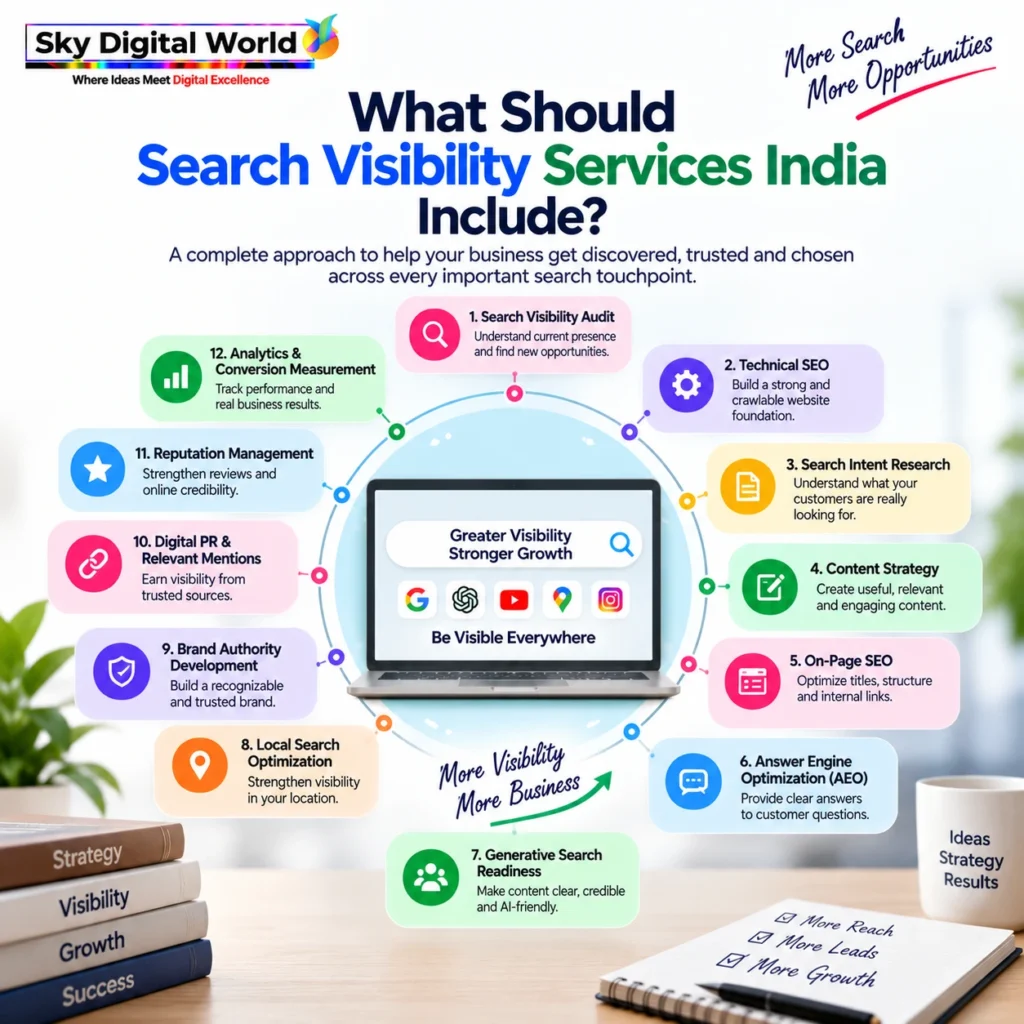
What Should Search Visibility Services India Include?
Businesses evaluating Search Visibility Services India should look beyond a package promising a fixed number of keywords.
A modern search visibility strategy can include:
1. Search Visibility Audit
Understanding where the business currently appears and identifying important gaps.
2. Technical SEO
Building a crawlable, accessible and well-organized website foundation.
3. Search Intent Research
Understanding what potential customers are genuinely trying to accomplish.
4. Content Strategy
Creating useful content around customer questions, problems and decisions.
5. On-Page SEO
Improving page titles, headings, internal links, content structure and relevance.
6. Answer Engine Optimization
Structuring information to clearly answer important customer questions.
7. Generative Search Readiness
Improving content clarity, expertise, brand information and digital credibility for evolving AI-assisted discovery.
8. Local Search Optimization
Strengthening visibility for geographically relevant searches.
9. Brand Authority Development
Building a recognizable and credible digital identity.
10. Digital PR and Relevant Mentions
Earning legitimate visibility from trusted external sources.
11. Reputation Management
Monitoring and strengthening the information customers use to evaluate the business.
12. Analytics and Conversion Measurement
Connecting visibility with enquiries, leads, customers and other meaningful outcomes.
The important point is integration.
These activities should support one another instead of operating as isolated marketing tasks.
What Should Businesses Measure Beyond Rankings?
Rankings remain useful—but they should be one part of the dashboard.
Businesses can also monitor:
Metric | What It Helps You Understand |
Search impressions | How often your content is being surfaced |
Organic clicks | How often search visibility generates visits |
Qualified organic traffic | Whether relevant audiences are arriving |
Branded searches | Whether brand awareness is increasing |
Non-branded visibility | Whether new audiences can discover you |
Local visibility | Whether nearby customers can find the business |
Engagement | Whether visitors find the content useful |
Conversions | Whether visibility produces meaningful actions |
Leads | Whether search contributes to enquiries |
Brand mentions | Whether the brand is being discussed elsewhere |
Returning visitors | Whether users come back after discovering you |
The most important metrics depend on the business model.
A local service provider, e-commerce store and B2B manufacturer should not necessarily use exactly the same success criteria.
Common Search Visibility Mistakes to Avoid in 2026
Chasing Rankings Without Understanding Intent
A high ranking for an irrelevant query provides little business value.
Publishing AI Content Without Expert Review
Speed does not compensate for inaccurate, generic or misleading information.
Creating Hundreds of Thin Location Pages
Location relevance requires useful, differentiated information—not city names swapped into identical templates.
Ignoring Brand Search
Generic keywords are valuable, but growing recognition can create another source of demand.
Treating AEO and GEO as Magic Tricks
Neither should be reduced to hacks designed to manipulate AI systems.
Ignoring the Website
Your website remains an important source of business information, expertise and conversion opportunities.
Measuring Only Traffic
Visibility should ultimately support meaningful business outcomes.
A Practical Search Visibility Framework for 2026
Businesses do not need to make modern search unnecessarily complicated.
Use this framework:
Step 1: Be Understandable
Clearly explain who you are, what you offer and whom you help.
Step 2: Be Useful
Answer genuine customer questions better.
Step 3: Be Technically Accessible
Maintain a strong website foundation.
Step 4: Be Consistent
Keep your business information accurate across relevant digital touchpoints.
Step 5: Be Credible
Demonstrate expertise, experience, reputation and proof.
Step 6: Be Discoverable
Use SEO, AEO, local search, content, video and other relevant channels.
Step 7: Be Memorable
Build a recognizable brand rather than depending entirely on generic searches.
Step 8: Be Measurable
Connect visibility with leads, conversions and business growth.
In simple terms:
Useful Content + Technical Quality + Search Understanding + Brand Authority + Reputation + Strong UX = Sustainable Search Visibility
The Future of Search Visibility Is Bigger Than a Blue Link
The future of search is unlikely to be defined by one format.
Customers may move between traditional results, AI-assisted discovery, local search, videos, social content, reviews and branded searches before making a decision.
Businesses therefore need to stop asking only:
“Are we ranking?”
A better set of questions is:
Are we being discovered?
Are we answering the right questions?
Do people recognize our brand?
Does our information demonstrate expertise?
Can customers verify and trust us?
Does our visibility create meaningful opportunities?
Those questions reveal far more about digital performance.
Final Thoughts
Search is changing, but the objective of good marketing remains surprisingly familiar:
Help the right people find the right information at the right time.
In 2026, achieving that goal requires businesses to look beyond traditional Google rankings.
SEO still matters. Rankings still matter. Website traffic still matters.
But so do AI-assisted discovery, Answer Engine Optimization, brand authority, local visibility, helpful content, reputation, digital PR, video, user experience and conversions.
The businesses that adapt successfully will not necessarily be those chasing every new search trend.
They will be the businesses building a digital presence that remains useful even as the interface changes.
That is what modern Search Visibility Services India should ultimately help achieve:
Not visibility in one ranking report—but a stronger chance of being discovered, understood, remembered and chosen across the customer’s entire search journey.
FAQs
1. What is search visibility in 2026?
Search visibility refers to how easily a business, its content, products, services and expertise can be discovered across relevant digital search experiences. It can include traditional organic results, local search, AI-assisted discovery, videos, images, branded searches and other relevant touchpoints.
2. Why are traditional Google rankings no longer enough?
Google rankings remain important, but customers can now discover businesses through many different search experiences. A business may appear through local results, AI-generated answers, videos, reviews or branded searches before a customer ever visits its website.
3. What are Search Visibility Services India?
Search Visibility Services India can include technical SEO, keyword and search-intent research, content strategy, on-page SEO, Answer Engine Optimization, local SEO, brand authority development, digital PR, reputation management and performance measurement.
4. Is SEO still important in 2026?
Yes. SEO remains an important foundation for online visibility. Technical quality, useful content, search intent, internal linking, crawlability and website structure still matter, but SEO increasingly works alongside AEO, brand building, local optimization and other discovery strategies.
5. What is the difference between SEO and search visibility?
SEO primarily focuses on improving organic search performance, while search visibility is a broader concept. It considers how often and where a business can be discovered throughout a customer’s search journey, including organic results, local listings, AI-assisted experiences and branded searches.