




Google AI Overview Optimization: The New SEO Strategy Businesses Need in 2026
Google Search is no longer just a list of websites competing for the first position. In 2026, search is becoming more conversational, contextual, and AI-driven. Users increasingly expect Google to understand a complete question and provide useful information without requiring them to open several pages first.
One of the biggest changes behind this shift is Google AI Overviews.
For businesses, this creates a new SEO challenge. Ranking on the first page remains important, but brands also need content that search systems can clearly understand, evaluate, and potentially surface within AI-powered search experiences.
This emerging approach is often described as Google AI Overview SEO.
It does not replace traditional SEO. Instead, it expands SEO by placing greater emphasis on useful answers, topical depth, brand credibility, structured information, and genuine expertise.
What Is Google AI Overview SEO?
Google AI Overview SEO is the process of optimizing website content so that it is useful for traditional organic search while also being clear, relevant, credible, and well-structured for AI-assisted search experiences.
Traditional SEO often asks:
“How can this page rank for a keyword?”
AI-focused SEO adds another question:
“Does this page provide information that clearly and reliably answers what the searcher actually wants to know?”
That difference is important.
A page cannot become valuable simply by repeating the target keyword. It needs to demonstrate that the business understands the subject and can provide information that helps users make better decisions.
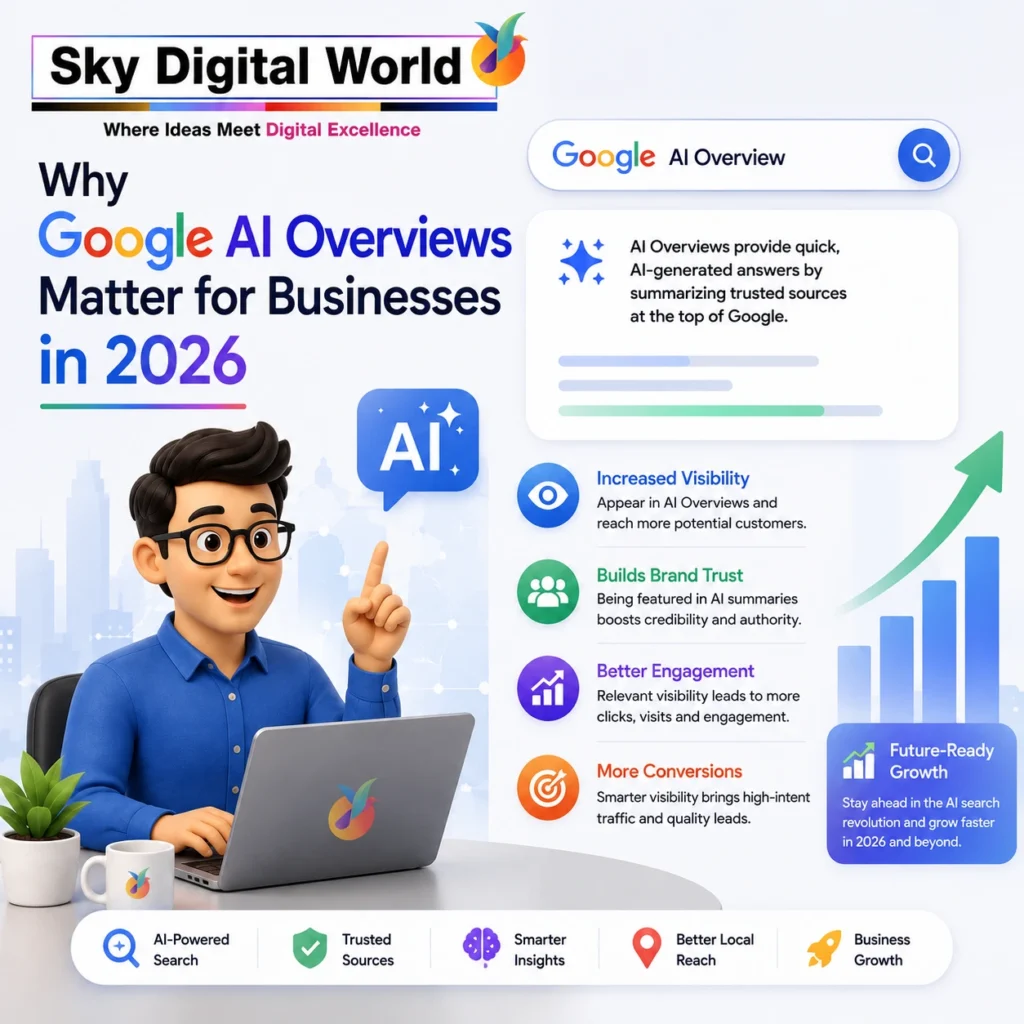
Why Google AI Overviews Matter for Businesses in 2026
Imagine someone searches:
“What is the best digital marketing strategy for a local business with a limited budget?”
This is more complex than a simple keyword such as “digital marketing services.”
An AI-assisted search experience may interpret the user’s intention, summarize relevant considerations, and help the user explore the topic before they decide which websites to visit.
This changes the customer journey.
A potential customer may now encounter information about your industry before reaching a traditional organic result or service page. Businesses therefore need to think about search visibility across the entire discovery journey, rather than concentrating only on one keyword position.
Strong AI search visibility can support:
- Brand discovery
- Topical authority
- Customer education
- Organic visibility
- Qualified website traffic
- Brand trust
- Long-term search presence
However, there is no guaranteed method for getting a page included in an AI Overview. Businesses should therefore focus on improving overall search quality rather than chasing guaranteed AI placements.
Traditional SEO vs Google AI Overview SEO
Traditional SEO and AI search optimization share the same foundation, but the way content is developed is evolving.
Traditional SEO focuses heavily on keyword research, crawlability, indexing, backlinks, page optimization, technical performance, and organic rankings.
Google AI Overview SEO retains these elements while placing additional importance on:
Clear answers: Information should address the user’s question without unnecessary filler.
Context: A page should explain the subject thoroughly instead of mentioning a keyword repeatedly.
Authority: Businesses should demonstrate genuine knowledge of the subjects they discuss.
Structure: Information should be logically organized with meaningful headings and sections.
Original value: Content should contribute useful perspectives rather than simply rewriting what competitors have already published.
Trust: Important claims should be accurate and supported where necessary.
The strongest SEO strategy in 2026 therefore combines traditional search optimization with content designed for a more AI-assisted search environment.
Search Intent Is Becoming More Important Than Keyword Density
Older SEO strategies sometimes treated keyword repetition as a shortcut to relevance.
That approach is increasingly ineffective.
Consider these searches:
“AI SEO”
“Google AI Overview SEO”
“How do I optimize my website for Google AI Overviews?”
“Can a local business appear in AI-generated Google results?”
They are related, but they do not represent exactly the same intent.
A good article recognizes these differences and provides useful information around the broader topic.
Instead of forcing into every paragraph, businesses should create content that naturally answers the questions surrounding the subject.
This makes the article more readable while also establishing stronger topical relevance.
Answer Important Questions Early
People do not want to read 800 words before discovering the answer to a basic question.
When a section asks:
What is Google AI Overview optimization?
Answer it immediately.
Then provide the deeper explanation.
This simple content structure works particularly well for informational searches:
Question → Direct Answer → Explanation → Example → Next Step
For example:
What is AI search optimization?
AI search optimization is the practice of making online content easier to understand, evaluate, and surface across AI-assisted search experiences while maintaining established SEO fundamentals.
The article can then explain how it works.
This makes content easier for readers to scan and understand.
Build Topic Clusters Instead of Publishing Random Blogs
Publishing more content does not automatically create authority.
A digital marketing company might publish 100 unrelated blogs and still have weaker topical depth than a competitor with 30 carefully connected resources.
A better strategy is to build topic clusters.
For example, an AI SEO cluster could include pages covering:
Google AI Overview SEO
AI Search Optimization
SEO Trends in 2026
Content Marketing for AI Search
Technical SEO
Local SEO
Google Business Profile Optimization
Search Intent Optimization
Structured Data
Website Authority
These articles can link naturally to one another.
This creates a connected knowledge structure rather than a collection of isolated posts.
Original Experience Is Becoming a Competitive Advantage
Generic content is everywhere.
Thousands of websites can explain that “SEO improves visibility” or “content builds authority.”
Businesses need something more useful.
If your company has real experience managing SEO campaigns, your content can explain what your team actually observes.
For example:
A service business may receive substantial organic traffic but very few enquiries because the page ranks for informational searches rather than commercial searches.
Another website may publish excellent content but struggle to gain visibility because important pages are poorly connected through internal links.
A local business might have a strong website but weak local visibility because its website information and business profile do not clearly reinforce the same location and services.
These practical observations provide value that generic content cannot easily replicate.
That is particularly important as search becomes increasingly capable of summarizing basic information.
Create Content Around Real Customer Questions
Your sales conversations can become an excellent SEO research source.
If customers regularly ask:
“Why isn’t my website ranking?”
“How long does SEO take?”
“Can AI-generated content rank?”
“Will AI Overviews reduce website traffic?”
“Do I still need blogs in 2026?”
“How can my business appear in AI search?”
Those questions represent genuine information needs.
Instead of creating articles only from keyword tools, combine keyword research with questions received through sales calls, WhatsApp conversations, emails, social media comments, and customer meetings.
This creates content around real search behaviour and business problems.
Strengthen E-E-A-T Signals Across Your Website
Quality content becomes more convincing when visitors can understand who is behind it.
Businesses should therefore pay attention to broader trust and credibility signals.
Your website should clearly communicate:
- Who the business is
- What services it provides
- Where it operates
- How customers can contact it
- Who creates or reviews important content
- What experience supports its claims
- Whether service and company information is consistent across the website
Case studies, genuine testimonials, author information, original examples, professional service pages, and transparent business details can all strengthen credibility when used appropriately.
The objective is not to manufacture authority.
It is to make genuine expertise easier to recognize.
Technical SEO Still Matters in the AI Era
Excellent writing cannot compensate for a website that search engines struggle to crawl or understand.
Businesses should continue maintaining core technical SEO fundamentals, including:
Indexability: Important pages should be accessible for indexing.
Internal linking: Relevant pages should connect logically.
Mobile usability: Content should work properly on mobile devices.
Page experience: Websites should be fast, stable, and easy to navigate.
Canonicalization: Duplicate or similar pages should be managed appropriately.
XML sitemaps: Important URLs should be discoverable.
HTTPS: Websites should use secure connections.
Structured data: Valid markup can help search engines interpret eligible content types.
AI search optimization should sit on top of good technical SEO, not replace it.
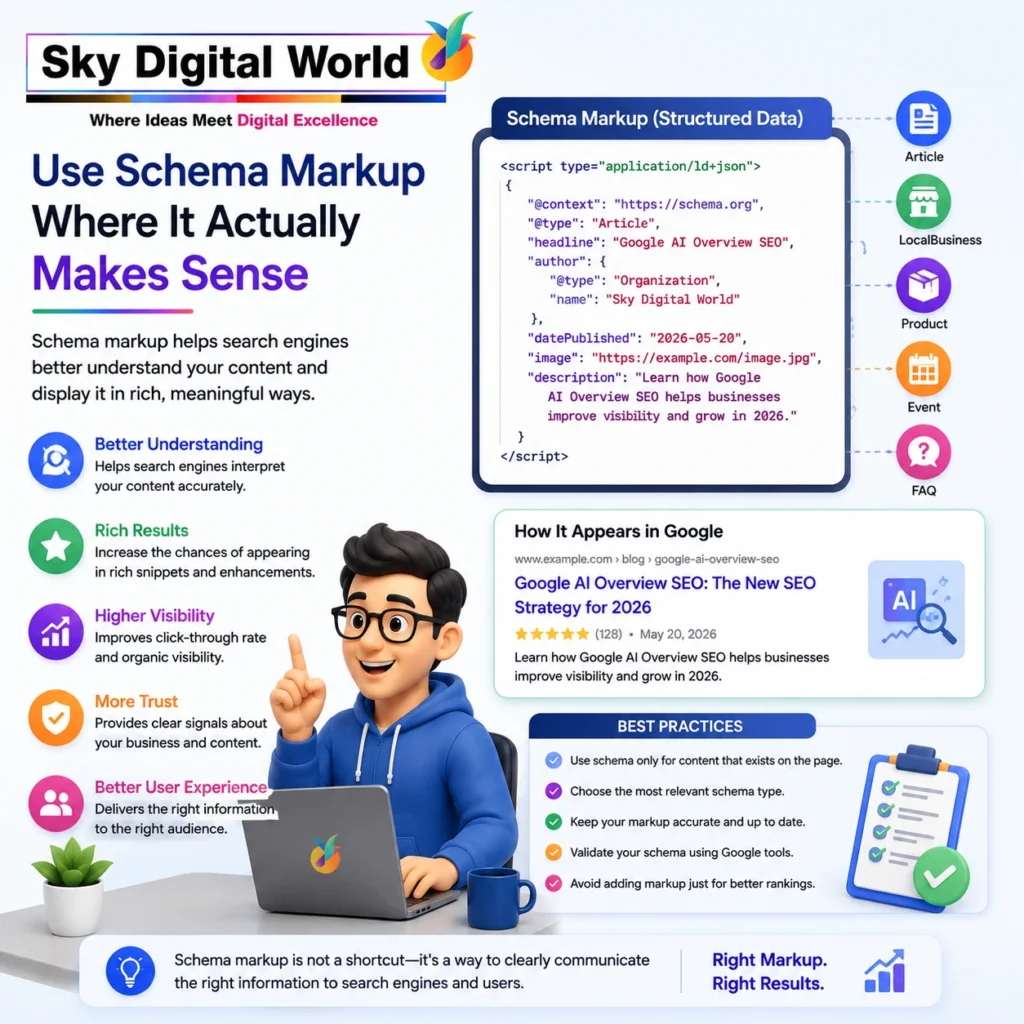
Use Schema Markup Where It Actually Makes Sense
Structured data helps provide machine-readable context about certain information on a webpage.
Depending on the website and page type, relevant structured data might include:
Article, Organization, LocalBusiness, Product, Breadcrumb, Event, or other supported schema types.
But businesses should avoid adding unnecessary markup simply because they believe it will make them appear in AI Overviews.
Schema should accurately represent visible page content.
Think of structured data as clarification, not manipulation.
Local Businesses Should Combine AI SEO With Local SEO
AI search does not make local optimization irrelevant.
A customer looking for a nearby agency, restaurant, clinic, real estate company, manufacturer, or service provider may still rely heavily on location-specific information.
Local businesses should maintain accurate business details, useful location pages where genuinely necessary, customer reviews, locally relevant content, Google Business Profile information, and consistent service information.
For an agency offering Google AI Overview SEO in India, for example, broader national content can be supported by relevant service pages and local expertise where the company actually operates.
This creates stronger context without creating dozens of thin city pages merely to target keywords.
AI-Generated Content Needs Human Value
AI can make content production faster, but publishing raw AI output at scale is not an SEO strategy.
Businesses can use AI for research organization, outlines, topic discovery, content briefs, editing assistance, FAQ discovery, and idea generation.
But valuable final content should still reflect:
Human expertise + Business knowledge + Customer understanding + Editorial review
Before publishing, ask:
Does this article say anything useful?
Is the information accurate?
Does it answer the searcher’s question?
Does it contain unnecessary repetition?
Could another website publish exactly the same article without changing anything?
If the last answer is yes, the content probably needs more original value.
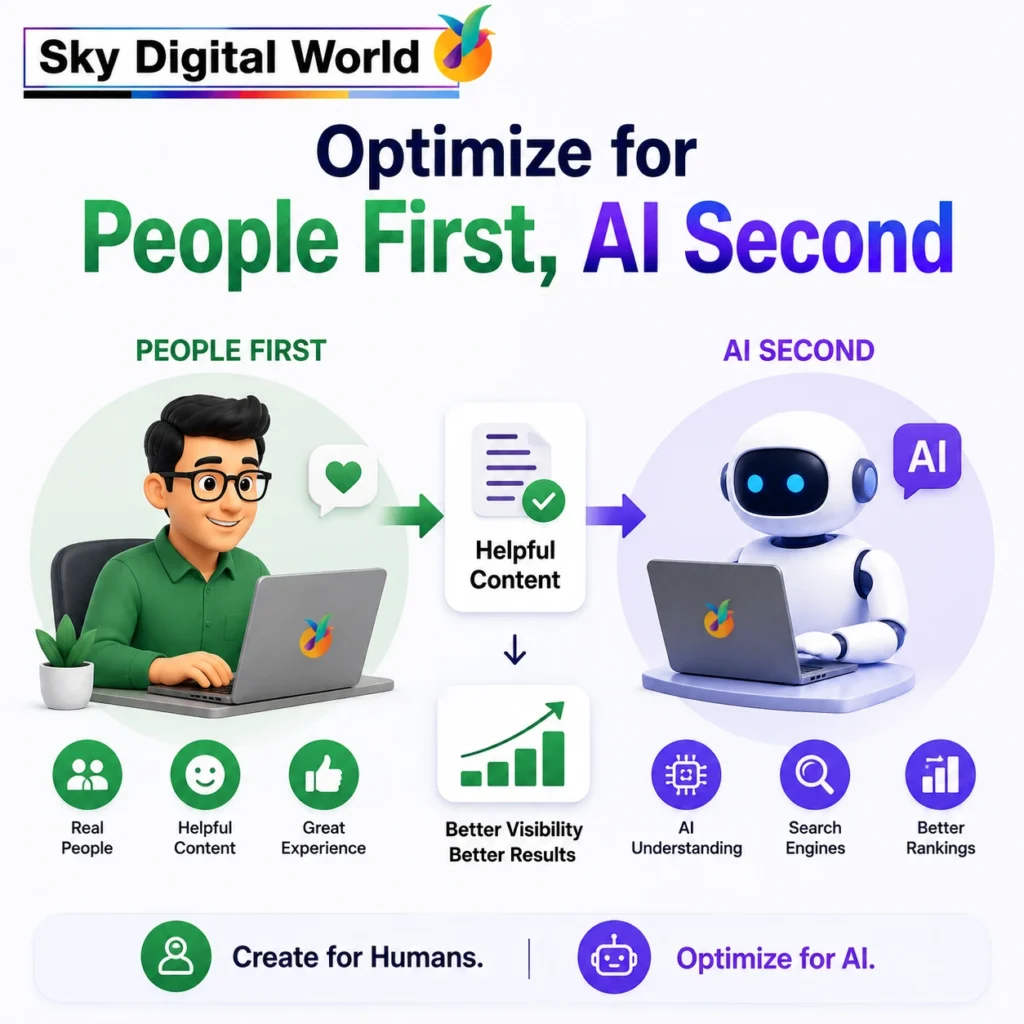
Optimize for People First, AI Second
This may be the most important principle of Google AI Overview SEO.
Do not make articles unnatural in an attempt to satisfy an AI system.
A visitor should be able to land on your page and quickly understand:
What is this about?
Does it answer my question?
Can I trust this information?
What should I do next?
If a page succeeds at those four things while maintaining sound SEO fundamentals, it has a much stronger foundation for modern search.
Measure More Than Rankings
SEO reporting also needs to evolve.
Keyword rankings remain useful, but businesses should evaluate the wider search journey.
Important metrics can include:
Organic impressions – Is the brand appearing more frequently?
Organic clicks – Are people visiting the website?
Qualified enquiries – Is search generating genuine prospects?
Conversions – Are visitors completing valuable actions?
Branded searches – Are more users actively searching for the company?
Landing-page performance – Which pages actually contribute to business results?
Search visibility trends – Is the site’s overall presence improving?
Ultimately, a business does not invest in SEO simply to own a keyword position.
It invests to become discoverable by the right audience and turn that visibility into business opportunities.
Common Google AI Overview SEO Mistakes to Avoid
Businesses should be particularly careful about shortcuts in a rapidly changing area.
Avoid mass-producing thin AI articles, stuffing keywords into every heading, creating fake statistics, copying competitor structures word-for-word, publishing unsupported claims, neglecting technical SEO, and creating hundreds of near-identical pages.
Also be cautious of anyone promising:
“Guaranteed #1 ranking in AI Overviews.”
AI-generated search results can vary depending on the query and search context. Sustainable optimization should focus on improving the quality and discoverability of your information rather than promising a placement that cannot be controlled.
Google AI Overview SEO Strategy for Businesses in India
Indian businesses operate in highly competitive digital markets. From e-commerce and real estate to healthcare, education, manufacturing, hospitality, and professional services, customers increasingly research businesses before making contact.
A practical Google AI Overview SEO strategy can combine:
Technical SEO → Search Intent → Quality Content → Topical Authority → Local SEO → Brand Trust → Conversion Optimization
Each component supports the next.
Technical SEO makes content accessible.
Search-intent research identifies what people need.
Content answers those needs.
Topical authority creates depth.
Local SEO improves geographic relevance.
Brand signals strengthen credibility.
Conversion optimization turns visibility into business opportunities.
That is a much more sustainable model than simply publishing blogs around high-volume keywords.
How Sky Digital World Can Help Businesses Prepare for AI Search
As search behaviour evolves, businesses need an SEO strategy that can adapt instead of relying on techniques that worked several years ago.
Sky Digital World can approach modern search through a combination of SEO strategy, website optimization, content planning, local SEO, Google Business Profile optimization, technical improvements, and conversion-focused digital marketing.
For businesses exploring Google AI Overview SEO, the priority should not be chasing every new trend.
The priority should be building a website that search engines can understand, customers can trust, and potential buyers genuinely find useful.
Final Thoughts: SEO in 2026 Is About Becoming the Best Answer
The future of search is not simply about writing more articles or inserting more keywords.
It is about becoming a credible and useful source of information.
Google AI Overviews are one part of a broader shift toward AI-assisted discovery. Businesses that continue investing in technical quality, helpful content, genuine expertise, strong brand signals, and user experience will be better prepared as search continues to evolve.
Traditional SEO is not disappearing.
It is expanding.
And Google AI Overview SEO represents an important part of that evolution.
For businesses in 2026, the question is no longer only:
“How do we rank higher?”
The better question is:
“How do we become a source customers—and modern search experiences—can confidently understand and trust?”
That is where the next generation of SEO begins.
Frequently Asked Questions (FAQs)
1. What is Google AI Overview SEO?
Google AI Overview SEO is the process of creating and optimizing website content so it is clear, useful, credible, and relevant for both traditional Google Search and AI-powered search experiences.
2. How is Google AI Overview SEO different from traditional SEO?
Traditional SEO focuses on rankings, keywords, backlinks, technical performance, and organic traffic. AI Overview optimization adds greater emphasis on direct answers, topical authority, content structure, context, expertise, and trustworthy information.
3. Can businesses guarantee visibility in Google AI Overviews?
No. There is no legitimate method to guarantee inclusion in an AI Overview. Businesses can improve their overall search readiness by publishing helpful content, strengthening technical SEO, demonstrating expertise, and building authority.
4. Is traditional SEO still important in 2026?
Yes. Technical SEO, keyword research, internal linking, backlinks, search intent, content quality, and user experience remain important. Google AI Overview SEO should complement traditional SEO rather than replace it.
5. How can I optimize content for Google AI Overviews?
Focus on answering real user questions clearly, creating comprehensive topic coverage, using logical headings, adding original expertise, strengthening internal links, maintaining technical SEO, and keeping information accurate and current.