





The Role of Data Analytics in Digital Marketing Success
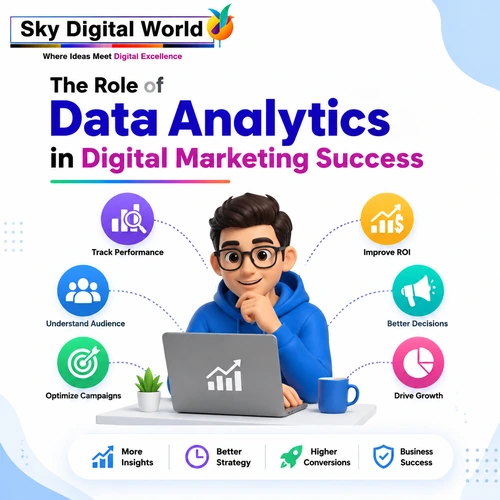
Digital marketing creates a huge amount of data every day. Website visits, Google searches, social media engagement, ad clicks, enquiries, conversions, abandoned forms, and customer behaviour all leave behind useful signals.
But collecting data alone does not improve marketing.
The real advantage comes from understanding what the data is telling you and using those insights to make better decisions.
This is where data analytics becomes an important part of digital marketing success. It helps businesses move away from assumptions and understand which campaigns attract the right audience, which channels generate meaningful leads, where customers lose interest, and where marketing budgets can be used more effectively.
For businesses competing in increasingly crowded digital markets, a data-driven marketing strategy can turn everyday numbers into practical growth opportunities.
What Is Data Analytics in Digital Marketing?
Data analytics in digital marketing is the process of collecting, organizing, measuring, and interpreting information generated through digital channels.
This may include data from:
- Website traffic and user behaviour
- SEO and organic search
- Google Ads and other paid campaigns
- Social media platforms
- Email marketing
- Landing pages
- Lead-generation forms
- CRM systems
- E-commerce activity
- Customer enquiries and conversions
The goal is not simply to create reports. The goal is to answer meaningful business questions.
For example: Which marketing channel generates our best leads? Why are visitors leaving a particular landing page? Which keywords actually contribute to enquiries? Which campaign deserves more budget?
Good analytics turns these questions into decisions backed by evidence.
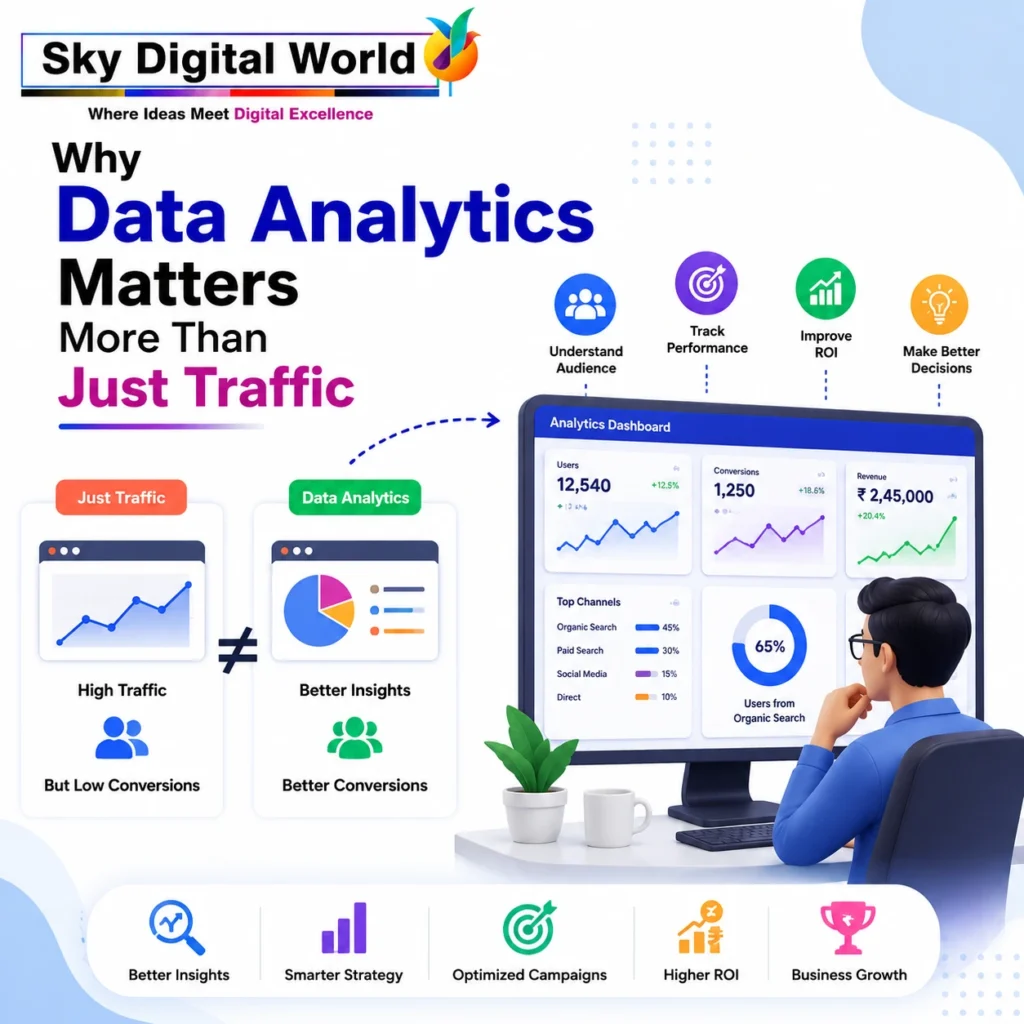
Why Data Analytics Matters More Than Just Traffic
A business may receive 20,000 website visits in a month and still struggle to generate qualified enquiries.
Another website may receive only 5,000 visits but produce significantly more leads.
This is why traffic should never be viewed in isolation.
A useful digital marketing analytics strategy connects traffic with user intent, engagement, leads, sales, and business outcomes.
Instead of asking:
“How much traffic did we get?”
businesses should also ask:
“What did that traffic do?”
This shift helps marketers focus on results rather than impressive-looking numbers.
1. Data Helps You Understand Your Real Audience
Businesses often have an idea of who their target customers are. Actual behavioural data can reveal a more accurate picture.
Analytics can help identify which locations generate interest, which devices customers use, which pages they visit, how they discover the website, and which content encourages further action.
For example, a business targeting customers across India may discover that a significant percentage of qualified enquiries come from Indore, Bhopal, Mumbai, or another specific market.
That information can influence SEO, paid advertising, landing pages, content, and even future service expansion.
Better audience understanding creates better marketing decisions.
2. Analytics Makes SEO More Strategic
SEO should not be based only on publishing content and checking keyword rankings.
Analytics allows businesses to examine organic traffic, landing-page engagement, search queries, click-through rates, conversions, and user journeys together.
Suppose a page is receiving impressions in Google but very few clicks. The title and search snippet may need improvement.
If another page receives strong organic traffic but produces almost no enquiries, the page may need a stronger call to action or better alignment with search intent.
Data-driven SEO helps marketers determine what needs improvement rather than optimizing blindly.
3. Paid Advertising Becomes More Efficient
Paid advertising provides enormous amounts of data, but focusing only on clicks can lead to poor decisions.
Consider two campaigns.
Campaign A generates 500 clicks and 10 qualified leads.
Campaign B generates 250 clicks and 25 qualified leads.
If decisions are based only on traffic, Campaign A appears stronger. When conversion data is considered, the picture changes completely.
Marketing analytics helps teams monitor metrics such as cost per lead, conversion rate, return on ad spend, campaign quality, landing-page performance, and lead value.
The objective is not necessarily to get the cheapest click. It is to generate valuable business outcomes at a sustainable cost.
4. Content Performance Becomes Easier to Understand
Not every blog, reel, social post, or landing page will perform equally.
Data helps businesses understand which topics attract visitors, which content keeps people engaged, which pages contribute to conversions, and what audiences want to explore next.
This information can guide future content planning.
Instead of continuously producing random content, marketers can build content around proven customer interests and search behaviour.
That makes content marketing more relevant, focused, and useful.
5. Analytics Reveals Problems in the Customer Journey
Sometimes marketing succeeds in attracting customers but loses them before conversion.
Imagine this journey:
Google Search → Website → Service Page → Contact Form → Enquiry
If 1,000 people reach the service page but only five complete the form, there may be friction somewhere in the experience.
The form might be too long. The page may load slowly. Pricing or service information may be unclear. The CTA may be difficult to notice. Mobile usability could also be causing problems.
Analytics helps marketers locate these drop-off points.
Fixing an existing conversion problem can sometimes create more value than simply spending more money to attract additional traffic.
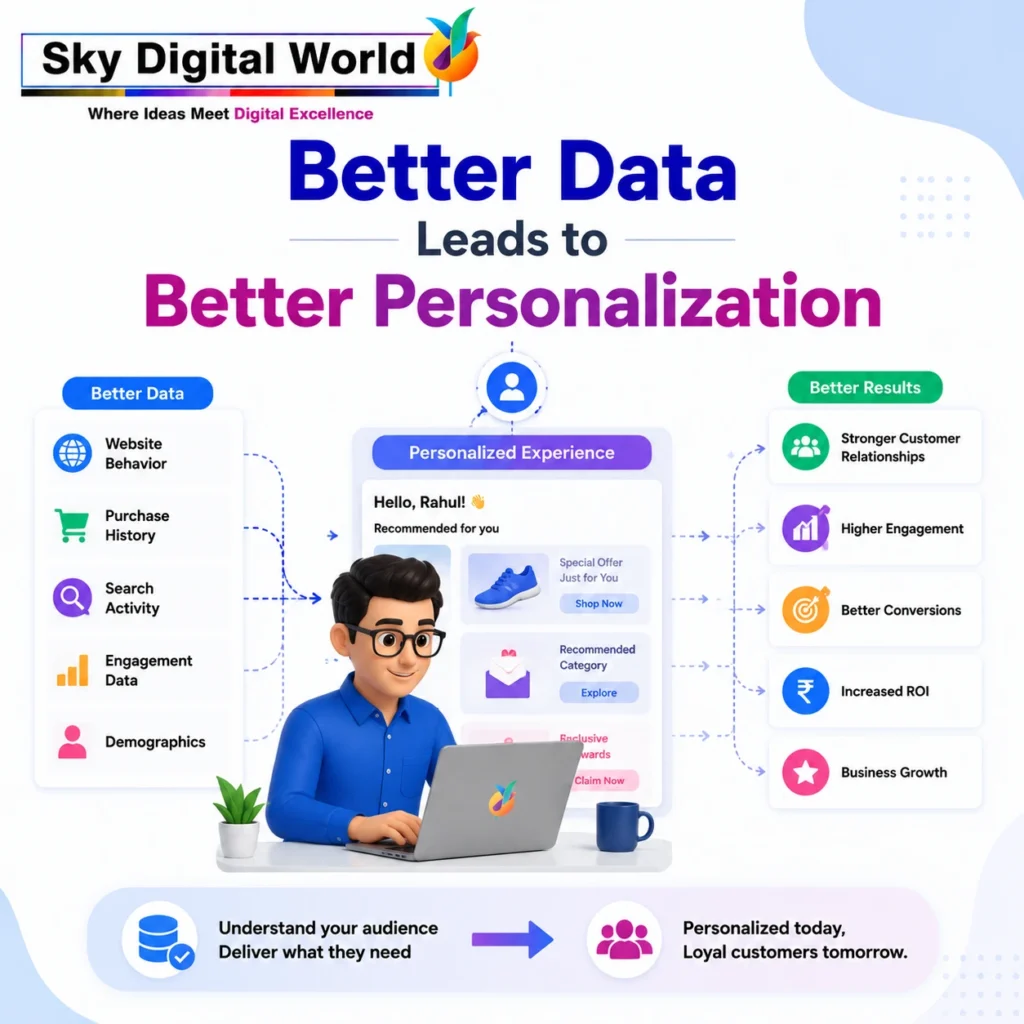
6. Better Data Leads to Better Personalization
Customers do not all have the same needs.
Someone reading an introductory blog post may require educational information, while someone visiting a pricing or service page may already be close to making a decision.
Behavioural insights allow businesses to create more relevant experiences based on customer intent.
This can influence remarketing campaigns, email sequences, content recommendations, landing pages, offers, and follow-up communication.
The result is marketing that feels more relevant rather than repetitive.
7. Data Helps Marketing Teams Allocate Budget Wisely
One of the biggest benefits of digital marketing analytics is better budget allocation.
When businesses can see which channels generate meaningful outcomes, they can make more informed investment decisions.
For example, analytics may reveal that organic search produces high-quality enquiries over time, Meta Ads work particularly well for awareness, Google Ads capture high-intent prospects, and remarketing improves conversions among previous visitors.
The correct strategy is rarely to put every rupee into one channel.
Instead, analytics helps businesses understand the role each channel plays in the overall customer journey.
The Metrics That Actually Matter
There is no single metric that defines digital marketing success. The right KPIs depend on the campaign objective.
For lead-generation businesses, useful measurements may include conversion rate, qualified leads, cost per lead, source of enquiry, landing-page conversion rate, and customer acquisition cost.
For SEO, businesses may monitor organic visibility, relevant clicks, search queries, engaged sessions, leads from organic traffic, and conversions.
For e-commerce, revenue, average order value, conversion rate, repeat purchases, cart abandonment, and return on ad spend may be more important.
The key principle is simple:
Measure metrics that connect marketing activity with business objectives.
A large number of likes or impressions can be useful for awareness, but they should not automatically be treated as proof of business growth.
Data Analytics and AI: A Powerful Combination
AI is making marketing analysis faster, but human interpretation remains essential.
AI tools can help identify patterns, summarize large datasets, detect unusual performance changes, segment audiences, and support forecasting.
However, AI does not automatically understand every business objective, customer relationship, local market condition, or commercial priority.
The strongest approach combines:
Reliable Data + AI Assistance + Human Marketing Strategy
Data provides evidence. AI helps process information. Experienced marketers decide what action makes sense.
Common Data Analytics Mistakes Businesses Should Avoid
A strong analytics strategy should avoid a few recurring problems:
- Tracking too many metrics without knowing which ones matter
- Treating traffic as the main definition of success
- Making major decisions from very small datasets
- Ignoring lead quality while measuring lead quantity
- Failing to configure conversion tracking correctly
- Looking at SEO, ads, social media, and CRM data completely separately
- Creating reports without turning findings into actions
A dashboard full of charts is not automatically a data-driven strategy.
Insight becomes valuable only when it influences the next decision.
How to Build a More Data-Driven Digital Marketing Strategy
Start with a clear business objective. Decide whether the priority is qualified leads, online sales, appointments, local enquiries, brand awareness, or another measurable outcome.
Then identify the customer journey and configure appropriate tracking across the important touchpoints.
Once reliable data is available, review it regularly to find patterns, opportunities, and bottlenecks. Test changes based on those findings and compare the results.
This creates a continuous cycle:
Measure → Understand → Improve → Test → Measure Again
Over time, this approach can make marketing more efficient because decisions are increasingly based on evidence rather than assumptions.
How Sky Digital World Uses Data to Support Smarter Marketing
At Sky Digital World, analytics can be integrated across SEO, paid advertising, social media, content marketing, local SEO, and lead-generation strategies.
Rather than looking at individual marketing channels as isolated activities, the objective is to understand how they contribute to the complete customer journey.
For a business looking for digital marketing services in India or a digital marketing agency in Indore, this approach can provide a clearer understanding of where enquiries originate, how prospects interact with campaigns, and which improvements deserve priority.
The goal is not simply to generate more numbers.
It is to generate better information for better marketing decisions.
Final Thoughts
Data analytics has changed digital marketing from a largely assumption-based activity into something businesses can continuously measure and improve.
It helps marketers understand audiences more clearly, identify high-performing channels, improve advertising efficiency, strengthen SEO, optimize customer journeys, and make smarter budget decisions.
But data itself is not the strategy.
The real competitive advantage comes from asking the right questions, measuring the right signals, and acting on what the information reveals.
Successful digital marketing is not about collecting more data. It is about making better decisions with the data you already have.
FAQs – Data Analytics in Digital Marketing
1. What is data analytics in digital marketing?
Data analytics in digital marketing is the process of collecting and analyzing information from websites, SEO, social media, paid ads, email campaigns, and other digital channels. It helps businesses understand customer behaviour and make better marketing decisions.
2. Why is data analytics important for digital marketing?
Data analytics helps businesses identify what is working and what needs improvement. It can reveal which campaigns generate leads, which channels perform better, where customers drop off, and how marketing budgets can be used more effectively.
3. How does data analytics improve marketing ROI?
Analytics connects marketing activity with measurable outcomes such as leads, conversions, sales, and customer acquisition costs. Businesses can invest more in high-performing campaigns and reduce spending on strategies that deliver limited results.
4. How can data analytics help SEO?
SEO analytics can provide insights into organic traffic, search queries, keyword visibility, landing-page performance, click-through rates, engagement, and conversions. These insights help marketers improve content and optimize pages based on actual user behaviour.
5. What are the most important digital marketing analytics metrics?
Important metrics depend on the business goal, but commonly tracked KPIs include conversion rate, qualified leads, cost per lead, customer acquisition cost, organic traffic, engagement, return on ad spend (ROAS), and landing-page performance.