




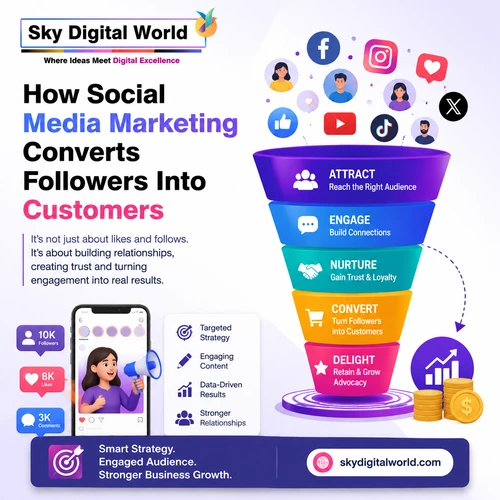
How Social Media Marketing Converts Followers Into Customers
Social media has changed the way people discover, evaluate, and interact with businesses. A potential customer may first notice a brand through an Instagram Reel, follow its page after seeing useful content, read comments and reviews for several days, visit the website, and only then decide to make an enquiry or purchase.
This is why having thousands of followers alone does not guarantee business growth. The real value of social media comes from turning audience attention into trust, conversations, leads, and eventually customers.
A well-planned social media strategy connects every stage of this journey. Businesses investing in Social Media Marketing Services India can use strategic content, consistent communication, audience targeting, advertising, and conversion-focused campaigns to transform social media from a visibility channel into a measurable growth platform.
Why Followers Do Not Automatically Become Customers
A follower has shown interest, but interest is only the beginning.
People follow business accounts for many different reasons. They may enjoy the content, want to learn something, compare options, watch for future offers, or simply remember the brand for later.
Before purchasing, most potential customers need stronger reasons to trust a business.
They usually want to understand:
- What does the business offer?
- Is the product or service relevant to their needs?
- Can the company be trusted?
- What makes the brand different?
- Have other customers had a positive experience?
- What should they do next?
Effective social media marketing answers these questions gradually rather than constantly
pushing followers to buy.
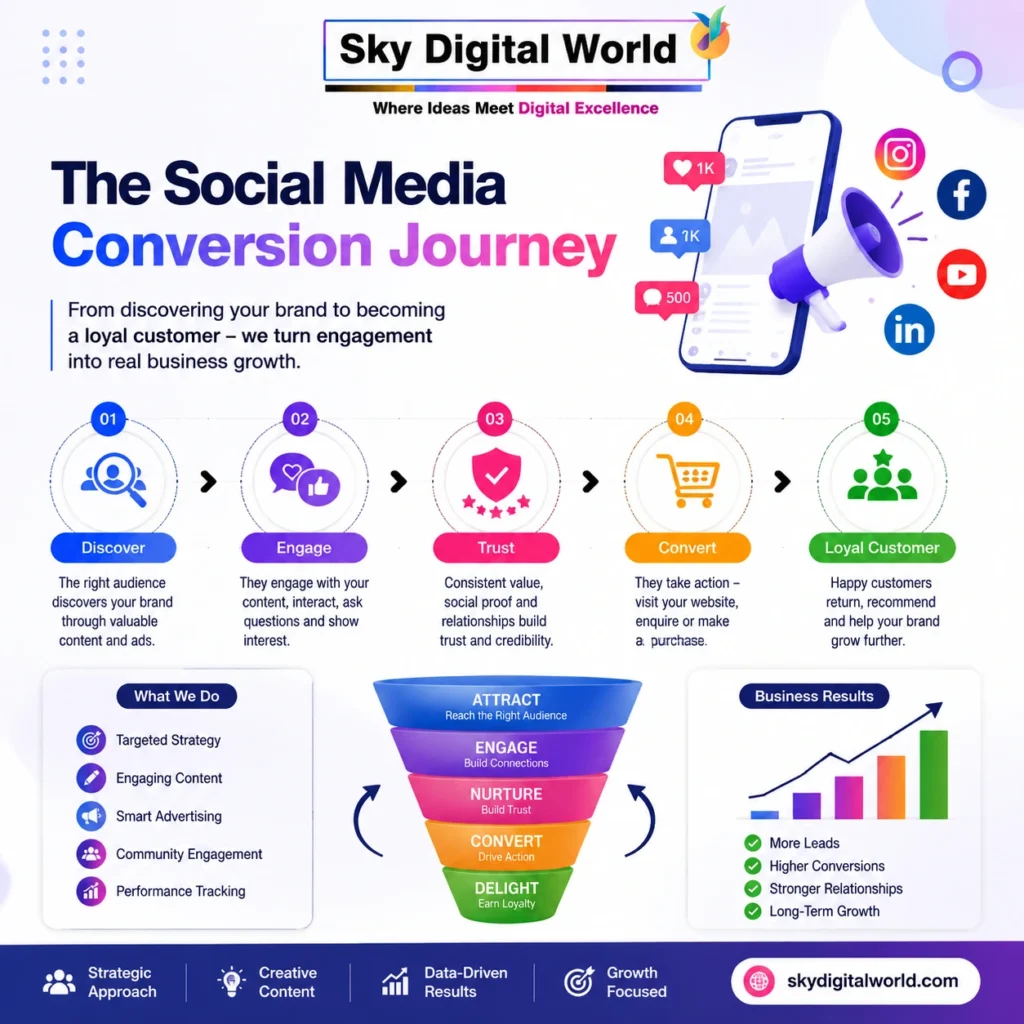
The Social Media Conversion Journey
A successful social media strategy generally moves users through four important stages:
Attention → Engagement → Trust → Conversion
Each stage has a different purpose.
1. Attention Introduces the Brand
Before someone can become a customer, they need to notice the business.
Strong visuals, short-form videos, educational posts, useful tips, relevant topics, customer-focused messaging, and paid campaigns can introduce a brand to potential buyers.
The objective at this stage is not necessarily an immediate sale. It is to create a strong first impression and give users a reason to stop scrolling.
Instead of communicating only what the company sells, good content addresses what customers care about.
For example, a website development company could post about common reasons websites fail to generate enquiries rather than repeatedly publishing posts saying, “We build websites.”
The first approach starts with a customer problem, making the content more relevant.
2. Valuable Content Builds Engagement
Once people discover a brand, useful content gives them a reason to stay connected.
Social media content can educate, entertain, answer questions, demonstrate expertise, introduce products, solve common problems, or show how a service works.
A balanced content strategy may include:
- Educational posts
- Reels and short videos
- Product demonstrations
- Frequently asked questions
- Industry insights
- Customer stories
- Behind-the-scenes content
- Problem-and-solution posts
- Offers and promotional campaigns
The goal is to create content that has a clear purpose rather than publishing simply to maintain posting frequency.
When followers regularly receive something useful from a page, engagement can develop naturally.
3. Consistency Builds Familiarity
Customers rarely develop confidence in an unfamiliar business after seeing one post.
Repeated exposure matters.
When people consistently see a brand sharing professional, relevant and useful information, the business becomes more familiar. Over time, this familiarity can reduce uncertainty when the customer is ready to make a decision.
Consistency does not mean posting identical promotional graphics every day.
It means maintaining a recognizable brand voice, visual identity, message and level of quality across different pieces of content.
A consistent social presence tells potential customers that the business is active, accessible and serious about its digital presence.
4. Social Proof Reduces Purchase Hesitation
Customers often want reassurance before spending money.
Social proof helps provide that reassurance.
Testimonials, reviews, case studies, customer experiences, project results and user-generated content can show potential buyers that real people or businesses have already chosen the brand.
Instead of a company simply claiming:
“Our service delivers great results.”
A detailed customer story explaining the problem, solution and outcome can be much more persuasive.
Social proof is particularly valuable for service businesses where customers cannot physically examine the service before purchasing.
5. Engagement Turns Content Into Conversation
Social media is different from traditional advertising because communication can happen in both directions.
People can comment, reply, ask questions, send direct messages and interact with Stories.
Businesses should treat these interactions as potential customer conversations rather than vanity metrics.
A person asking about price, availability, specifications, location or service details may already be moving toward a purchase decision.
Fast, helpful and professional responses can keep that journey moving.
Businesses can also use polls, question stickers, comment prompts and interactive posts to understand what their audience wants.
The insights collected from these conversations can improve future content and campaigns.
6. Clear Calls to Action Create the Next Step
Even highly engaged followers may not convert if they do not know what to do next.
Every conversion-focused campaign needs a clear next step.
Depending on the business, calls to action may include:
Book a Consultation
Send Us a Message
Request a Quote
Visit Our Website
Shop Now
Call Today
Download the Guide
WhatsApp Us
Schedule a Demo
The CTA should match the user’s position in the buying journey.
Someone seeing a brand for the first time may respond better to “Learn More,” while someone actively comparing providers may be ready for “Request a Quote.”
Good social media marketing does not force every user toward the same action.
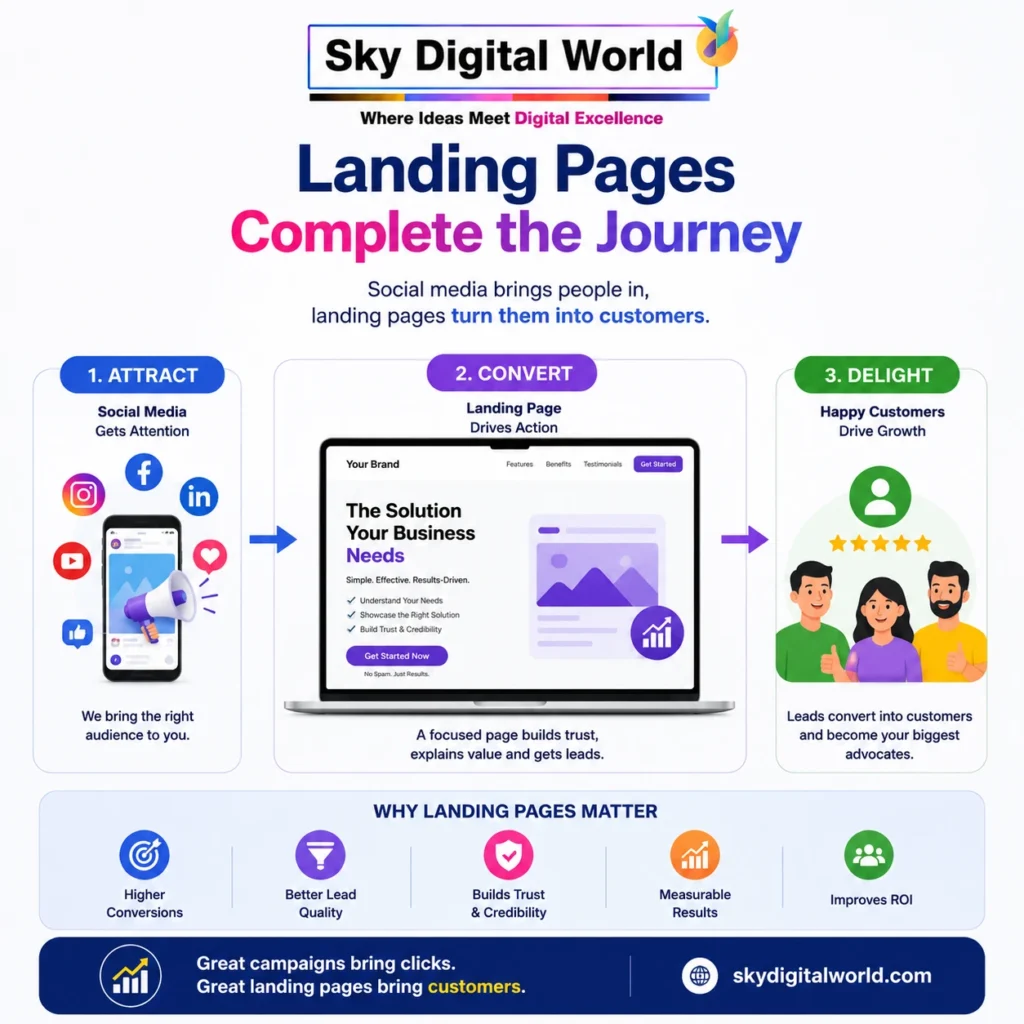
7. Landing Pages Complete the Journey
Getting someone to click is only part of the conversion process.
Imagine a social media campaign generates significant interest, but users arrive on a slow, confusing or poorly designed landing page. Many potential customers may leave without taking action.
The landing page should continue the promise made in the social media content or advertisement.
It should provide:
- A clear headline
- Relevant information
- Strong value proposition
- Easy navigation
- Trust signals
- Mobile-friendly design
- Simple enquiry or purchase process
- Visible CTA
Social media and website conversion optimization therefore work best as part of the same customer journey.
8. Paid Social Advertising Reaches High-Intent Audiences
Organic social media is valuable for community building, brand visibility and long-term engagement. Paid advertising adds another important capability: targeted distribution.
Businesses can use advertising platforms to reach audiences based on relevant targeting options and campaign objectives.
Campaigns can be designed around goals such as:
- Lead generation
- Website traffic
- Product sales
- Video views
- Brand awareness
- App promotion
- Customer enquiries
Instead of depending entirely on existing followers, paid campaigns allow businesses to place their message in front of additional potential customers.
This becomes particularly powerful when advertising is combined with strong creative content and a well-designed conversion funnel.
9. Retargeting Brings Interested Users Back
Not everyone converts during their first interaction.
A user might watch a video today, visit a website tomorrow and make an enquiry several days later.
Retargeting can help businesses reconnect with people who have already interacted with their digital presence.
Depending on platform capabilities and available first-party data, businesses can build campaigns for audiences such as previous website visitors or people who engaged with content.
Because these users may already recognize the brand, retargeting campaigns can focus on stronger conversion messages, product benefits, testimonials, offers or reminders.
The objective is to continue the conversation instead of treating every interaction as a completely new customer journey.
10. Content Should Address Different Buying Stages
One common social media mistake is creating every post for people who are ready to purchase immediately.
In reality, followers are at different stages.
Awareness Stage
The user has a problem or interest but may not know the solution.
Useful content includes educational posts, tips, awareness videos and industry insights.
Consideration Stage
The user understands the problem and is evaluating possible solutions.
Useful content includes service explanations, comparisons, demonstrations, FAQs and case studies.
Decision Stage
The user is closer to purchasing.
Useful content includes testimonials, offers, detailed benefits, consultations and strong calls to action.
Creating content for all three stages allows businesses to nurture followers instead of repeatedly asking them to buy.
11. Analytics Reveal What Actually Converts
Likes and follower counts can provide useful context, but they should not be the only measures of success.
Businesses should connect social media activity with meaningful performance indicators.
Depending on campaign goals, useful metrics can include:
- Reach
- Engagement rate
- Video watch time
- Link clicks
- Website sessions
- Enquiries
- Leads
- Conversion rate
- Cost per lead
- Customer acquisition cost
- Sales
- Return on ad spend
Suppose one Reel receives 100,000 views but produces five enquiries, while another receives 15,000 views and generates 40 enquiries.
If the objective is lead generation, the second Reel may have significantly greater business value.
Good social media marketing therefore focuses on the quality of actions, not simply the quantity of attention
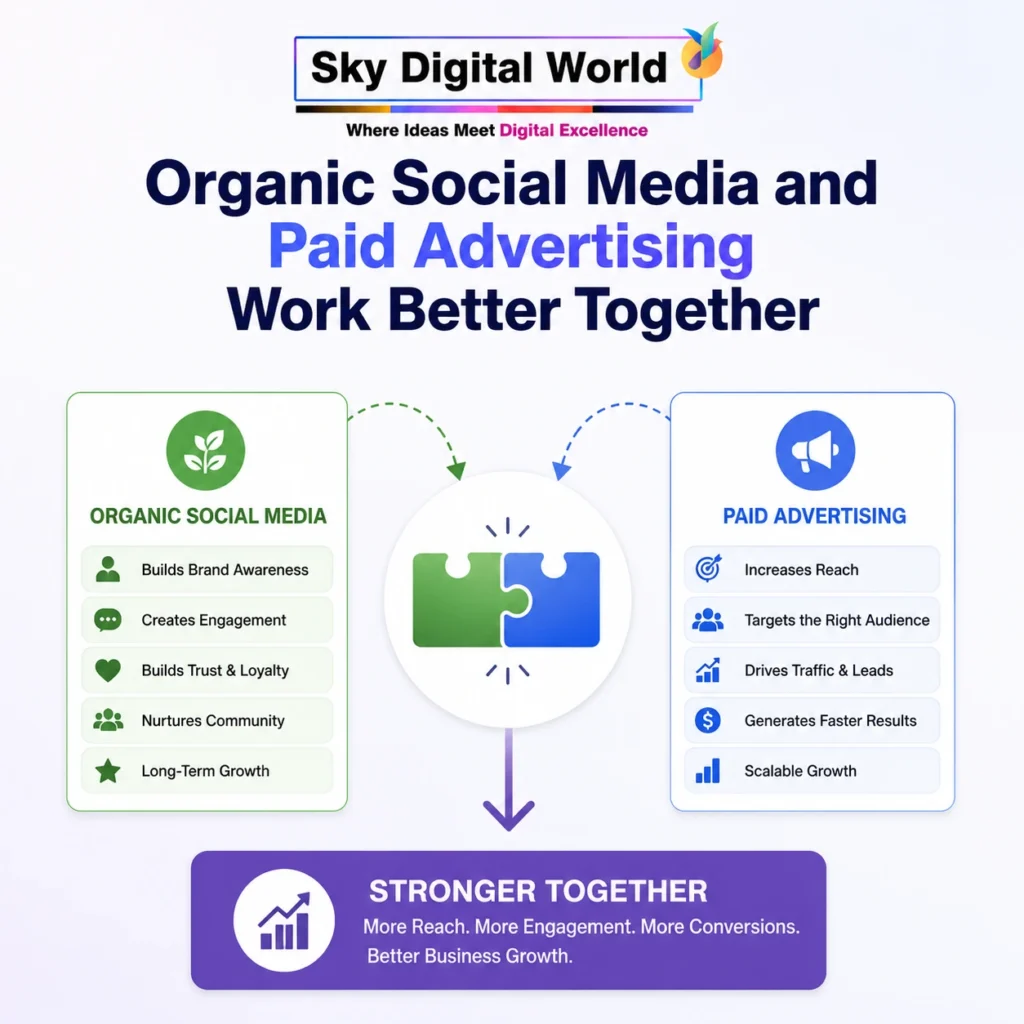
Organic Social Media and Paid Advertising Work Better Together
Organic and paid social media serve different but complementary purposes.
Organic content helps establish brand personality, educate audiences, demonstrate expertise and maintain customer relationships.
Paid advertising helps expand reach, target specific audiences, generate leads and accelerate conversions.
An effective strategy can use organic content to identify messages that resonate with audiences and then amplify strong concepts through paid campaigns.
This creates a connected system rather than treating content creation and advertising as separate activities.
Why Businesses Choose Professional Social Media Marketing Services India
Managing social media effectively requires much more than designing attractive graphics.
Businesses need audience research, content planning, copywriting, creative production, platform knowledge, campaign management, performance analysis and continuous optimization.
Professional Social Media Marketing Services India can help businesses create a structured approach where content is connected to specific marketing and business objectives.
Rather than asking only:
“What should we post today?”
A strategic team asks:
“What should we communicate today to move the right audience closer to becoming a customer?”
That difference changes social media from routine posting into purposeful marketing.
How Sky Digital World Approaches Social Media Growth
At Sky Digital World, social media marketing is approached as part of a broader digital growth strategy.
Instead of focusing only on follower growth, businesses need a combination of content, audience engagement, creative communication, paid campaigns and conversion-focused digital journeys.
A structured strategy can include social media planning, content creation, graphic design, Reels and video content, audience targeting, engagement strategies, Meta advertising, lead generation and performance analysis.
The objective is to create a stronger connection between what people see on social media and the actions that contribute to business growth.
For businesses searching for reliable Social Media Marketing Services India, the right strategy should ultimately connect creativity with measurable outcomes.
Common Mistakes That Prevent Followers From Converting
Even businesses with large audiences can struggle to generate customers when their strategy has gaps.
Some common mistakes include:
- Posting only promotional content
- Buying or attracting irrelevant followers
- Using weak or unclear CTAs
- Ignoring comments and messages
- Publishing inconsistently
- Sending users to poor landing pages
- Focusing entirely on likes and views
- Creating content without understanding the audience
- Running ads without proper conversion tracking
- Failing to retarget interested prospects
Fixing these problems can sometimes create more value than simply trying to gain more followers.
Followers Are Not the Final Goal
A large follower count may look impressive, but followers alone do not pay the bills.
Businesses need to think beyond audience size.
A smaller community of genuinely interested prospects can often be more commercially valuable than a large audience with little connection to the business.
The real goal is to build an audience that knows the brand, understands its value, trusts its expertise and feels confident taking the next step.
That is where strategic social media marketing makes the difference.
Conclusion
Social media conversion is rarely the result of a single post.
It happens through a series of connected experiences.
A customer discovers the brand, consumes useful content, becomes familiar with its message, sees evidence of credibility, interacts with the business and eventually receives the right reason to take action.
Businesses that understand this journey can stop treating social media as a simple posting platform and start using it as a complete customer acquisition and relationship-building channel.
With the right combination of strategy, content, engagement, advertising, retargeting, landing pages and analytics, social media can do much more than generate followers. It can help generate conversations, qualified leads, sales and long-term customer relationships.
For businesses looking to build such a system, professional Social Media Marketing Services India can provide the strategy and execution required to turn digital attention into meaningful business growth.
Frequently Asked Questions
Can social media followers really become paying customers?
Yes. Followers can become customers when businesses consistently provide useful content, build trust, communicate their value clearly and create convenient opportunities for users to enquire or purchase.
How long does social media marketing take to generate customers?
There is no universal timeframe. Results depend on the industry, audience, offer, competition, content quality, advertising budget and existing brand awareness. Some campaigns can produce enquiries quickly, while organic community building generally requires consistent long-term effort.
Which social media platform is best for generating customers?
The best platform depends on where the target audience spends time and how they research products or services. Instagram and Facebook can work well for many consumer-facing businesses, while LinkedIn can be valuable for B2B marketing. YouTube can support businesses that benefit from educational and demonstration-based video content.
Do businesses need paid ads to convert followers?
Not always. Organic social media can generate enquiries and customers, particularly for brands with strong communities. Paid campaigns, however, can help expand reach, target specific audiences and scale successful messages faster.
What should businesses look for in Social Media Marketing Services India?
Look for a partner that understands business goals rather than focusing only on posting frequency. Strong services should cover strategy, audience research, content creation, engagement, advertising, conversion tracking and performance analysis.
How can a business measure social media ROI?
Track metrics connected to business outcomes, such as qualified enquiries, leads, purchases, conversion rates, customer acquisition costs and revenue attributed to social media campaigns.