




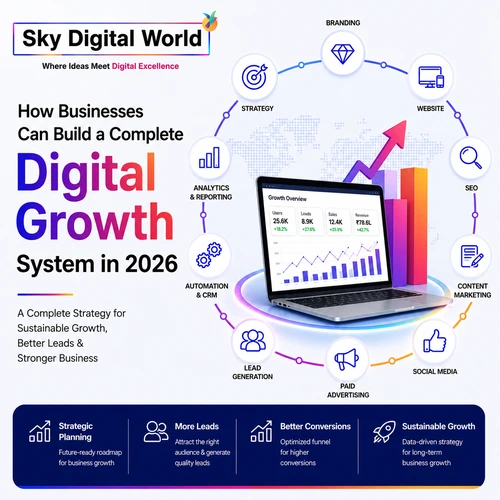
How Businesses Can Build a Complete Digital Growth System in 2026
Introduction
Digital growth in 2026 is no longer about simply having a website, posting regularly on social media, or occasionally running paid advertisements. Customers move between Google Search, social platforms, websites, reviews, videos, email, and messaging apps before making a buying decision.
This means businesses need more than individual marketing activities. They need a connected digital growth system.
A strong Digital Growth Strategy India should bring together branding, website experience, SEO, content, social media, paid advertising, lead management, automation, analytics, and customer retention. When these elements work together, marketing becomes easier to measure, optimize, and scale.
The objective isn’t to be everywhere. It is to build a system in which every digital channel has a clear purpose and contributes to business growth.
What Is a Digital Growth System?
A digital growth system is an interconnected marketing framework designed to attract potential customers, convert their interest into enquiries or sales, and build long-term customer relationships.
A simple growth journey can look like this:
Visibility → Interest → Trust → Lead → Conversion → Retention → Growth
For example, someone may discover your business through Google, visit your website, check your Instagram profile, read customer reviews, submit an enquiry, receive a follow-up, and eventually become a customer.
When these touchpoints are planned separately, opportunities can be lost. A complete digital growth system connects them into one customer journey.
Why Businesses Need a Digital Growth Strategy in 2026
Customer journeys are becoming increasingly fragmented. A potential buyer might see a social media post today, search for your company several days later, compare your website with competitors, and contact you only after seeing additional proof of credibility.
A professional Digital Growth Strategy India helps businesses create consistency across these interactions.
It can help a business:
- Build stronger online visibility
- Reach relevant audiences
- Establish brand credibility
- Generate qualified enquiries
- Improve conversion rates
- Reduce wasted marketing expenditure
- Track marketing performance
- Improve customer retention
- Scale successful campaigns
Most importantly, it replaces disconnected marketing activities with a structured growth process.
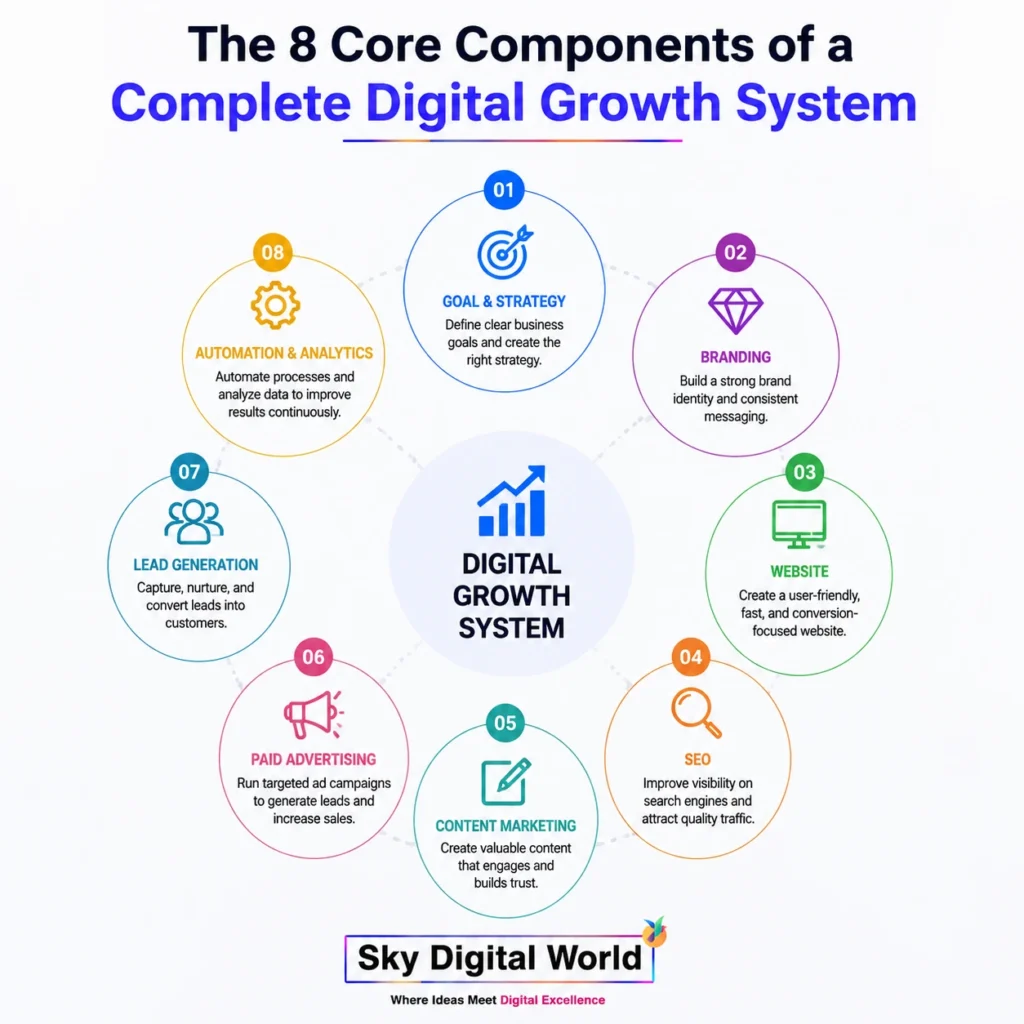
The 8 Core Components of a Complete Digital Growth System
1. Start With Clear Business and Marketing Goals
Before selecting marketing channels, businesses need to determine what growth actually means for them.
The objective could be:
- Increasing qualified leads
- Generating eCommerce sales
- Expanding into new cities
- Building brand awareness
- Increasing repeat purchases
- Improving customer acquisition costs
- Generating B2B enquiries
Goals should be connected to measurable metrics.
For example, instead of:
“We want more website traffic.”
A stronger objective would be:
“We want to increase qualified organic enquiries while improving website conversion rates.”
This distinction matters because traffic alone does not guarantee business growth.
2. Build a Strong and Consistent Brand Identity
Customers encounter hundreds of businesses online. A recognizable brand helps a company stand apart.
Brand identity goes beyond a logo.
It includes:
Visual Identity: Logo, colors, typography, graphics and imagery.
Brand Messaging: How the company communicates its value.
Voice & Tone: The personality reflected across marketing communication.
Value Proposition: Why customers should choose the business over alternatives.
The same identity should remain recognizable across the website, Google Business Profile, social media, advertisements, email communication, presentations, and other customer touchpoints.
Consistency creates familiarity, and familiarity can help build trust.
3. Turn Your Website Into a Conversion Platform
A website shouldn’t function as a digital brochure. It should help visitors move toward a meaningful business action.
A growth-focused website should answer three questions quickly:
What do you offer?
Why should customers trust you?
What should they do next?
Important website elements include:
- Clear navigation
- Mobile responsiveness
- Fast loading performance
- Strong service or product pages
- Visible calls-to-action
- Testimonials and reviews
- Case studies
- Contact options
- WhatsApp or enquiry integration
- Helpful content
- SEO-friendly architecture
Businesses should also review individual landing pages instead of evaluating only the homepage.
If your advertising attracts the right people but your website creates confusion, marketing costs can rise without producing proportional sales.
4. Build Sustainable Visibility Through SEO
Paid advertising can generate immediate visibility, but organic search can create an additional long-term customer acquisition channel.
SEO should therefore be a fundamental part of a Digital Growth Strategy India.
A comprehensive SEO approach includes:
Technical SEO
Improve crawlability, indexing, page performance, mobile usability, internal architecture, and other technical elements.
On-Page SEO
Optimize pages around relevant search intent, titles, headings, content structure, internal links, and metadata.
Local SEO
For location-focused businesses, optimize local landing pages, business information, reviews, and Google Business Profile visibility.
Content SEO
Publish genuinely useful resources addressing questions potential customers search for.
Authority Building
Earn relevant mentions, links, citations, and other trust signals.
The objective should not be rankings for random keywords. Businesses should prioritize searches capable of attracting the right potential customers.
5. Create Content for Different Stages of the Customer Journey
One of the biggest content marketing mistakes is creating every piece of content for immediate selling.
Potential customers need different information at different stages.
Awareness Stage
Users are identifying a problem.
Content examples:
- Educational blogs
- Short videos
- Guides
- Social media explainers
Consideration Stage
Users are evaluating possible solutions.
Useful content includes:
- Comparisons
- Service guides
- Case studies
- FAQs
- Industry insights
Decision Stage
The customer is close to choosing a provider.
Content should include:
- Service pages
- Testimonials
- Pricing information where appropriate
- Demonstrations
- Consultation CTAs
- Proof of results
This approach turns content into part of the sales journey rather than treating it simply as a traffic-generation activity.
6. Use Paid Advertising for Targeted and Measurable Growth
SEO and content support organic visibility, while paid advertising can help businesses reach targeted audiences more quickly.
Depending on the business, this may include:
- Google Search Ads
- Meta Ads
- Instagram Ads
- YouTube campaigns
- Retargeting
- Shopping campaigns
- Lead generation campaigns
However, increasing advertising budgets is not automatically a growth strategy.
A better approach is:
Target → Test → Measure → Optimize → Scale
Businesses should monitor metrics such as:
- Cost per lead
- Cost per acquisition
- Conversion rate
- Return on ad spend
- Lead-to-customer rate
- Customer acquisition cost
Scaling should happen after the business identifies campaigns, audiences, creatives, and offers that consistently produce meaningful results.
7. Connect Social Media With Business Objectives
Social media should support the wider digital growth system rather than operate as an isolated content calendar.
Different content can serve different objectives.
Educational content builds authority.
Behind-the-scenes content humanizes the brand.
Customer stories provide social proof.
Product demonstrations explain value.
Short-form videos increase discovery.
Offers and CTAs encourage action.
Instead of measuring success only through followers or likes, businesses should also evaluate profile visits, website clicks, enquiries, assisted conversions, and customer interactions.
The right question isn’t simply, “How many followers did we gain?”
It is also, “How is social media contributing to our customer journey?”
8. Build a Lead Management and Follow-Up System
Generating leads is only half the process.
A business can invest heavily in SEO and advertising but still lose revenue because enquiries aren’t handled effectively.
Every new lead should have a defined next step.
A basic workflow might look like:
New Enquiry → Qualification → Follow-Up → Sales Conversation → Proposal → Conversion → Customer Nurturing
Businesses can use CRM systems and automation to support this process.
Useful automations can include:
- Instant enquiry acknowledgement
- Lead assignment
- Follow-up reminders
- Email sequences
- WhatsApp communication
- Appointment reminders
- Abandoned-cart messages
- Customer feedback requests
Automation should remove repetitive work without making communication feel impersonal.
How AI Fits Into a Digital Growth Strategy in 2026
AI can make marketing teams more efficient, but it works best when supporting a clear strategy rather than replacing one.
Businesses can use AI to assist with:
Customer Analysis: Identify patterns within marketing and customer data.
Content Research: Discover topics, questions, and audience interests.
Advertising: Support audience analysis, creative testing, and campaign optimization.
Customer Support: Handle repetitive queries while escalating complex conversations to people.
Lead Management: Prioritize, organize, and follow up with enquiries.
Reporting: Summarize marketing data and highlight unusual performance changes.
The competitive advantage isn’t simply “using AI.” It comes from integrating AI into workflows where it improves speed, decision-making, or customer experience.
Create One Connected Marketing Funnel
The real power of digital growth appears when individual channels begin supporting one another.
Consider this example:
Google Search
↓
SEO Blog
↓
Service Page
↓
Remarketing Ad
↓
Lead Form / WhatsApp
↓
CRM Follow-Up
↓
Sales Conversation
↓
Customer
↓
Review / Referral / Repeat Business
Now every marketing channel contributes to a larger system.
SEO attracts demand. Content builds trust. The website converts interest. Advertising reconnects with prospects. CRM manages opportunities. Retention creates additional customer value.
That is the difference between running marketing campaigns and building a digital growth engine.
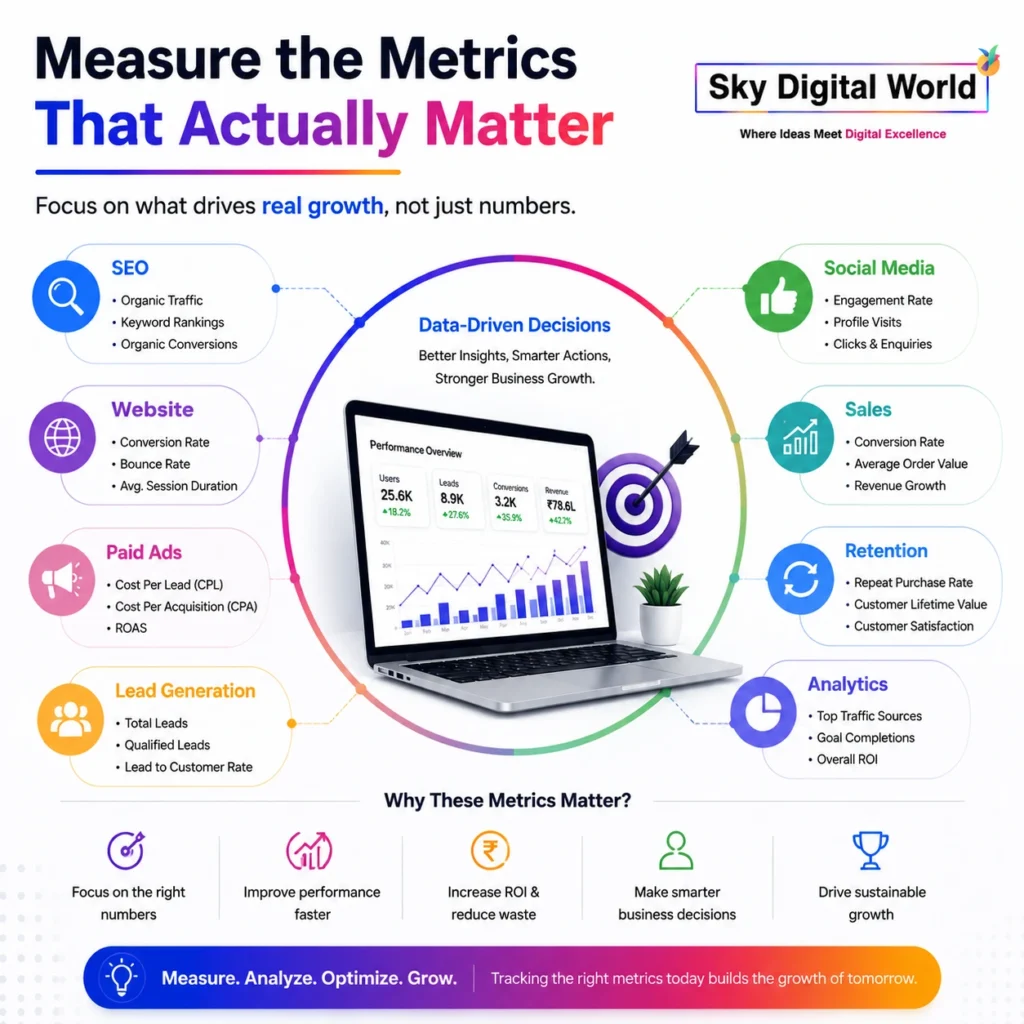
Measure the Metrics That Actually Matter
Digital marketing provides enormous amounts of data, but not every metric deserves equal attention.
Businesses should separate visibility metrics from business metrics.
Marketing Area | Useful Metrics |
SEO | Qualified organic traffic, rankings, organic conversions |
Website | Conversion rate, engagement, enquiries |
Paid Ads | CPL, CPA, ROAS, conversion rate |
Social Media | Reach, engagement, clicks, enquiries |
Lead Generation | Qualified lead rate, lead-to-sale rate |
Sales | Customer acquisition cost, revenue |
Retention | Repeat purchase rate, customer value |
This prevents businesses from celebrating vanity metrics while actual sales performance remains unchanged.
Common Mistakes Businesses Should Avoid
Even a strong strategy can underperform when execution is fragmented. Common mistakes include:
Trying every marketing channel at once: Start with channels that match customer behavior and business goals.
Focusing only on traffic: Relevant traffic and conversions matter more than raw visitor numbers.
Ignoring the website experience: Marketing cannot compensate indefinitely for a poor conversion experience.
Creating content without search intent: Every SEO article should answer a genuine user need.
Running ads without proper tracking: Decisions become guesswork when conversions aren’t measured correctly.
Ignoring existing leads: Improving follow-up can sometimes produce more revenue than generating additional leads.
Changing strategy too frequently: Marketing requires enough data to identify patterns before major decisions are made.
A Practical 90-Day Digital Growth Framework
Businesses don’t need to transform everything overnight.
Days 1–30: Foundation
Audit the current website, SEO visibility, branding, analytics, competitors, customer journey, and advertising accounts. Define target audiences, goals, conversion actions, and measurement systems.
Days 31–60: Build
Improve priority website pages, publish strategic content, strengthen SEO foundations, develop campaign creatives, establish lead workflows, and connect tracking systems.
Days 61–90: Optimize
Review actual performance. Improve landing pages, audiences, content, advertisements, CTAs, and follow-up processes. Scale the channels demonstrating strong commercial potential.
After 90 days, the cycle should continue:
Measure → Learn → Improve → Scale
How to Choose the Right Digital Growth Strategy India
There is no universal marketing plan that works for every Indian business.
A local service provider may depend heavily on Local SEO, Google Business Profile, Meta Ads, and WhatsApp.
A B2B manufacturer may prioritize SEO, technical content, Google Search, LinkedIn, and enquiry optimization.
An eCommerce company may focus on product SEO, shopping campaigns, Meta Ads, remarketing, email automation, and customer retention.
Therefore, an effective Digital Growth Strategy India should be developed around:
- Business model
- Target customer
- Geographic market
- Buying cycle
- Competition
- Available budget
- Customer acquisition channels
- Existing digital assets
Strategy should determine the channels—not the other way around.
Final Thoughts
Building sustainable digital growth in 2026 requires more than isolated SEO campaigns, social media posts, advertisements, or website improvements.
Businesses need an integrated system.
A well-planned Digital Growth Strategy India connects brand positioning, website experience, SEO, content, social media, paid advertising, lead management, automation, analytics, and customer retention into one measurable framework.
Start with a strong foundation. Understand where your customers discover you, what builds their trust, what motivates them to take action, and what happens after they become a lead.
Then connect those stages.
The businesses that build this kind of system won’t simply generate more digital activity. They will be better positioned to turn marketing investment into predictable and scalable growth.
Frequently Asked Questions
What is a Digital Growth Strategy?
A digital growth strategy is a structured plan that combines marketing channels, customer experience, technology, analytics, and conversion processes to support measurable business growth.
Why is a Digital Growth Strategy important for Indian businesses?
India’s digital marketplace is highly competitive. A structured strategy helps businesses choose relevant channels, improve customer acquisition, measure performance, and invest resources more effectively.
Is SEO enough for digital business growth?
SEO can be an important acquisition channel, but businesses often achieve stronger results when it works alongside a conversion-focused website, content, advertising, social media, lead management, and retention.
How long does a digital growth strategy take to deliver results?
The timeline depends on the channel, competition, starting position, budget, and execution. Paid campaigns can produce data quickly, while SEO and authority-building generally require a longer-term approach.
Can small businesses build a digital growth system?
Yes. Small businesses do not need to implement every channel simultaneously. They can start with the highest-priority channels and gradually expand the system as results and resources grow.