





What Should a Business Include in Its Digital Brand Guidelines?
What Should a Business Include in Its Digital Brand Guidelines? A Complete Guide for 2026
Imagine visiting a business website that uses a professional blue and white design. Later, you open its Instagram profile and notice completely different colors, fonts, and graphics. Then you receive a promotional email that looks like it belongs to another company.
You may wonder whether all these platforms represent the same business.
This is a common branding challenge for growing businesses.
When multiple people create advertisements, social media posts, website content, and marketing materials, maintaining a consistent brand identity can become difficult.
That is where Digital Brand Guidelines become important.
Digital brand guidelines help businesses maintain a recognizable identity across websites, social media platforms, digital advertisements, emails, and other online communication channels.
They provide clear instructions about how a brand should look, sound, and communicate with customers.
In this guide, we will explore what digital brand guidelines are, which elements businesses should include, and how to create a practical brand guideline document that supports consistent digital marketing.
What Are Digital Brand Guidelines?
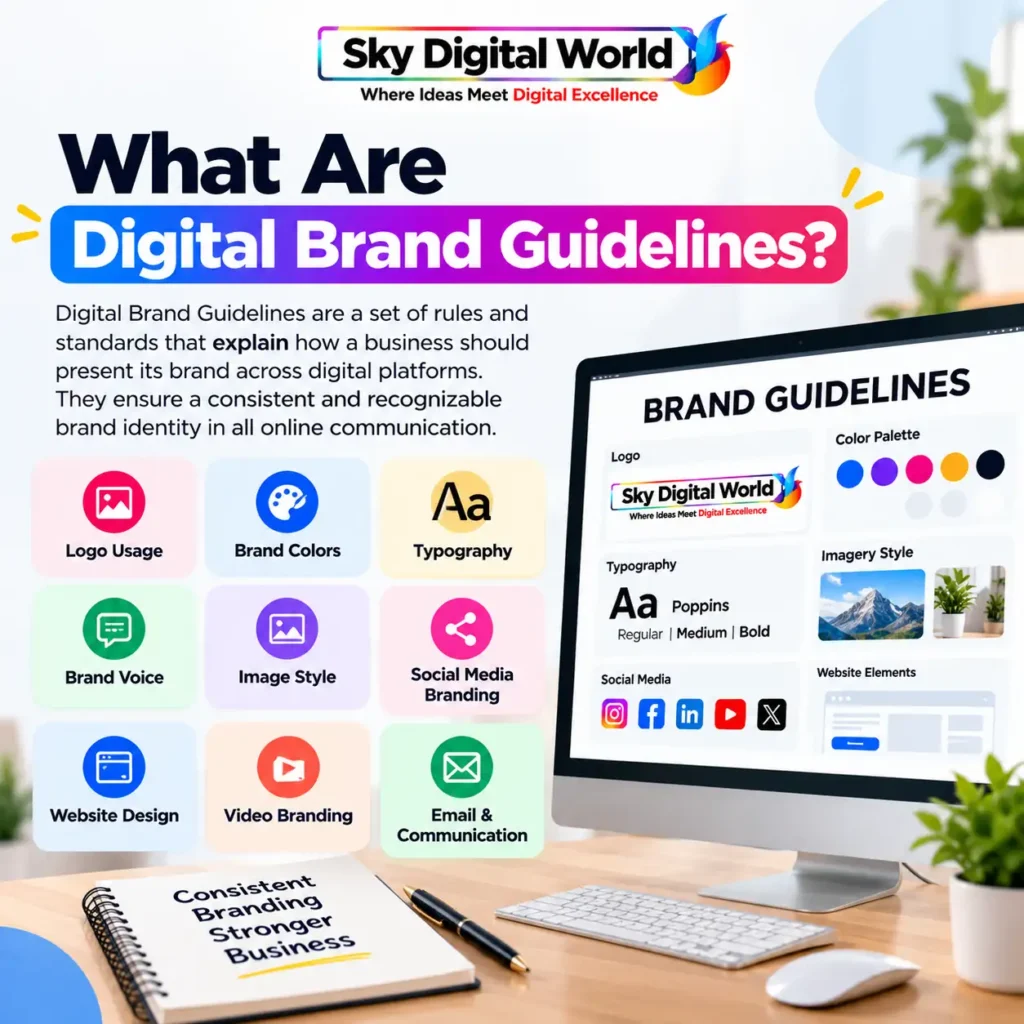
Digital Brand Guidelines are a set of instructions that explain how a business should present its brand across digital platforms.
They establish standards for visual design, messaging, communication, and content creation.
For example, a digital marketing agency may use specific brand colors, a particular logo style, consistent typography, and a professional yet approachable communication tone.
Its guidelines explain how those elements should appear on Instagram posts, website pages, digital advertisements, and presentations.
The purpose is not to make every design look identical.
Instead, the guidelines help ensure that different marketing materials remain recognizable as part of the same brand.
Digital Brand Guidelines act as a reference document for anyone creating or managing content for a business.
Why Does Every Business Need Digital Brand Guidelines?
Brand guidelines are useful for businesses of all sizes, including startups, local businesses, manufacturers, service providers, and e-commerce brands.
Without clear guidelines, different team members may interpret the brand identity differently.
This can create inconsistent marketing materials and unnecessary design revisions.
1. They Help Build Brand Recognition
When customers repeatedly see familiar colors, logos, typography, and messaging, they may find it easier to recognize a business.
A consistent visual identity helps connect different marketing activities to the same brand.
2. They Make Content Creation Easier
Designers and social media managers do not need to guess which colors, fonts, or design styles to use.
A documented brand identity gives them a starting point for every creative project.
3. They Improve Team Coordination
Businesses often work with different designers, agencies, website developers, video editors, and advertising professionals.
Brand guidelines help these teams follow the same creative direction.
4. They Support Professional Communication
Consistent branding can make a business appear more organized and dependable.
Customers should be able to recognize the same business across different digital touchpoints.
What Should a Business Include in Its Digital Brand Guidelines?
A useful brand guideline document should cover more than a logo and a few colors.
It should explain how the brand identity works in practical marketing situations.
Here are the most important elements.
1. Brand Introduction, Mission, and Values
Before defining design rules, businesses should explain what their brand represents.
This section gives employees and creative teams an understanding of the business identity.
It may include:
- Brand name and background
- Mission and long-term vision
- Core business values
- Target customers
- Brand personality
- Unique value proposition
For example, a sustainable home products brand may describe its personality as natural, practical, responsible, and approachable.
These characteristics can influence its visual design, photography, and communication style.
Practical Tip: Keep this section clear and concise. Creative teams should be able to understand the brand’s personality without reading a lengthy company history.
2. Logo Usage Guidelines
A logo is one of the most recognizable elements of a brand.
However, using the same logo incorrectly across different platforms can weaken visual consistency.
Your digital brand guidelines should include approved logo variations and instructions for their use.
What Should Logo Guidelines Cover?
Primary Logo: The main version used on websites, presentations, and promotional materials.
Secondary Logo: An alternative arrangement for smaller or different layouts.
Monochrome Logo: An approved single-color version for suitable backgrounds.
Minimum Logo Size: The smallest size at which the logo remains readable.
Clear Space: The minimum empty space required around the logo.
Background Rules: Instructions for placing the logo on light, dark, or photographic backgrounds.
Common Logo Mistakes to Avoid
Businesses should clearly explain which logo modifications are not permitted.
For example, designers should avoid stretching the logo, changing its colors without approval, adding unnecessary effects, or placing it over backgrounds that reduce visibility.
If a business has only one approved logo, the guidelines should specify that the original artwork must be used without alteration.
3. Brand Color Palette and Color Codes
Colors help create a recognizable visual identity.
A business may use one primary color, two supporting colors, and a small group of neutral shades.
However, simply mentioning color names is not enough.
Digital brand guidelines should provide exact color codes.
Color Type | Purpose | Example HEX Code |
Primary Color | Main brand identity | #1646D8 |
Secondary Color | Supporting visual elements | #7B2CE6 |
Accent Color | Buttons and highlights | #FF6B35 |
Dark Neutral | Headings and text | #172033 |
Light Neutral | Backgrounds | #F5F7FA |
These are illustrative color codes, not the official colors of Sky Digital World.
For digital platforms, HEX and RGB values are especially useful.
Guidelines should also explain where each color is used, such as headings, backgrounds, buttons, icons, and promotional banners.
Businesses should ensure sufficient contrast between text and backgrounds so content remains readable.
4. Typography and Font Guidelines
Typography plays an important role in how a brand communicates visually.
Different fonts can create different impressions.
For example, a modern technology company may prefer clean sans-serif typography, while a luxury brand may use a more refined type style.
A typography section should define:
- Primary heading font
- Secondary heading font
- Body text font
- Font weights
- Recommended text sizes
- Line spacing
- Capitalization style
For websites, guidelines may also specify typography rules for desktop and mobile devices.
Businesses should choose fonts that remain readable across different screen sizes.
If a brand uses a paid or licensed font, its guidelines should explain where that font can legally be used and identify approved alternatives.
5. Brand Voice and Communication Tone
Visual branding helps customers recognize a business, while communication style influences how they understand it.
A brand voice describes the consistent personality used in written and spoken communication.
For example, a business may communicate in a professional, friendly, informative, confident, or conversational style.
How Should Businesses Define Their Brand Voice?
Consider a digital marketing agency that wants to sound professional but approachable.
Its guidelines might include:
Preferred Tone: Clear, helpful, confident, and easy to understand.
Avoid: Unnecessary technical jargon, exaggerated promises, and overly aggressive sales language.
Example of Unclear Communication:
“We provide integrated digital transformation solutions for optimized business outcomes.”
Example of Clear Communication:
“We help businesses build a stronger online presence through websites, SEO, and digital marketing.”
Both statements communicate a service, but the second is easier for a general audience to understand.
Brand voice guidelines should include examples for website content, social media captions, advertisements, emails, and customer support messages.
6. Social Media Branding Guidelines
Social media platforms are important digital touchpoints for many businesses.
However, a brand should remain recognizable even when content formats change.
Your guidelines should define how the brand appears on Instagram, Facebook, LinkedIn, YouTube, and other relevant platforms.
Important Social Media Rules
Post Design: Define approved layouts, colors, logo placement, and visual styles.
Reels and Videos: Specify title styles, subtitles, transitions, and brand elements.
Captions: Establish the preferred tone, writing style, and call-to-action approach.
Profile Branding: Maintain consistent profile pictures, descriptions, and business information.
Content Categories: Explain which topics align with the brand’s positioning.
For example, a manufacturing company may use professional product photography, technical information, and industrial visuals.
A lifestyle brand may use more expressive imagery and storytelling.
Both approaches can work when they match the brand’s identity and audience.
7. Photography and Image Style Guidelines
Images communicate a brand’s personality before customers read the accompanying text.
Businesses should define which types of photographs and graphics fit their identity.
This section may cover photography style, lighting, background preferences, subject selection, image editing, and illustration styles.
For example, a premium skincare brand might prefer clean product photography, natural lighting, and minimal backgrounds.
An industrial equipment manufacturer may prioritize clear product details, realistic workplace environments, and accurate product representation.
Should Businesses Include AI-Generated Images?
Businesses can include AI-generated visuals in their digital brand guidelines, but they should establish quality and accuracy standards.
For example, AI-generated images should not misrepresent actual products, customer experiences, certifications, or business facilities.
The guidelines should also explain when original product photographs are required and whether AI-generated imagery needs internal review before publication.
This helps maintain consistency and avoid misleading marketing content.
8. Website Design and User Interface Guidelines
A website is often one of the most important digital assets of a business.
Brand guidelines should explain how the visual identity is applied to website pages.
This includes navigation, buttons, headings, banners, icons, forms, and other interface elements.
What Should Website Guidelines Include?
Website Element | Recommended Guideline |
Header | Approved logo size and navigation style |
Buttons | Consistent colors, shapes, and text |
Headings | Defined font sizes and hierarchy |
Images | Approved photography and illustration style |
Forms | Clear labels and consistent styling |
Footer | Standard contact and business information |
Mobile Layout | Responsive and readable design |
Businesses should also consider accessibility, including readable text, appropriate contrast, keyboard-friendly navigation, and clear form labels.
The objective is to maintain both brand consistency and usability.
9. Digital Advertisement Guidelines
Advertisements often require different creative formats, messages, and calls to action.
Without clear guidelines, each campaign may look unrelated to the brand.
A digital advertising section should explain how the brand identity appears in Meta Ads, Google Display Ads, YouTube advertisements, and other promotional materials.
It may define headline styles, logo placement, approved colors, product presentation, promotional messaging, and calls to action.
For example, a brand may use different creative concepts for awareness and lead generation campaigns while keeping its logo, colors, and communication style consistent.
Guidelines should also explain which claims require evidence and which promotional statements are not allowed.
A successful advertising guideline allows creative flexibility without losing brand identity.
10. Video Branding and Motion Graphics
Video content is widely used for social media marketing, product demonstrations, and digital advertisements.
Businesses should define how their brand appears in moving visuals.
This may include intro and outro styles, logo animations, subtitle fonts, text overlays, transitions, background music guidelines, and closing calls to action.
For example, a company may use a consistent ending frame featuring its logo, website address, and contact information.
A recognizable video style can help connect different reels and advertisements to the same business.
However, branding should not interfere with the video’s message or readability.
11. Email, WhatsApp, and Customer Communication Guidelines
Brand consistency should continue beyond public marketing content.
Customers also interact with businesses through emails, WhatsApp messages, quotations, invoices, and customer support.
These communications influence how professional and reliable a business appears.
Guidelines can define email signatures, greeting styles, message templates, response tone, and approved business information.
For example, a quotation email should use the same company name, contact details, and professional communication style as the website.
Businesses should also define rules for handling complaints and sensitive customer information.
The objective is to create a consistent experience across both marketing and customer service.
12. Brand Templates and Approved Design Assets
A brand guideline document becomes more useful when it includes ready-to-use assets.
Businesses can maintain a shared library containing approved logos, social media templates, presentation designs, email signatures, icons, and other marketing materials.
Templates can help teams create content more efficiently while following brand standards.
For example, a company may maintain separate templates for product announcements, educational posts, testimonials, and festival greetings.
Each template can have a different layout while maintaining consistent brand colors and typography.
This approach reduces unnecessary design changes and improves coordination.
How Can Businesses Create Digital Brand Guidelines Step by Step?
Creating a practical brand guideline document does not need to be complicated.
Businesses can begin with the essential elements and expand the document as their marketing activities grow.
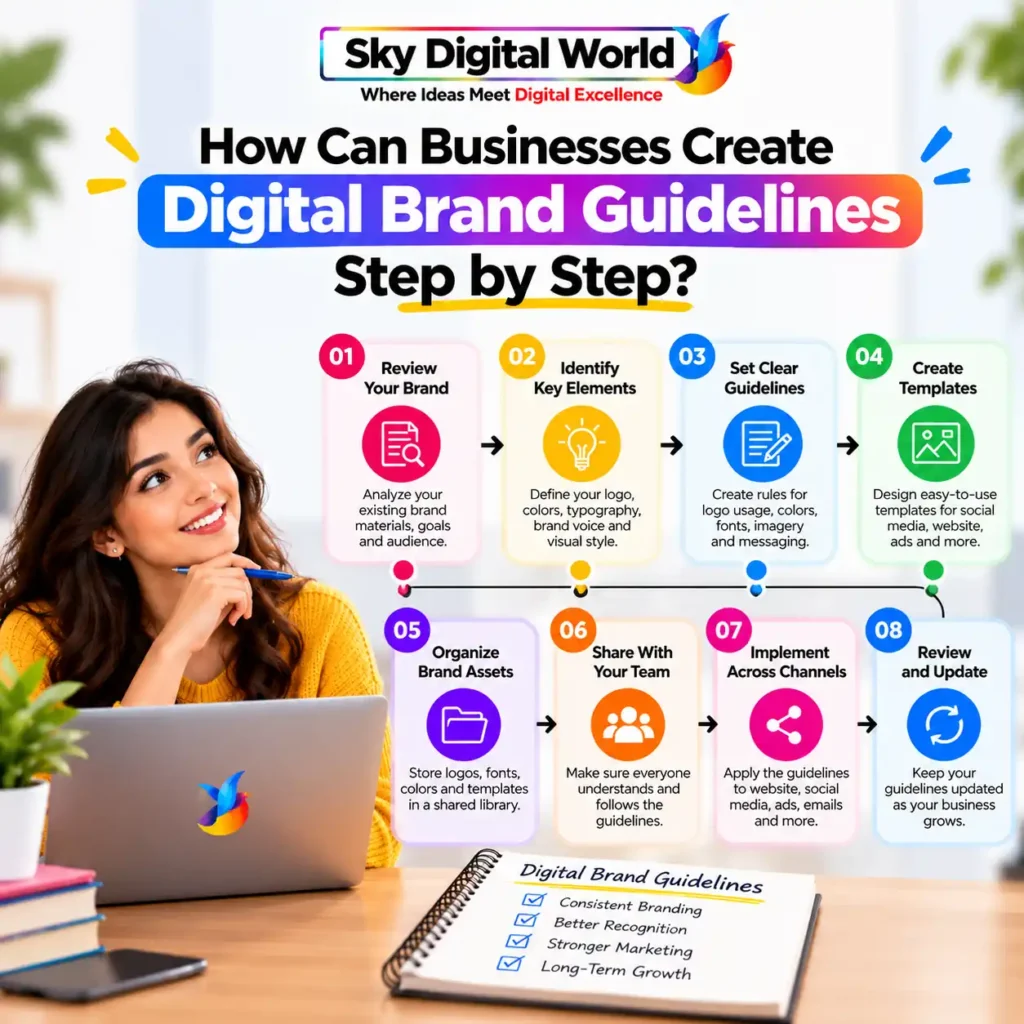
Digital Brand Guidelines Creation Process
- Review Existing Brand Materials
Collect logos, website designs, advertisements, social media posts, and presentations. - Identify Inconsistencies
Check whether colors, fonts, messaging, and logo usage differ across platforms. - Define Brand Standards
Finalize approved visual elements, brand voice, and communication rules. - Create Practical Examples
Include sample posts, advertisements, website sections, and correct versus incorrect usage. - Organize Approved Assets
Store original logos, templates, fonts, and design files in an accessible location. - Share Guidelines With Your Team
Ensure designers, agencies, developers, and marketing staff understand the rules. - Review and Update Periodically
Revise the document when the business introduces new platforms, services, or approved branding changes.
What Are the Most Common Digital Branding Mistakes?
Even businesses with strong products and services can make branding mistakes.
One common issue is using different logo versions across platforms without a clear reason.
Another is changing design styles too frequently in an attempt to follow every new trend.
Businesses may also overlook mobile readability, use inconsistent communication tones, or create advertisements that do not visually connect with their website.
A further mistake is preparing brand guidelines but never sharing them with the people responsible for marketing.
Brand guidelines only become useful when teams apply them consistently.
How Can Digital Brand Guidelines Support Business Growth?
Digital Brand Guidelines do not automatically increase sales or guarantee customer loyalty.
However, they can support several important business activities.
Consistent branding may improve recognition, make marketing production more efficient, and reduce confusion between different customer touchpoints.
Clear guidelines also help businesses maintain a professional identity when working with external agencies, freelancers, or new employees.
As a business expands into new products, services, or markets, documented branding standards can make it easier to maintain consistency.
The long-term benefit is a more organized and recognizable digital presence.
How Can Sky Digital World Help Businesses Maintain Brand Consistency?
At Sky Digital World, we understand that effective digital marketing requires more than attractive graphics or individual advertising campaigns.
Businesses need a recognizable identity that connects their website, social media presence, advertisements, and marketing communication.
Our services include graphic design, social media management, website development, professional video content, SEO, and digital advertising.
By maintaining a consistent creative direction across these activities, businesses can present a more unified digital identity.
Whether a company is launching a new brand or improving its existing online presence, clear brand standards can help guide future marketing decisions.
Conclusion
A recognizable digital brand is built through consistent experiences, not just a memorable logo.
Every website page, social media post, advertisement, video, and customer message contributes to how people perceive a business.
Digital Brand Guidelines help organize these interactions by establishing clear rules for visual design, communication, and content creation.
Businesses that document and follow their brand standards can create more consistent marketing materials, improve team coordination, and build a recognizable digital presence.
The goal is simple: wherever customers discover your business online, they should experience the same brand identity.
Frequently Asked Questions About Digital Brand Guidelines
Digital Brand Guidelines are documented rules explaining how a business should use its logo, colors, typography, imagery, messaging, and other brand elements across digital platforms.
Yes. Even small businesses can benefit from basic guidelines covering logo usage, brand colors, fonts, communication tone, and social media design standards.
Brand identity refers to the visual and communication elements that represent a business. Brand guidelines explain how those elements should be used consistently.
There is no fixed length. A small business may begin with a concise document, while a larger organization may need more detailed instructions for different teams and platforms.
Businesses should review their guidelines periodically and update them when approved branding changes, new communication channels, or additional design requirements are introduced.