




How Can Businesses Create a Customer Journey Map That Actually Helps Sales?
How Can Businesses Create a Customer Journey Map That Actually Helps Sales?
Every business wants more customers, but not every business understands what happens before a customer makes a purchase.
Some people discover your business through Instagram. Others visit your website, compare your services, read reviews, and leave without contacting you. A few return after several days and finally request a quotation.
These actions may appear unrelated, but they are all part of the customer journey.
The challenge is that many businesses focus only on the final sale. They overlook the questions, doubts, expectations, and experiences that influence customers before making a decision.
This is where Customer Journey Mapping becomes useful.
A well-planned customer journey map helps businesses understand how people discover their brand, what information they need, where they face difficulties, and what encourages them to take the next step.
More importantly, it can help marketing and sales teams work together to create a smoother buying experience.
In this guide, we will explore how businesses can create a practical customer journey map that supports better communication, stronger customer experiences, and more effective sales processes.
What Is Customer Journey Mapping?
Customer Journey Mapping is the process of visually organizing the different steps a customer takes while interacting with a business.
It shows how customers move from discovering a product or service to making an enquiry, purchasing, and potentially returning for future business.
A customer journey map usually includes:
- Customer goals and expectations
- Online and offline interactions
- Questions customers ask
- Problems or frustrations they experience
- Actions they take before purchasing
- Opportunities for businesses to improve the experience
For example, someone searching for website development services may first discover a business through Google, visit its website, explore previous projects, compare quotations, and contact the agency through WhatsApp.
Understanding this journey helps the agency provide relevant information at each stage.
The purpose of Customer Journey Mapping is not simply to record customer actions. It is to understand why those actions happen and what businesses can improve.
Why Is Customer Journey Mapping Important for Sales?
Sales do not begin only when customers contact a business.
In many cases, customers have already researched different options before speaking with a sales representative.
If they cannot find useful information, understand your services, or feel confident about your business, they may choose another provider.
Customer Journey Mapping helps businesses identify these gaps.
1. It Helps Businesses Understand Customer Behaviour
Instead of assuming what customers want, businesses can study actual interactions.
For example, if visitors frequently explore a service page but rarely submit enquiries, the business can investigate whether pricing expectations, missing information, confusing navigation, or weak calls to action are contributing factors.
2. It Improves Marketing Communication
Different customers need different information.
Someone discovering your brand for the first time may need an introduction, while someone comparing quotations may want detailed specifications or project examples.
Journey mapping helps businesses communicate more appropriately at each stage.
3. It Supports Better Sales Follow-Ups
A customer requesting information today may not be ready to purchase immediately.
Understanding their stage in the buying journey helps sales teams provide relevant follow-ups rather than repeatedly sending generic promotional messages.
4. It Identifies Customer Experience Problems
Businesses can identify situations where customers face unnecessary difficulties, such as complicated enquiry forms, unclear product information, or delayed responses.
Fixing these problems may make the buying process easier.
What Are the Five Main Stages of a Customer Journey?
Although customer journeys vary by industry, many businesses can begin with five practical stages.
Customer Journey Stage | Customer’s Main Question | Business Opportunity |
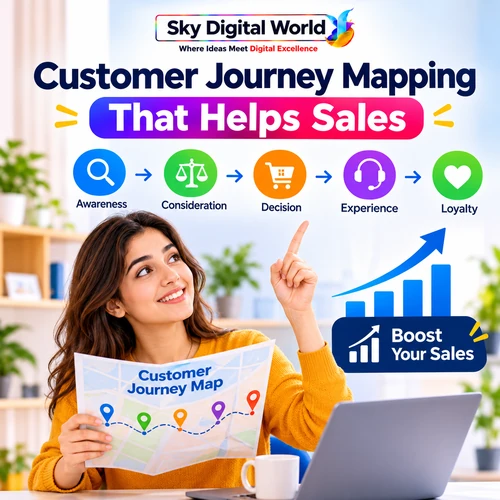
Awareness | What options are available? | Build visibility and introduce the brand |
Consideration | Which business should I choose? | Provide useful comparisons and information |
Decision | Can I trust this business? | Simplify enquiries and purchasing |
Experience | Did I make the right choice? | Deliver reliable service and support |
Loyalty | Should I purchase again? | Maintain relationships and encourage repeat business |
Let’s understand each stage.
Stage 1: Awareness – How Do Customers Discover Your Business?
The awareness stage begins when customers recognize a need or problem.
They may search on Google, watch a social media reel, see an advertisement, or receive a recommendation.
For example, a business owner might realize that their existing website is outdated and begin searching for professional website development services.
At this stage, they may not know which agency to choose.
What should businesses do?
Create educational blog content, useful social media posts, relevant advertisements, and clear service information.
The objective is to help potential customers understand their problem and discover possible solutions.
Stage 2: Consideration – Why Should Customers Choose You?
During consideration, customers compare different businesses.
They may evaluate service quality, previous work, customer reviews, pricing structures, experience, and communication.
For example, a customer comparing digital marketing agencies may visit several websites and examine their services and portfolios.
If your website does not clearly explain your offering, customers may struggle to understand your value.
What should businesses do?
Provide detailed service pages, genuine testimonials, relevant case studies, project examples, and answers to frequently asked questions.
The goal is to help customers make informed comparisons.
Stage 3: Decision – What Encourages Customers to Take Action?
At this stage, customers may be ready to request a quotation, schedule a consultation, or purchase a product.
However, small difficulties can interrupt the process.
A complicated contact form, unclear next step, or delayed response may discourage customers.
What should businesses do?
Make contact options easy to find, communicate the next steps clearly, and respond to enquiries promptly.
Businesses should also explain what customers can expect after submitting their details.
Stage 4: Experience – What Happens After the Purchase?
The customer journey does not end when payment is received.
Customers continue evaluating the business through delivery, communication, product quality, service support, and problem resolution.
For example, a website development client may judge the agency by its project updates, delivery process, responsiveness, and post-launch support.
What should businesses do?
Set realistic expectations, communicate progress, deliver agreed services, and provide appropriate support.
A positive experience can help build customer confidence.
Stage 5: Loyalty – Why Would Customers Return?
After a successful purchase, customers may return for additional products or services.
However, businesses should not assume customers will remember them automatically.
Relevant follow-ups, useful updates, and dependable service can help maintain relationships.
For example, a website development client may later require SEO, website maintenance, or social media marketing.
A business that maintains helpful communication may be considered again when those needs arise.
How Can Businesses Create a Customer Journey Map Step by Step?
Creating a customer journey map does not require expensive software.
A spreadsheet, whiteboard, or simple visual diagram can be enough to get started.
The important part is collecting useful information and turning it into practical improvements.
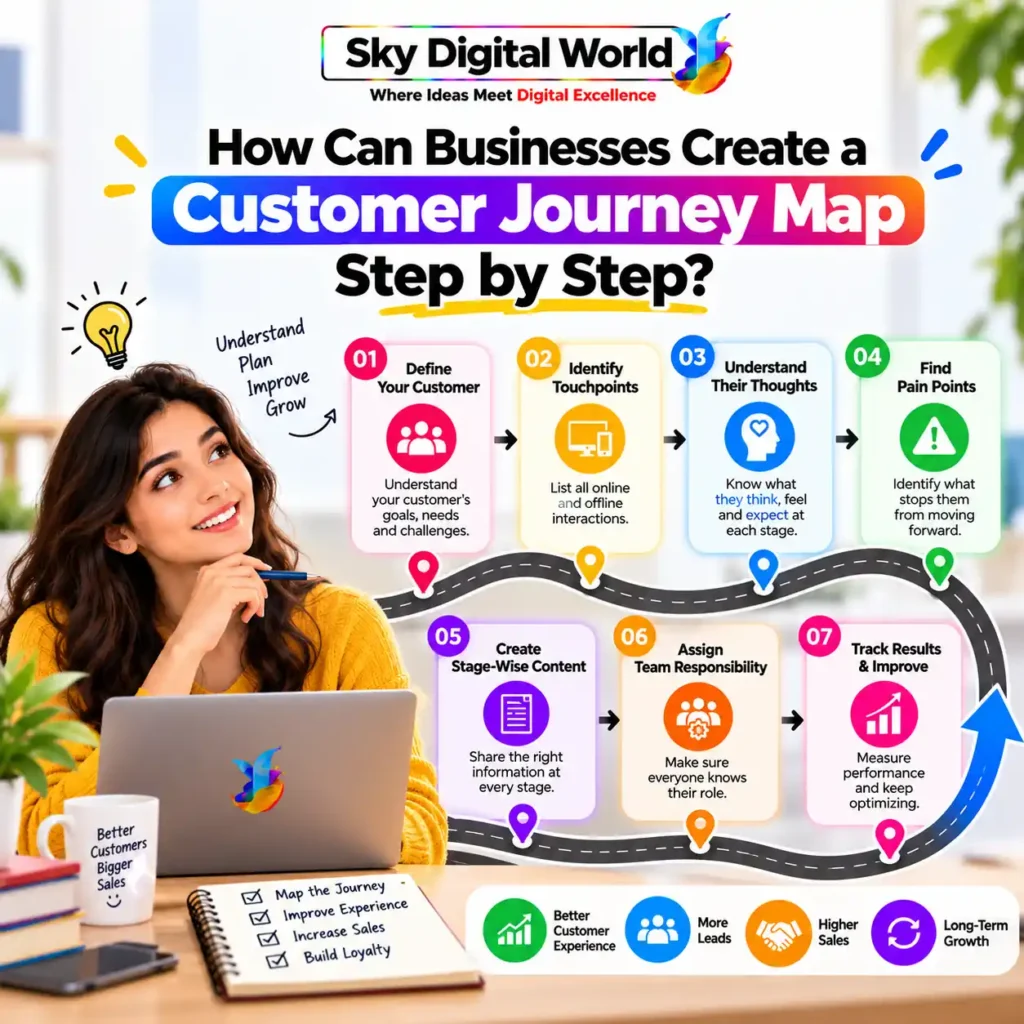
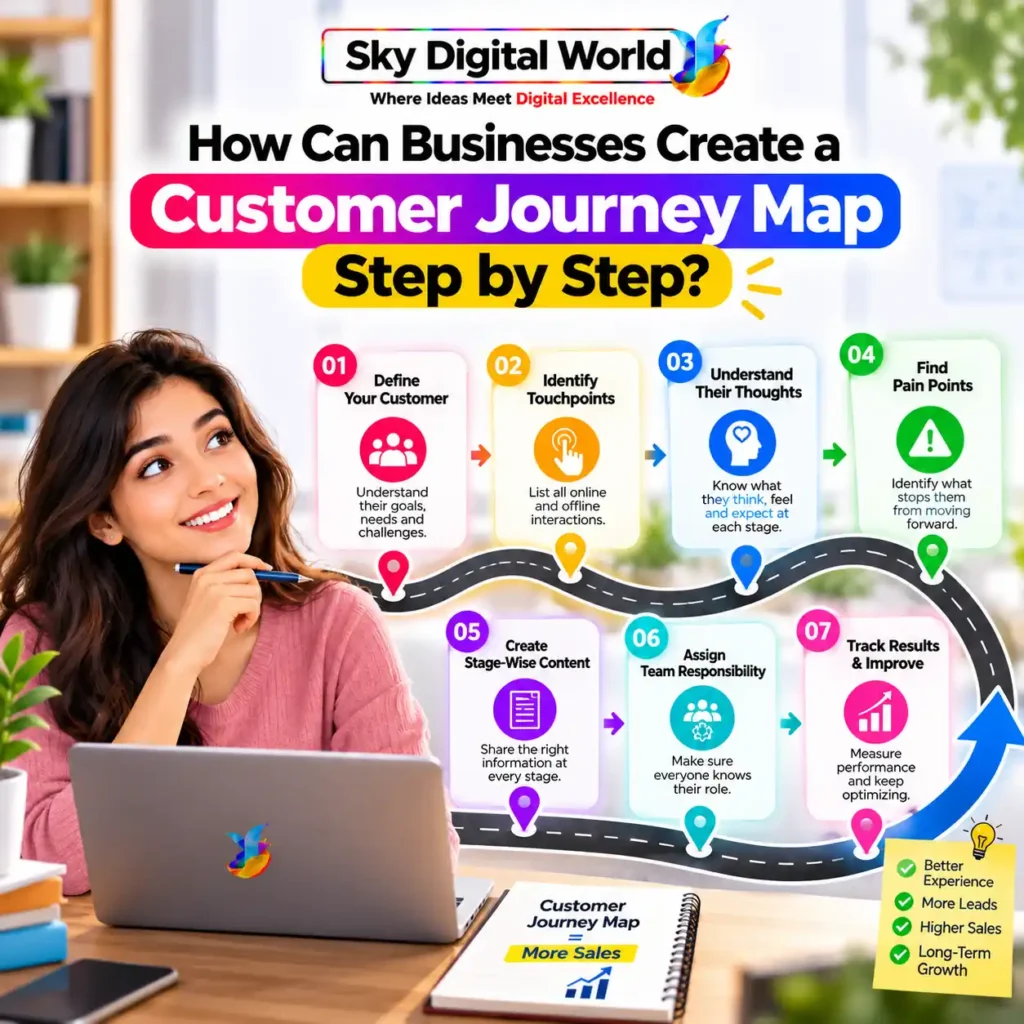
Step 1: Define the Customer You Want to Understand
Start with a specific customer group.
For example, a digital marketing agency may serve local retailers, manufacturers, real estate companies, and e-commerce businesses.
These customers may have very different needs and decision-making processes.
Trying to map all of them together can create confusion.
Instead, choose one customer segment.
Example: Small business owners looking for website development services.
Identify their common goals, concerns, preferred communication channels, and buying expectations.
Step 2: Identify Every Important Customer Touchpoint
A customer touchpoint is any interaction between a customer and your business.
Common touchpoints include Google Search, social media profiles, paid advertisements, website pages, WhatsApp conversations, telephone calls, emails, quotations, and customer support.
For example, a potential customer may follow this path:
Example: Website Development Customer Journey
Google Search
Discovers the agency
Website & Portfolio
Reviews services and past work
WhatsApp Enquiry
Asks about requirements and pricing
Quotation & Discussion
Evaluates the proposed solution
Project Confirmation
Approves the project and proceeds
Mapping these interactions helps businesses understand where customers need additional information or support.
Step 3: Understand What Customers Think and Feel
Customer Journey Mapping should go beyond tracking clicks and enquiries.
Try to understand the questions customers may have at different stages.
For example:
- Is this business experienced?
- Can they understand my requirements?
- Will the service fit my budget?
- What happens after I make an enquiry?
- Can I trust their delivery commitments?
These questions should be validated through customer interviews, enquiry conversations, feedback, or other available evidence rather than relying only on assumptions.
When businesses understand customer concerns, they can communicate more effectively.
Step 4: Identify Problems That Interrupt the Journey
Look for points where customers stop progressing.
Examples include visitors leaving a website before reaching the contact page, customers requesting quotations but not responding, or buyers abandoning a checkout process.
These situations may indicate friction, but the underlying reason needs investigation.
Businesses can review website analytics, enquiry records, customer feedback, and sales conversations to understand possible causes.
The goal is to identify specific problems that can be improved rather than assuming every lost enquiry has the same explanation.
Step 5: Match the Right Content With Each Stage
Not every customer needs the same message.
A customer discovering your business may benefit from educational content, while someone ready to purchase may need a quotation or clear contact information.
Journey Stage | Recommended Content |
Awareness | Educational blogs, introductory reels, helpful social posts |
Consideration | Service explanations, comparisons, case studies |
Decision | Quotation information, contact options, consultation details |
Experience | Onboarding instructions, project updates, support information |
Loyalty | Helpful updates, relevant service recommendations, feedback requests |
Matching content with customer needs can make marketing communication more relevant.
Step 6: Assign Responsibility to Your Team
A journey map becomes more useful when each improvement has a responsible person.
For example, the marketing team may manage awareness content, the website team may improve service pages, and the sales team may handle enquiries and quotations.
Customer support may be responsible for post-purchase communication.
Even small businesses with limited staff can assign clear responsibilities.
This helps prevent customer enquiries or follow-up tasks from being overlooked.
Step 7: Measure Results and Update the Journey Map
Customer behaviour changes over time.
Businesses should review their journey maps periodically and compare them with actual customer interactions.
Useful indicators may include enquiry conversion rate, response time, quotation acceptance rate, checkout completion rate, customer satisfaction, and repeat purchase rate.
The most useful metrics depend on the business model.
If a particular stage shows weak results, investigate it and test relevant improvements.
What Does a Practical Customer Journey Map Look Like?
Consider a hypothetical company offering social media marketing services.
Example Customer Journey Map
Stage | Customer Action | Business Improvement |
Awareness | Sees an Instagram reel | Explain a common marketing problem |
Consideration | Visits service page | Show deliverables and examples |
Decision | Requests a proposal | Provide a clear quotation |
Experience | Starts the service | Share timelines and updates |
Loyalty | Reviews monthly results | Discuss next steps |
This simple map shows how marketing, sales, and service delivery can support the same customer experience.
Businesses can expand it by adding customer questions, difficulties, performance indicators, and responsible team members.
How Can Customer Journey Mapping Help Reduce Lost Sales Opportunities?
Not every customer who leaves without purchasing represents a lost sale. Some visitors are researching, comparing options, or simply not ready.
However, businesses can reduce avoidable difficulties by making the next step easier.
For example, if customers regularly request quotations but do not proceed, the business could examine whether its proposals clearly explain the scope of work, deliverables, timelines, and payment terms.
If website visitors struggle to find contact information, the business can improve navigation and enquiry options.
If existing customers frequently ask the same support questions, the business can create clearer onboarding material.
These improvements help address specific customer needs rather than relying only on additional advertising.
What Are the Most Common Customer Journey Mapping Mistakes?
One common mistake is creating a visually attractive journey map without using real customer information.
Another is focusing entirely on attracting new customers while ignoring what happens after an enquiry or purchase.
Businesses may also create overly complicated maps with too many stages, assumptions, and metrics.
A useful journey map should remain simple enough for the team to understand and act upon.
It should also be reviewed when customer behaviour, services, or sales processes change.
A customer journey map is valuable because of the decisions it helps a business make, not because of how detailed the diagram looks.
Which Tools Can Businesses Use for Customer Journey Mapping?
Businesses can begin with familiar tools.
Google Sheets or Excel can organize stages, customer questions, touchpoints, problems, and improvement tasks.
Visual tools such as Miro or FigJam can help teams create diagrams and collaborate.
Google Analytics 4 can provide information about website interactions, while customer relationship management systems can help organize enquiries and sales progress.
Customer surveys, support conversations, and sales records can provide additional context.
No single tool automatically explains the entire customer journey. Combining available information with customer feedback is often more useful than relying on one dashboard.
How Can Sky Digital World Support a Better Digital Customer Journey?
At Sky Digital World, we help businesses develop a more connected digital presence through website development, SEO, social media management, creative content, and digital advertising.
These services support different stages of the customer journey.
For example, SEO and educational content can help potential customers discover a business, while professional website design can make service information easier to understand.
Social media content and digital advertisements can communicate relevant messages, while clear website calls to action can help interested visitors take the next step.
By aligning digital marketing activities with customer needs, businesses can create a more consistent experience across online channels.
Conclusion
A customer journey is more than a series of clicks, conversations, and purchases. It represents the complete experience people have while discovering, evaluating, and interacting with a business.
When businesses understand this experience, they can identify what customers need, where communication becomes confusing, and which improvements deserve attention.
Customer Journey Mapping helps connect marketing activities, sales conversations, and customer service into a more organized process.
The objective is not simply to push customers toward a purchase. It is to make every important interaction clearer, more helpful, and easier to navigate.
Businesses that regularly study their customer journeys can make better decisions about their content, websites, sales follow-ups, and long-term customer relationships.
Frequently Asked Questions About Customer Journey Mapping
The main purpose is to understand how customers interact with a business, identify their needs and difficulties, and improve the experience across different stages of the buying process.
Yes. Small businesses can begin with a simple spreadsheet showing customer stages, common questions, touchpoints, and possible improvements. Expensive software is not necessary.
A sales funnel focuses mainly on how prospects progress toward a purchase. A customer journey map provides a broader view of customer actions, questions, experiences, and interactions before and after purchasing.
Businesses should review their maps periodically, especially when customer behaviour changes, new services are introduced, or recurring problems appear in the sales process.
No. It does not guarantee sales growth. However, it can help businesses identify friction, improve communication, and make more informed marketing and sales decisions.