





Why Should Businesses Invest in Google Ads?
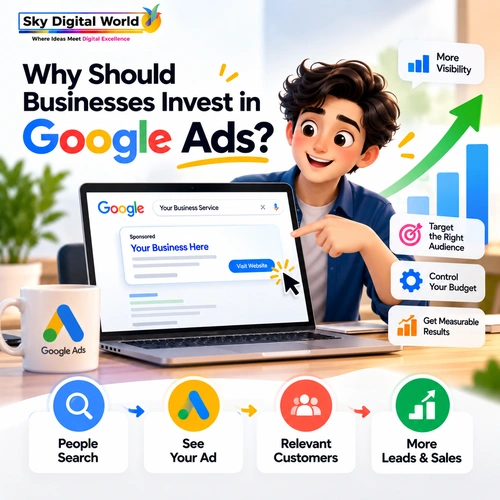
Why Should Businesses Invest in Google Ads?
Getting attention online is becoming harder. Customers have more choices, search results are more competitive, and simply having a website does not guarantee that the right people will find your business.
This is where Google Ads can play an important role.
Unlike many advertising channels that interrupt people while they are doing something else, Google Search Ads can connect businesses with users who are actively searching for a related product, service or solution. Google itself describes Search campaigns as a way to reach people while they are searching for what a business offers.
For businesses looking for faster visibility, measurable enquiries and greater control over advertising spend, professional Google Ads Management Services in India can become an important part of the overall digital marketing strategy.
But investing in Google Ads does not simply mean choosing a budget and running an advertisement. The real opportunity comes from understanding customer intent, selecting the right keywords, creating relevant ads and turning clicks into genuine business opportunities.
Google Ads Helps You Reach People With Existing Intent
Imagine two people.
One is scrolling through social media without looking for anything in particular. Another opens Google and searches:
“commercial interior designer near me”
or
“best digital marketing agency in Indore.”
The second person is already expressing an intention. They may be researching, comparing options or preparing to contact a business.
This is one of the biggest strengths of Google Search Ads.
Keywords allow advertisers to connect their ads with relevant searches, helping businesses appear when potential customers are actively looking for related products or services.
That does not guarantee a sale, but it can put your business in front of a customer at a highly relevant moment.
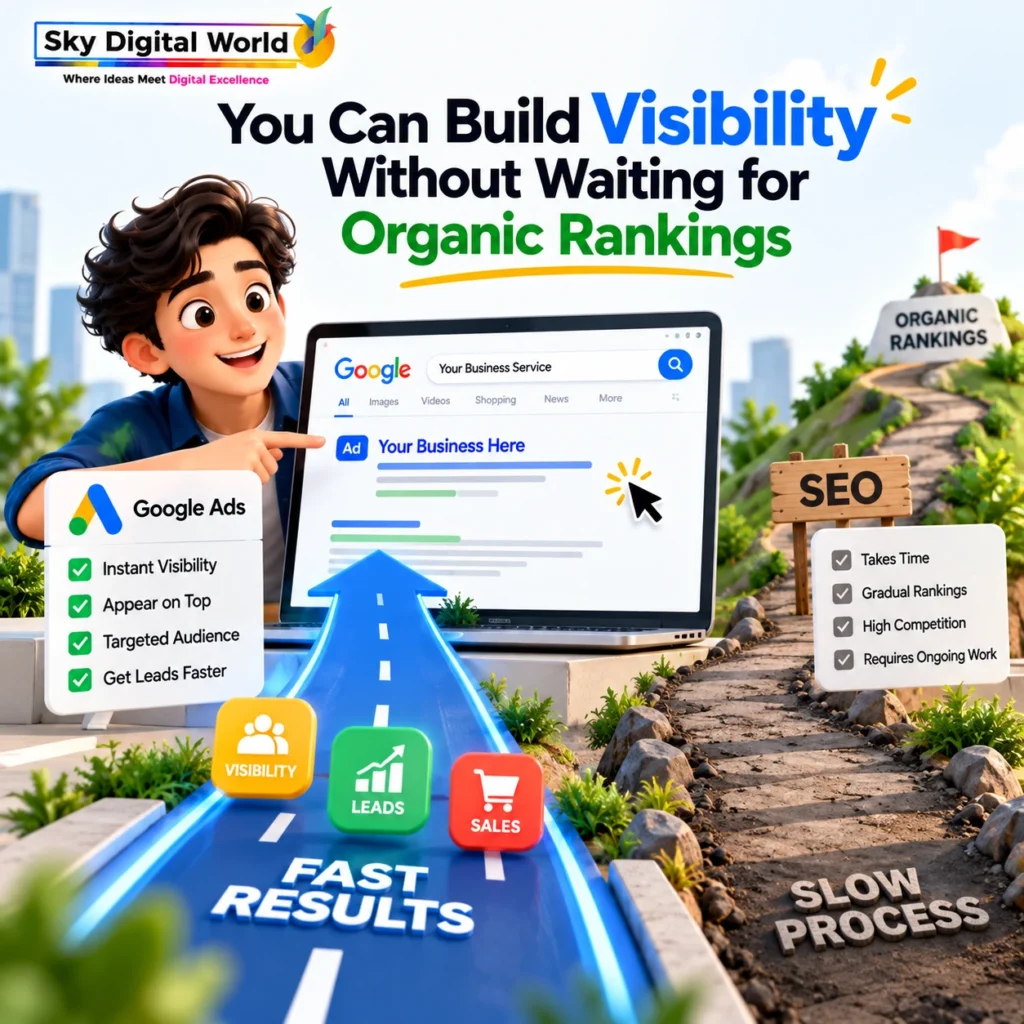
You Can Build Visibility Without Waiting for Organic Rankings
SEO is valuable for sustainable organic visibility, but it usually requires ongoing work.
A newly launched website, a business entering a competitive market or a company promoting a new service may not immediately have strong organic search positions.
Google Ads provides another route to search visibility.
A properly configured campaign can make eligible ads available for relevant searches without waiting for a page to build organic rankings first.
This makes paid search particularly useful for:
- New businesses and websites
- New product or service launches
- Competitive industries
- Location-specific campaigns
- Seasonal promotions
- Lead generation campaigns
- Businesses testing new markets
Google Ads should not necessarily replace SEO. For many businesses, SEO and paid search serve different purposes: SEO builds organic search presence while Google Ads provides paid access to relevant search opportunities.
Google Ads Offers Detailed Targeting
Showing an advertisement to everyone is rarely an efficient marketing strategy.
A local service provider in Madhya Pradesh, for example, may not need enquiries from locations it cannot serve.
Google Ads provides targeting options based on factors such as keywords, geographic location, language, devices, days and times.
This allows campaigns to be designed around the actual market of a business.
For example, a company providing B2B services could build separate campaigns for Indore, Bhopal, Mumbai or other priority markets rather than using one generic campaign for the entire country.
The objective is not simply to generate more clicks.
It is to create more relevant opportunities from the right audience.
Businesses Can Control Their Advertising Budget
One concern businesses often have about paid advertising is:
“How much money will we need?”
There is no single budget that works for every Google Ads campaign.
Competition, keyword costs, location, industry, conversion rate and business goals all influence what makes sense.
The advantage is that Google Ads provides advertisers with control over their spending settings. Google states that advertisers can choose how much they spend and adjust their budgets according to their requirements.
A business can therefore start with a planned budget, collect data and make decisions based on campaign performance.
However, budget control alone does not make a campaign profitable.
A ₹50,000 campaign targeting the wrong keywords can waste money, while a carefully structured smaller campaign may generate more useful enquiries.
Strategy matters as much as budget.
Google Ads Makes Marketing More Measurable
Traditional advertising can sometimes make one important question difficult to answer:
What actually happened after people saw the advertisement?
Digital advertising provides much greater measurement potential.
Google Ads can track actions such as ad clicks and, when conversion tracking is correctly implemented, valuable actions including purchases, calls or other defined conversions.
Depending on the business and tracking setup, marketers can evaluate metrics such as:
Impressions → Clicks → Enquiries → Qualified Leads → Sales
Instead of saying:
“The campaign received 1,000 clicks.”
a business should ultimately be asking:
“How many of those clicks created valuable business opportunities?”
That difference is important.
Clicks are activity. Conversions and revenue are business outcomes.
Google Ads Can Generate Leads for Service Businesses
Google Ads is not only useful for e-commerce businesses.
It can also work particularly well for service companies because many customers use Google when they have a specific requirement.
Someone might search for:
“SEO company in Madhya Pradesh”
“industrial pipe manufacturer in Indore”
“property consultant near me”
or
“website development company in India.”
A well-planned Search campaign can direct these users to a relevant service landing page and encourage them to call, submit an enquiry or request a quotation.
Google specifically positions Search campaigns as suitable for goals such as leads, sales and website traffic.
For B2B and high-value services, however, lead quality should usually matter more than raw lead volume.
Ten relevant decision-makers may be more valuable than 100 unrelated form submissions.
You Can Understand What Customers Are Actually Searching For
Google Ads can also provide useful marketing intelligence.
Search data can reveal the language customers use when looking for solutions.
For example, a business may describe its offering internally as:
“Integrated Digital Growth Solutions.”
Customers may actually be searching for:
“Google Ads agency,” “SEO company,” “social media marketing company,” or “lead generation services.”
That information can help businesses refine advertising messages, landing pages, website copy and even SEO content.
Google Ads therefore should not be viewed only as an advertising platform.
When interpreted carefully, campaign data can also help businesses understand customer demand and search behaviour.
Google Ads Can Support Different Stages of the Customer Journey
Not every potential customer is ready to buy immediately.
Some users are discovering a problem. Others are comparing providers. Some are ready to request a quote.
Google Ads offers different campaign formats that can support different objectives. Current options include Search, Performance Max, YouTube and Demand Gen, among others.
For example, Search can capture active demand, while visual and video formats can help businesses reach audiences beyond traditional search results.
The correct campaign type depends on the business objective rather than simply choosing whichever format appears newest.
Landing Page Quality Matters as Much as the Advertisement
One of the biggest Google Ads mistakes happens after the click.
A company may create an excellent advertisement but send visitors to a slow, confusing or irrelevant page.
Google identifies three components within its Quality Score diagnostic framework:
Expected click-through rate, ad relevance and landing-page experience.
This highlights an important principle:
Ad → Landing Page → Conversion
should feel like one continuous experience.
If somebody searches for “Google Ads Management Services in India,” clicks an advertisement about Google Ads management, and lands on a generic homepage covering ten unrelated services, the experience may be weaker than sending them to a dedicated Google Ads page.
The landing page should clearly answer:
What do you offer?
Who is it for?
Why should the customer trust you?
What should they do next?
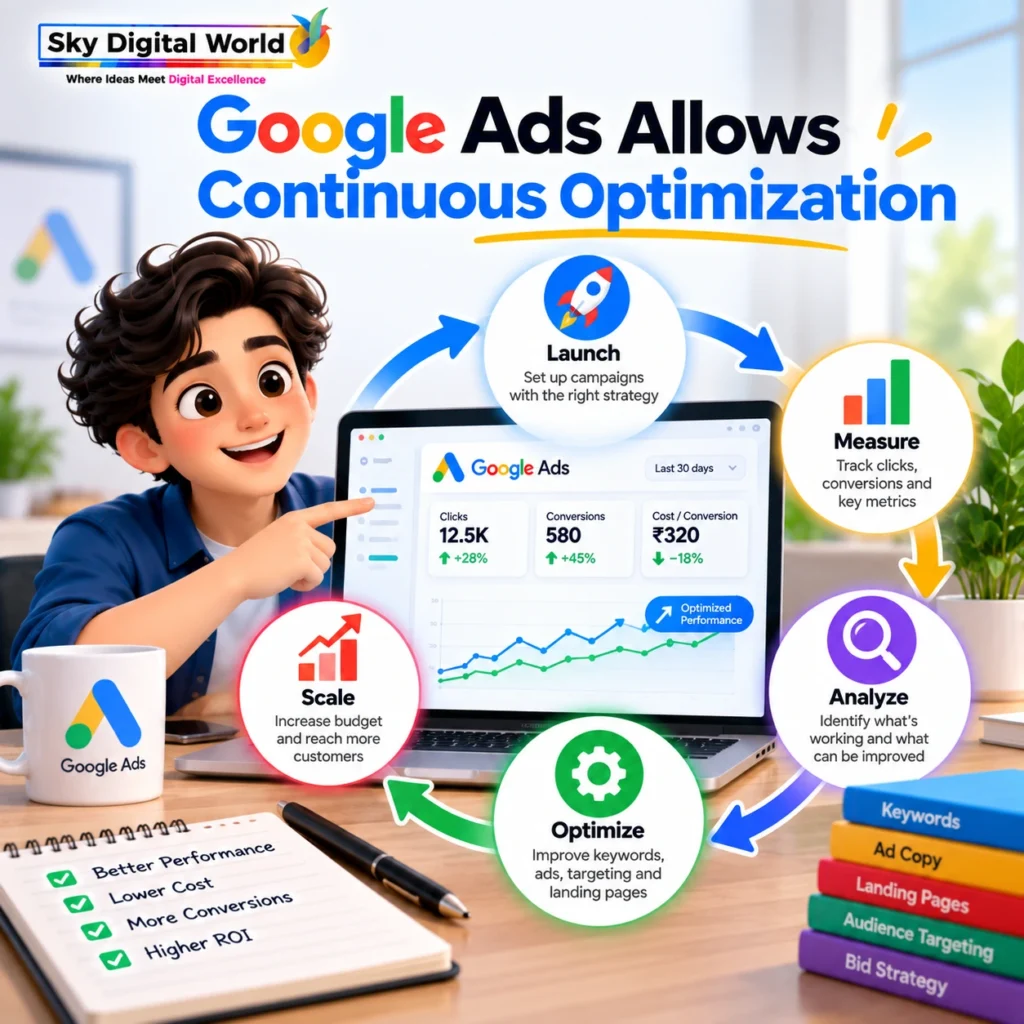
Google Ads Allows Continuous Optimization
A campaign should not remain unchanged for months.
Good campaign management involves learning from real performance data.
Businesses can continuously review areas such as search terms, keywords, ad messaging, targeting, devices, locations, conversion rates and landing-page performance.
Google also recommends examining metrics such as click-through rate and conversion rate alongside its Quality Score diagnostics rather than treating Quality Score itself as the main business KPI.
This creates an ongoing cycle:
Launch → Measure → Learn → Optimize → Scale
The goal is not to constantly make random changes. It is to use enough reliable data to identify what is working and what needs improvement.
Google Ads Is Evolving With AI-Powered Search
Google Search itself is changing as AI becomes more integrated into the search experience.
In 2026, Google announced additional experimentation with AI-driven ad experiences in Search, including new formats associated with AI Mode and Gemini.
For businesses, this makes campaign strategy increasingly important.
Automation can assist with bidding, targeting and creative combinations, but businesses still need strong fundamentals: accurate conversion tracking, useful landing pages, clear offers, quality customer data and sensible commercial goals.
AI does not make strategy unnecessary.
It makes good inputs and measurement even more important.
What Should Google Ads Management Services in India Include?
Running Google Ads professionally involves much more than creating a campaign and adding a few keywords.
A comprehensive Google Ads strategy should normally cover business and competitor research, keyword research, campaign structure, location and audience targeting, ad copy, negative keyword management, conversion tracking, landing-page recommendations, budget management, bidding strategy, search-term analysis and ongoing optimization.
Most importantly, reporting should connect advertising metrics with actual business results.
Instead of focusing only on impressions and clicks, businesses should monitor metrics such as cost per qualified lead, conversion rate, lead quality and return on advertising spend, where those measures are appropriate to the business model.
Is Google Ads Worth the Investment?
Google Ads can be valuable when a business has identifiable customer demand, a clear offer, appropriate targeting, useful landing pages and reliable conversion measurement.
It is not a shortcut that guarantees sales.
Poor keyword selection, broad targeting, weak landing pages or incomplete tracking can quickly turn advertising spend into expensive traffic.
The better question therefore is not:
“Should we spend money on Google Ads ?”
It is:
“Can we build a Google Ads system that reaches the right people and measures whether those interactions create business value?”
When that system is designed properly, Google Ads can become much more than a traffic source. It can become a measurable customer-acquisition channel that works alongside SEO, content marketing, social media and other digital strategies.
Frequently Asked Questions
Google Ads can help businesses reach potential customers who are searching for relevant products or services. It also provides targeting, budget controls and measurable campaign data, making it useful for lead generation, sales and website traffic.
Yes. Small businesses can use geographic, keyword and other targeting controls to focus campaigns on relevant audiences. The appropriate budget and campaign structure will depend on competition, goals and expected customer value.
Ads can begin receiving impressions and clicks after an eligible campaign is approved and starts serving, but profitable results may take longer. Campaigns often need enough conversion data to evaluate keywords, targeting, ads and landing pages effectively.
Google Ads provides paid visibility, while SEO focuses on earning organic search visibility. Paid campaigns can support faster market exposure, whereas SEO generally focuses on building sustainable organic presence over time. Many businesses use both rather than treating them as substitutes.
Businesses should look beyond clicks and impressions. Depending on the campaign goal, useful metrics can include conversions, conversion rate, cost per conversion, qualified leads, sales value, customer acquisition cost and return on advertising spend.