




How Does AI Search Use Structured Data?
How Does AI Search Use Structured Data?
Search engines are evolving beyond traditional keyword-based results. Platforms such as Google AI Overviews, ChatGPT and Gemini can help users discover information through conversational answers, summaries and recommendations.
For businesses, this creates a new challenge. Publishing informative website content is important, but making that information easy for search engines and automated systems to interpret is equally valuable.
This is where structured data for AI search becomes relevant.
Structured data helps search engines understand important information about a business, its products, services, articles and other website content in a standardized format.
When implemented correctly, it can support better content interpretation, search visibility and digital discoverability.
Quick Answer
Structured data helps search engines identify and understand website information by providing standardized labels for businesses, products, services and other entities. It can support AI-powered search by making content easier to interpret. However, structured data alone does not guarantee rankings, recommendations or inclusion in AI-generated answers.

What Is Structured Data in SEO?
Structured data is a standardized format used to describe information on a website in a machine-readable way.
While visitors understand website information by reading text and viewing images, search engines can use structured data to identify what specific information represents.
For example, a digital marketing agency website may display its company name, services, contact details and business location.
Structured data can help search engines distinguish these details as specific business attributes rather than ordinary website text.
Most websites implement structured data using the vocabulary available at Schema.org, commonly through JSON-LD markup.
How Does AI Search Use Structured Data?
AI-powered search systems can use multiple sources and signals to interpret information, understand relationships and generate relevant responses.
Structured data can support this process in several ways.
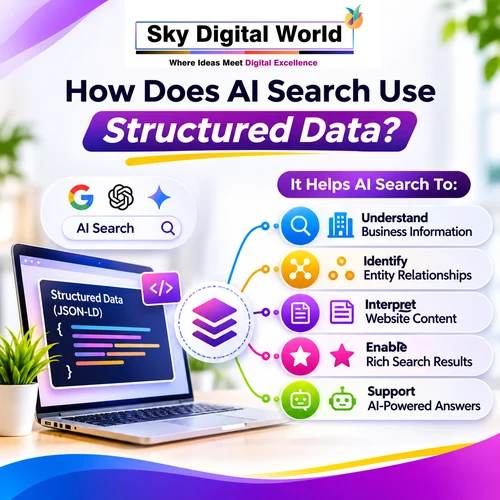
1. Understanding Business Information
Structured data helps search engines identify essential business details, including:
- Company name and location
- Products and services
- Contact information
- Business operating hours
- Official website and social profiles
Consistent information can help establish a clearer understanding of a business across digital platforms.
2. Identifying Relationships Between Entities
Modern search systems interpret relationships between people, organizations, products, locations and topics.
These identifiable subjects are commonly called entities.
For example, structured data can describe the relationship between a digital marketing agency, its service offerings and its business location.
This provides additional context about the organization and its activities.
3. Interpreting Website Content
Structured data can help distinguish different types of website content, such as articles, product listings, videos and business information.
An article containing appropriate Article schema, for example, can communicate its headline, author, publication date and featured image in a standardized format.
4. Supporting Search Result Features
Certain structured data types can make eligible pages qualify for enhanced Google search appearances, commonly known as rich results.
These may include product information, ratings, prices and availability.
However, rich result eligibility and inclusion in AI-generated answers are different things. Neither is guaranteed by implementing schema markup.
Which Types of Structured Data Are Useful for AI Search?
Businesses should select schema types according to the actual purpose and visible content of each webpage.
Schema Type | Purpose |
Organization Schema | Describes company information and identity |
LocalBusiness Schema | Provides local business information |
Service Schema | Describes professional services |
Product Schema | Identifies products, prices and availability |
Article Schema | Describes blog posts and editorial content |
BreadcrumbList Schema | Explains website navigation hierarchy |
VideoObject Schema | Provides information about website videos |
FAQPage Schema | Identifies frequently asked questions and answers |
Person Schema | Describes authors, professionals and individuals |
Not every schema type qualifies for Google rich results. For example, FAQ rich results are generally restricted to eligible authoritative government and health websites.
How Can Structured Data Support Different Businesses?
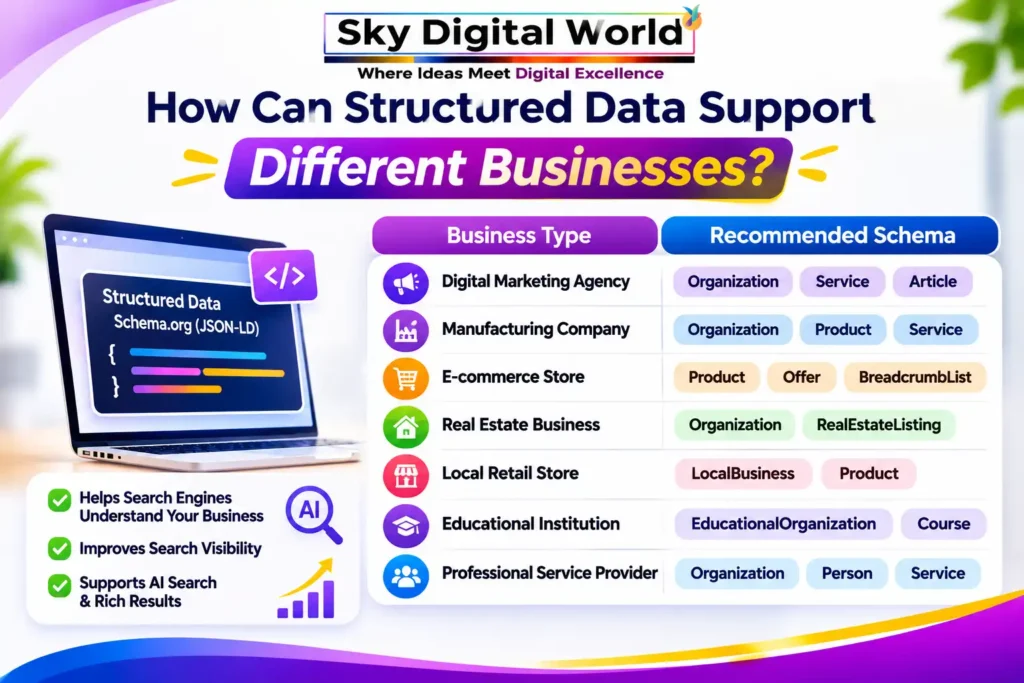
Structured data is useful across multiple industries because each business communicates different types of information online.
Business Type | Recommended Schema |
Digital Marketing Agency | Organization, Service, Article |
Manufacturing Company | Organization, Product, Service |
E-commerce Store | Product, Offer, BreadcrumbList |
Real Estate Business | Organization, RealEstateListing |
Local Retail Store | LocalBusiness, Product |
Educational Institution | EducationalOrganization, Course |
Professional Service Provider | Organization, Person, Service |
Selecting relevant schema types helps businesses describe their website information more accurately.
How Can Businesses Implement Structured Data on Their Websites?
Step 1: Identify Important Website Pages
Start by reviewing your homepage, service pages, product pages, contact page and published blog articles.
Each page may require different structured data depending on its content.
Step 2: Select Relevant Schema Types
Choose schema markup that accurately represents the information available on the page.
Avoid adding unrelated schema simply to target additional keywords.
Step 3: Add JSON-LD Markup
JSON-LD is a widely used format for implementing structured data.
For example, an organization schema for a digital marketing agency could look like this:
{
“@context”: “https://schema.org”,
“@type”: “Organization”,
“name”: “Sky Digital World”,
“url”: “https://skydigitalworld.com/”,
“description”: “Digital marketing, SEO, website development and branding services.”
}
This is a basic illustrative example. Businesses should expand their markup using accurate, verified company information.
Step 4: Validate Structured Data
Use reliable testing tools to identify markup errors and missing properties.
Tool | Purpose |
Google Rich Results Test | Checks supported Google rich result eligibility |
Schema Markup Validator | Validates Schema.org markup |
Google Search Console | Monitors supported search enhancements and indexing issues |
Step 5: Maintain Accurate Information
Update structured data whenever business details, product prices, availability, services or other relevant website information changes.
Does Structured Data Help Websites Rank in ChatGPT, Gemini and Google AI Overviews?
Structured data can contribute to a more understandable and technically organized website. However, different AI search platforms use different information retrieval and ranking systems.
There is no universal schema markup that guarantees visibility across all AI platforms.
Google does not require special AI-specific structured data for inclusion in its AI search features.
Businesses should combine structured data with strong SEO fundamentals, including original content, accessible website pages, clear business information, relevant internal links and trustworthy external references.
This broader approach supports both traditional SEO and Generative Engine Optimization (GEO).
Common Structured Data Mistakes Businesses Should Avoid
Common Mistake | Recommended Solution |
Adding irrelevant schema | Select markup that matches page content |
Using incorrect business information | Maintain accurate company details |
Adding fake ratings and reviews | Use genuine, eligible review information |
Displaying outdated product prices | Update product and offer markup |
Ignoring validation errors | Test structured data regularly |
Marking up hidden or misleading content | Ensure markup reflects visible information |
Expecting instant AI rankings | Combine schema with comprehensive SEO |
Conclusion
Structured data for AI search is a valuable component of a modern website optimization strategy.
By implementing relevant schema markup, maintaining accurate business information and publishing helpful content, businesses can make their websites easier for search engines to understand.
However, sustainable search visibility requires more than technical markup. Content quality, website accessibility, business credibility and consistent SEO practices remain essential.
At Sky Digital World, we help businesses implement technical SEO, structured data, GEO optimization and AI-focused content strategies to strengthen their digital presence.
Want to make your business website more accessible to traditional and AI-powered search engines? Connect with Sky Digital World for professional SEO and GEO optimization services.
Frequently Asked Questions
Structured data can help search engines interpret website information more clearly, although its use varies across AI search platforms.
Schema markup is not a guaranteed ranking boost. It helps Google understand content and can make eligible pages qualify for enhanced search appearances.
Yes. WordPress websites can implement structured data through compatible SEO plugins, custom code or theme functionality.
Yes. Shopify stores can use Product and Offer schema to communicate product information, pricing and availability.
No. Structured data is a technical SEO practice, while GEO is a broader approach to improving content discoverability in generative search environments.