




Shopify Product Bundles: How to Increase AOV
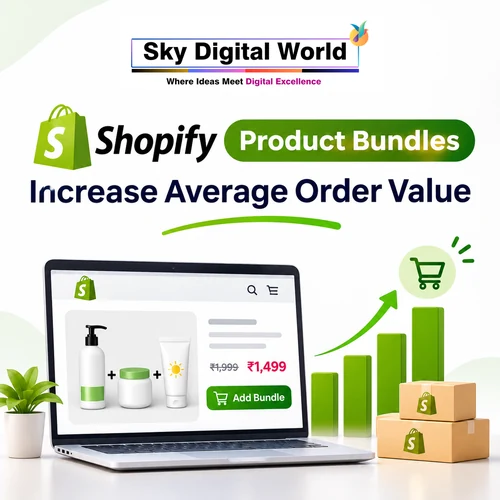
How Can Shopify Stores Use Product Bundles to Increase Average Order Value?
Getting more visitors to your Shopify store is exciting. But what if your store receives regular traffic and customers still purchase only one product at a time?
Imagine a customer visiting your online store to buy a face cleanser. They add it to their cart and proceed to checkout. However, your store also sells a moisturizer and sunscreen that complement the cleanser.
What if you could introduce these products as a complete skincare routine?
That’s where Shopify product bundles become useful.
Instead of encouraging customers to purchase unrelated products, bundling helps them discover combinations that solve a problem, complete a routine, or offer better value.
Let’s explore how Shopify stores can use product bundles to increase average order value (AOV) while creating a more convenient shopping experience.
What Are Product Bundles in Shopify?
A product bundle is a combination of two or more products offered together as a single purchasing option.
For example, an online grocery store might combine rice, lentils, and spices into an Indian cooking essentials bundle.
A fashion store could offer a shirt, trousers, and belt as a coordinated outfit.
Bundles can be offered at a special combined price or simply presented as a convenient set.
The main objective is to encourage customers to purchase complementary items together.
When implemented thoughtfully, product bundling can increase the amount customers spend per order without requiring additional website visitors.
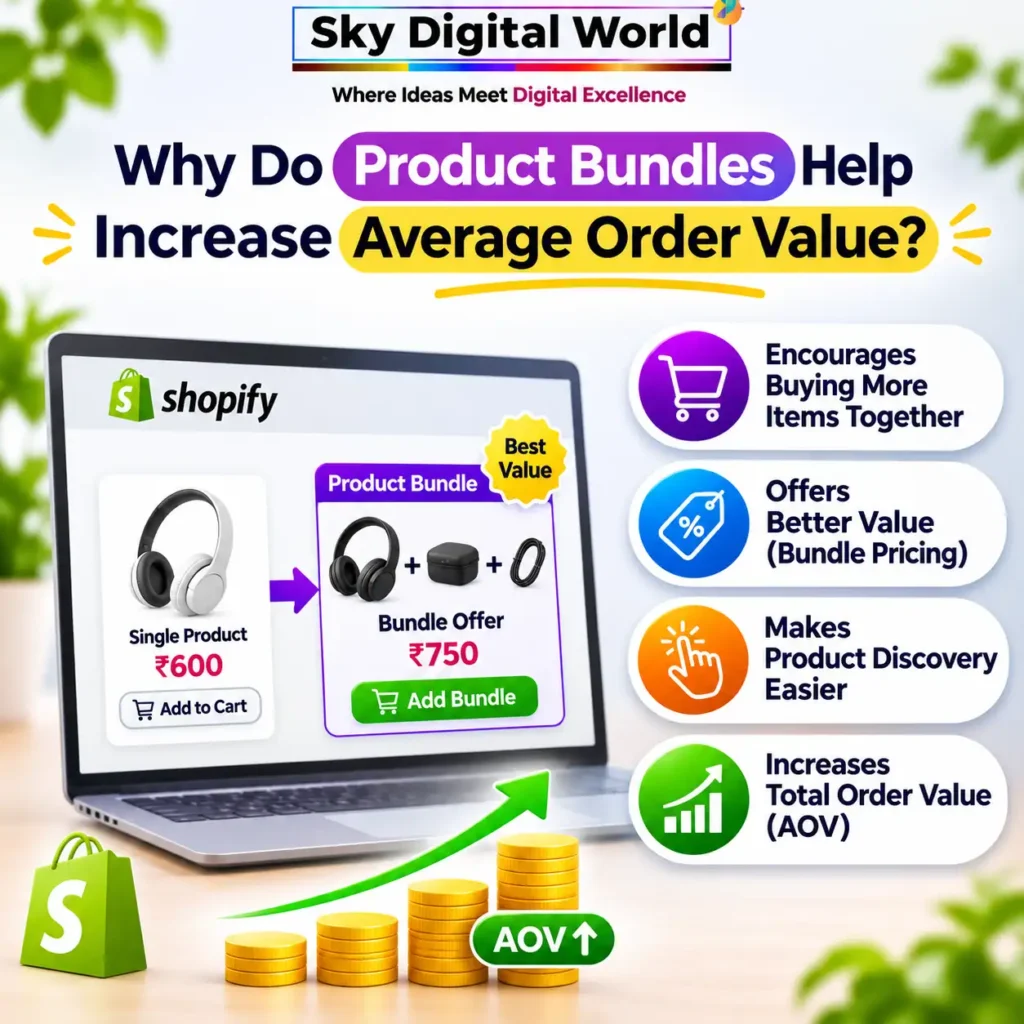
Why Do Product Bundles Help Increase Average Order Value?
Average Order Value represents the average amount customers spend each time they place an order.
The formula is simple:
Average Order Value = Total Revenue ÷ Number of Orders
For example, if your Shopify store generates ₹60,000 from 100 orders, your AOV is ₹600.
Now imagine introducing useful product bundles that encourage some customers to purchase additional items.
Illustrative AOV improvement
Before bundling
₹600
Average order value
After bundling
₹750
Average order value
Potential AOV increase
25%
This is a hypothetical example, not a guaranteed result.
Product bundles can support higher AOV because they make related products easier to discover and purchase.
However, businesses must also monitor profit margins, discount costs, and customer satisfaction.
1. Create Frequently Bought Together Bundles
One of the simplest bundling strategies is combining products customers naturally use together.
For example, someone purchasing a laptop might also need a laptop sleeve or wireless mouse.
A customer buying cooking oil may be interested in complementary pantry products.
These combinations feel relevant because they support the customer’s original purchasing decision.
Example:
A Shopify electronics store could offer:
- Wireless Keyboard
- Wireless Mouse
- Mouse Pad
Instead of displaying these items separately, the store can introduce a “Complete Workstation Essentials” bundle.
Quick tip: Use your actual order history to identify products customers frequently purchase together rather than relying only on assumptions.
2. Offer Build-Your-Own Product Bundles
Not every customer wants the same product combination.
Build-your-own bundles allow shoppers to choose products according to their preferences.
For example, a skincare store could let customers select one cleanser, one moisturizer, and one sunscreen.
A grocery store could allow shoppers to choose three snack packets from a collection of available flavours.
This approach gives customers more control while encouraging them to explore additional products.
A clear selection interface is important. Customers should understand how many products they need to choose, which items qualify, and whether any discount applies.
3. Introduce Starter Kits for First-Time Customers
First-time customers sometimes struggle to decide which products they should purchase.
Starter kits simplify this decision by grouping essential items into one convenient package.
For example, a coffee brand could create a beginner’s coffee kit containing ground coffee, a filter, and a measuring scoop.
A gardening store could combine seeds, small gardening tools, and planting accessories.
These bundles are particularly useful when customers are unfamiliar with a product category.
Bundle idea: “Everything You Need to Get Started.”
The bundle should contain genuinely useful items rather than unnecessary products added simply to increase its price.
4. Use Quantity-Based Bundles for Everyday Products
Quantity bundles work well for products customers purchase regularly.
Examples include personal care products, cleaning supplies, packaged groceries, and office stationery.
A store might offer a three-pack or five-pack with a clearly explained quantity discount.
For example:
Purchase Option | Illustrative Price |
One Product | ₹300 |
Pack of Three | ₹840 |
Pack of Five | ₹1,350 |
Customers can compare the options and decide whether purchasing a larger quantity makes sense.
For consumable products, consider shelf life, storage requirements, and typical usage before creating large packs.
5. Create Occasion-Based and Seasonal Bundles
Customers often shop for specific occasions rather than individual products.
This creates opportunities for curated bundles.
For example, a home décor store might introduce a festive decoration set, while a personal care brand could offer a travel essentials kit.
Gift bundles can also simplify shopping by combining complementary products into one presentable package.
Seasonal bundles should reflect actual customer demand.
Avoid creating bundles around every festival or event without considering whether the products are relevant.
Where Should Shopify Stores Display Product Bundles?
Even a well-designed bundle may perform poorly if customers cannot find it.
Placement plays an important role in encouraging customers to explore additional products.
Product Pages
Display complementary bundles near product information or the Add to Cart button.
Shopping Cart
Suggest a relevant bundle upgrade before checkout without interrupting the buying process.
Collection Pages
Create dedicated collections for starter kits, gift sets, and value packs.
Email and Social Media
Promote useful combinations through product demonstrations, Reels, and customer-focused campaigns.
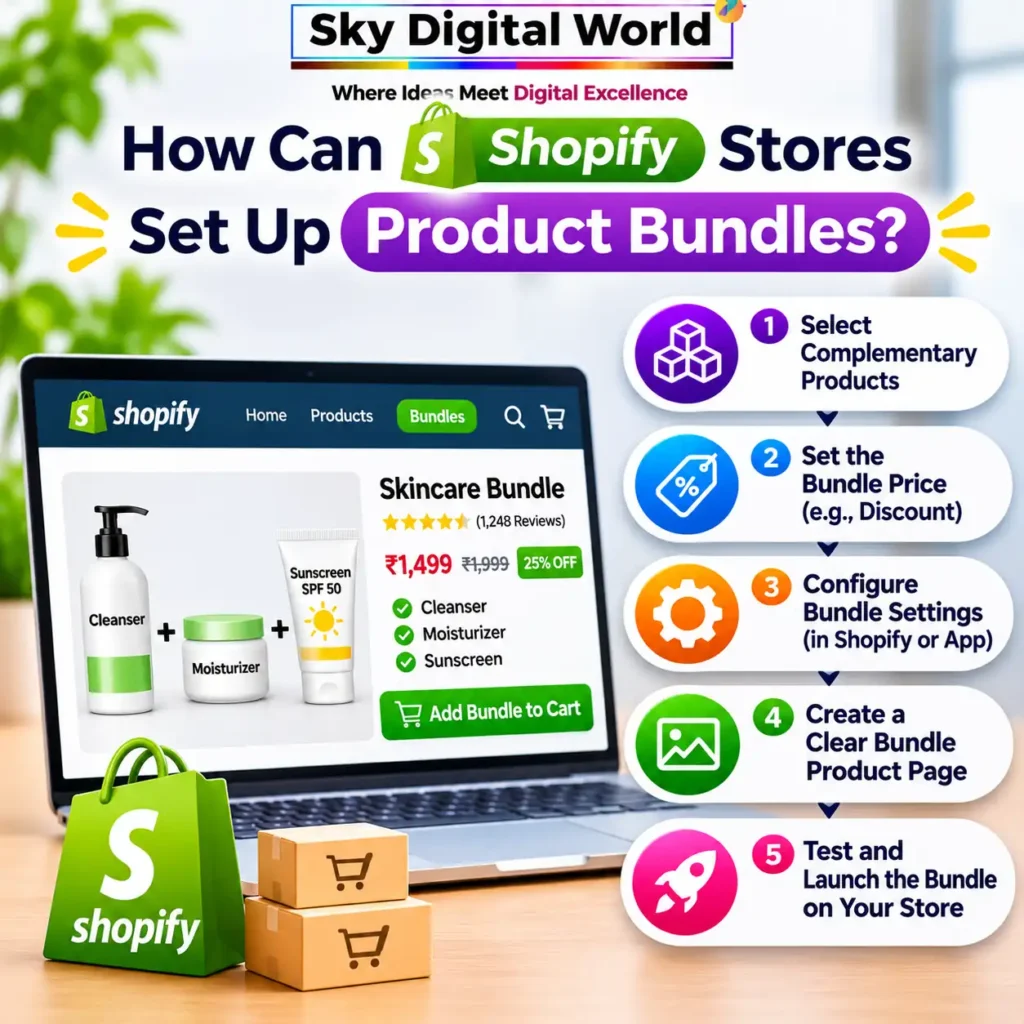
How Can Shopify Stores Set Up Product Bundles?
Shopify merchants can explore the Shopify Bundles app for supported fixed bundles and multipacks.
Stores requiring more advanced features, such as mix-and-match selections or complex bundle rules, may need a compatible third-party application or custom development.
Before launching, check whether your chosen solution supports your store’s theme, inventory requirements, discounts, sales channels, and checkout setup.
A practical implementation process includes selecting complementary products, setting the bundle price, configuring inventory, creating product images, and testing the complete purchase experience.
Make sure the bundle works correctly on mobile devices.
What Mistakes Should Shopify Stores Avoid When Creating Bundles?
Bundling should make shopping easier, not more confusing.
One common mistake is combining products that have little connection with each other.
Another is offering excessive discounts without calculating profitability.
Businesses should also avoid unclear pricing, inaccurate inventory information, and forcing customers to purchase products they do not want.
Keep bundle names simple and explain exactly what customers receive.
For example, “Daily Hair Care Set – Shampoo + Conditioner + Hair Serum” is clearer than a vague name such as “Premium Beauty Collection.”
How Can Businesses Measure Product Bundle Performance?
After launching bundles, Shopify merchants should evaluate whether they improve business performance.
Important metrics include:
Metric | Why It Matters |
Average Order Value | Measures changes in average customer spending |
Bundle Conversion Rate | Shows how effectively bundle views lead to purchases |
Bundle Revenue | Tracks sales generated through bundles |
Gross Profit per Order | Helps evaluate profitability |
Attach Rate | Measures how often customers add complementary products |
Compare results with relevant periods and account for seasonal promotions or advertising changes.
A bundle that increases AOV but significantly reduces profit may not be the best long-term strategy.
Conclusion
Increasing average order value doesn’t always require attracting more customers. Sometimes, it starts with helping existing shoppers discover products that naturally belong together.
From starter kits and quantity packs to personalized combinations and seasonal collections, Shopify product bundles offer businesses practical ways to improve product discovery and encourage larger purchases.
The most effective bundles focus on customer needs, clear pricing, and convenience rather than unnecessary discounts.
At Sky Digital World, we help businesses develop Shopify stores, improve e-commerce product pages, and create digital marketing strategies that support customer engagement and online sales.
Frequently Asked Question
Product bundles can encourage customers to purchase complementary items together. Results depend on product relevance, pricing, placement, and customer demand.
Yes. Bundles can provide convenience by grouping related products even when no discount is offered.
Products frequently used together, everyday consumables, starter kits, and complementary accessories are good candidates.
Yes, with a compatible mix-and-match bundling solution. Available functionality depends on the app and store configuration.
There is no fixed number. Start with a small, useful combination and expand only when the additional items provide clear value.