





How Does AI Improve Customer Experience?
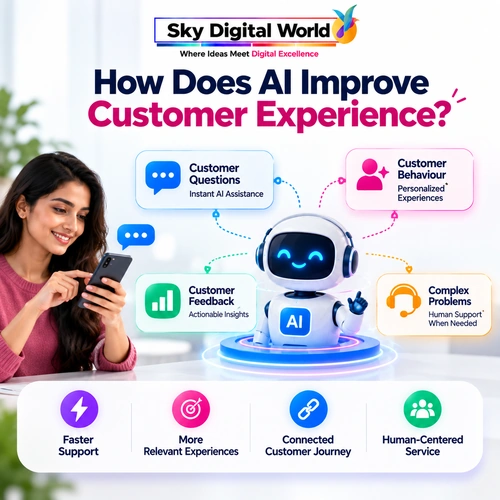
How Does AI Improve Customer Experience?
Customers rarely compare businesses only on price anymore. They also remember how easy it was to find information, how quickly they received help, whether recommendations felt relevant, and how smoothly the entire interaction worked.
That is why customer experience has become an important part of digital growth.
Artificial intelligence is changing this experience by helping businesses understand customer intent, respond faster, personalize interactions and automate repetitive processes. Modern AI-powered customer experience can work across different stages of the buyer journey rather than being limited to a basic website chatbot.
But good AI customer experience is not about replacing every human conversation.
It is about creating a smarter combination:
AI Speed + Customer Data + Automation + Human Understanding = Better Customer Experience
Let’s understand how this works.
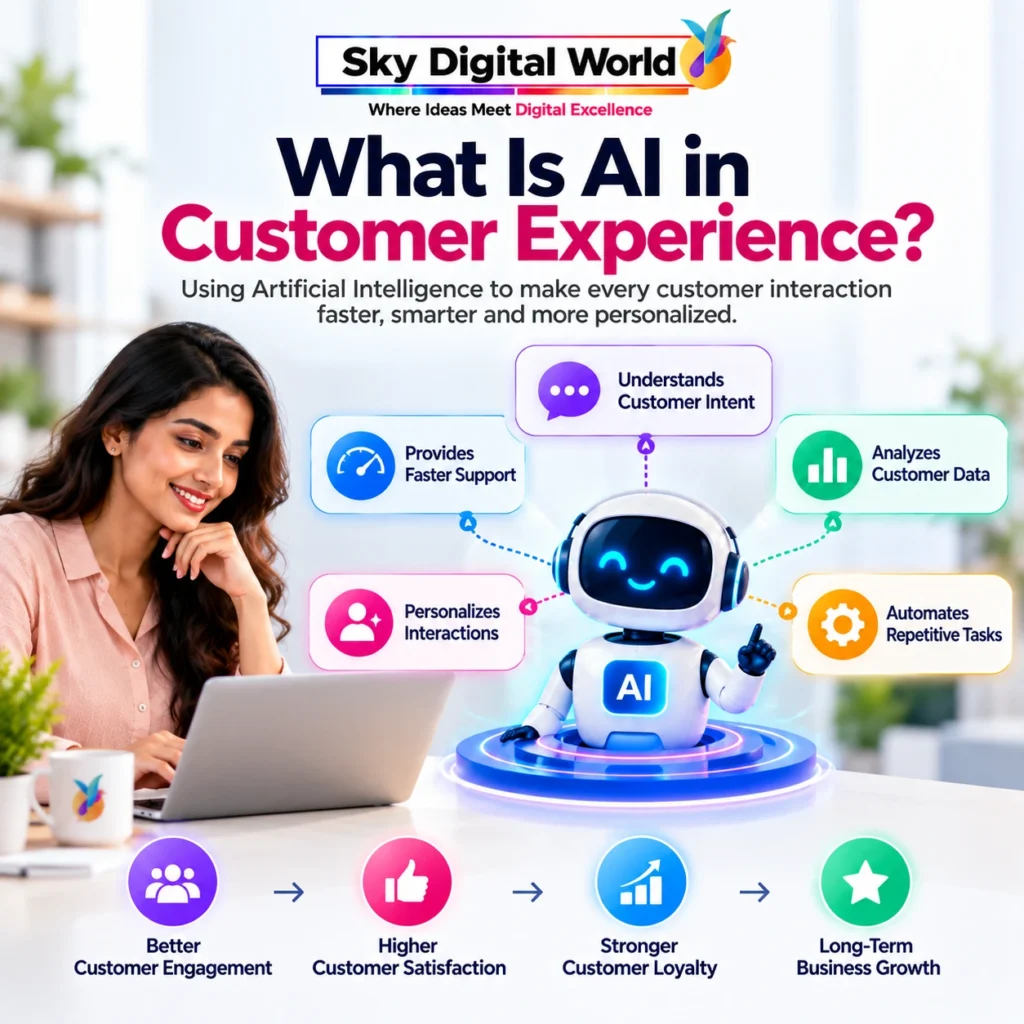
What Is AI in Customer Experience?
AI in customer experience means using artificial intelligence technologies to improve how customers discover, communicate with and receive support from a business.
AI can help businesses analyze information, understand customer intent, automate common conversations, recommend relevant products or content, assist support teams and identify patterns in customer behaviour.
Imagine a customer visiting an online store at 11:30 PM.
They want to know whether a product is available, how delivery works and which option suits their requirement.
Instead of waiting until the next morning, an AI-powered assistant may be able to provide immediate answers using approved business information.
If the question becomes complicated, the conversation can be transferred to a human team member.
That creates a better model:
AI Handles Repetition → Humans Handle Complexity
1. AI Can Make Customer Support Faster
Speed matters when customers need help.
Someone asking a simple question such as “Where is my order?” usually does not want to wait several hours for an email response.
AI-powered support systems can handle common questions such as:
- Order status
- Delivery information
- Appointment availability
- Product information
- Return policies
- Basic troubleshooting
- Account-related guidance
This can reduce unnecessary waiting for routine enquiries while allowing customer-service teams to concentrate on situations requiring judgement or personal attention.
The goal should not simply be faster replies.
It should be:
Fast Response + Useful Answer + Clear Next Step
A quick but incorrect response creates frustration. Therefore, businesses need to monitor AI responses and provide accurate source information.
2. Customers Can Receive Support Beyond Business Hours
Traditional customer service is often limited by working hours.
Customers are not.
Someone may research your services early in the morning, browse products during lunch or have a question late at night.
AI-powered assistants can provide first-level assistance outside normal office hours.
For example:
A potential customer discovers your company through Google at night.
They visit your website.
An AI assistant answers basic service questions.
The customer shares their requirements.
The information is recorded.
Your sales team continues the conversation the next working day.
The AI has not replaced the salesperson. It has simply prevented the opportunity from disappearing because nobody was available at that moment.
3. AI Can Create More Relevant Personalization
Personalization should mean more than adding someone’s first name to an email.
Customers have different interests, needs and stages in their buying journey.
AI can help businesses identify patterns from appropriate customer data and use those patterns to create more relevant experiences.
Consider an e-commerce website.
One customer repeatedly explores running shoes.
Another browses formal clothing.
A third has already purchased a product and is looking for accessories.
Showing exactly the same homepage recommendations to all three visitors may not be ideal.
AI-supported personalization can help businesses make recommendations based on signals such as previous interactions, browsing behaviour, purchases or stated preferences—provided that the data is collected and used responsibly.
The process becomes:
Customer Signals → Understand Intent → Personalize Experience → Measure Response → Improve
4. AI Helps Businesses Understand Customer Intent
Customers do not always describe their needs perfectly.
One person may type:
“Need affordable marketing for my shop.”
Another might ask:
“How can I get more local customers?”
Although the wording is different, their underlying requirements may overlap.
AI systems can help interpret natural language and identify intent rather than relying only on exact keywords.
This can improve chat experiences, internal search, customer-service routing and recommendation systems.
Instead of forcing customers to understand your company’s terminology, businesses can become better at understanding the customer’s language.
That small change can make an experience feel much easier.
5. AI Can Make the Customer Journey More Connected
Customers rarely interact with a company through one channel.
Their journey may look like:
Google Search → Website → Instagram → WhatsApp/Chat → Sales Call → Purchase → Customer Support
The problem begins when every interaction feels disconnected.
A customer explains the same problem on chat, repeats it by email and then explains everything again during a phone call.
That is frustrating.
When customer systems are properly integrated, AI can help teams organize interaction history and provide useful context for the next conversation.
The objective is to create continuity:
Discover → Engage → Ask → Purchase → Receive Support → Return
Customers should feel like they are dealing with one business—not six disconnected departments.
6. AI Can Help Human Support Teams Work Better
One of the most useful applications of AI happens behind the scenes.
Support representatives often spend significant time searching previous conversations, reading long message threads, categorizing tickets and writing repetitive replies.
AI can assist by summarizing conversations, identifying topics, retrieving relevant information, suggesting responses or routing enquiries to appropriate teams.
This allows the human employee to spend more time understanding the actual problem.
For example, instead of reading 15 previous messages before responding, a support executive could receive a concise summary:
Customer issue: Delivery delayed
Previous contact: Two conversations
Current status: Shipment dispatched
Next action: Confirm revised delivery estimate
The employee still makes the decision, but reaches the important context faster.
7. AI Can Turn Customer Feedback Into Useful Insights
Customer feedback exists everywhere.
Reviews.
Emails.
Support tickets.
Survey responses.
Social media comments.
Chat conversations.
Reading thousands of individual comments manually is difficult.
AI can help businesses organize large amounts of feedback into recurring themes.
For example, analysis might reveal that customers frequently mention:
Slow Checkout | Delivery Questions | Product Quality | Difficult Navigation | Helpful Support
Businesses can then investigate these patterns rather than relying only on assumptions.
This is an important distinction.
AI should not merely help a business talk to customers.
It should help the business listen to them at scale.
8. AI Can Support Better Product Recommendations
Customers can become overwhelmed when they have too many choices.
Imagine visiting a website containing 5,000 products.
You probably do not want to examine every item.
You want the most relevant options.
AI recommendation systems can use appropriate signals to narrow choices and help customers discover products, services or content that better match their interests.
This can create a shorter path:
Too Many Choices → Relevant Options → Easier Comparison → Confident Decision
However, recommendations should remain useful rather than intrusive. Excessive personalization can make customers uncomfortable, particularly when they do not understand how their information is being used.
Transparency matters.
9. AI Can Help Businesses Become More Proactive
Traditional customer service is usually reactive.
A problem happens.
The customer complains.
The company responds.
AI can sometimes help businesses identify patterns earlier.
For example, repeated support requests about the same checkout step could indicate a usability problem.
Instead of answering the same question 500 times, the business can improve the checkout experience itself.
That is a much more valuable use of AI.
Reactive Service: Problem → Complaint → Response
Proactive Experience: Pattern → Insight → Improvement → Fewer Problems
The best customer experience is sometimes the support conversation that never needed to happen.
10. AI Can Improve Website and Search Experiences
AI is also changing how people discover information online.
Google’s current guidance says people are increasingly using generative AI search experiences for more complex questions and follow-up exploration. Google also emphasizes that unique, useful, people-first content and established SEO fundamentals remain important for visibility in generative AI search.
This matters for customer experience because discovery itself is part of the journey.
Businesses should structure website content around real customer questions.
Instead of creating generic pages filled with keywords, provide useful information such as:
What is the service?
Who is it suitable for?
How does it work?
What problems does it solve?
What should customers consider?
What happens next?
Google specifically recommends creating content for people rather than content primarily designed to manipulate search rankings.
That approach benefits both customers and search visibility.
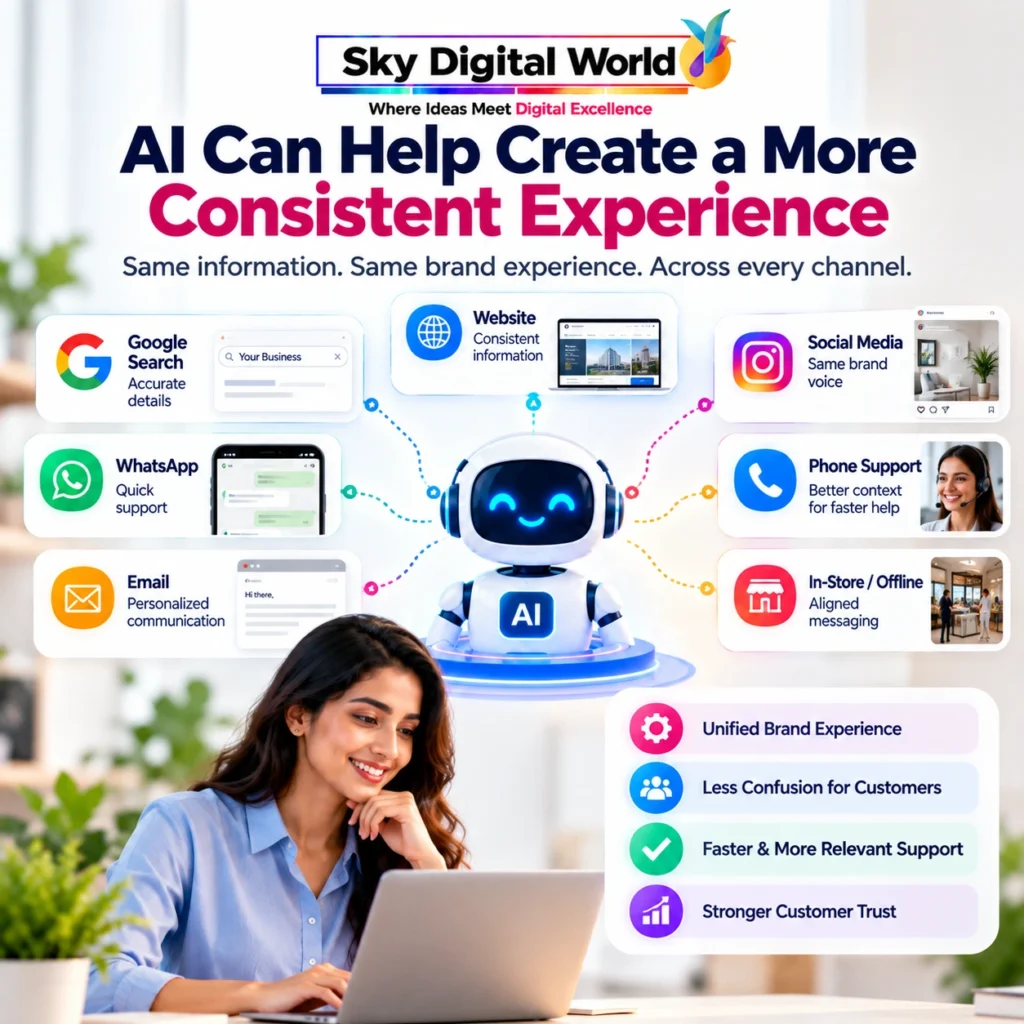
11. AI Can Help Create a More Consistent Experience
Customers expect consistency.
Your website should not promise something your chatbot contradicts.
Your advertising should not promote something your support team knows nothing about.
Your sales team should not provide completely different information from your website.
AI can help businesses organize approved information and make it easier for different customer-facing systems to access consistent knowledge.
But AI is only as useful as the information supporting it.
Outdated data can produce outdated answers.
Poor processes can become automated poor processes.
Therefore:
Better Data + Better Processes + AI = Better Customer Experience
Not simply:
AI = Better Customer Experience
12. Human Interaction Still Matters
AI is excellent at speed, pattern recognition, summarization and repetitive tasks.
Humans remain essential when situations require empathy, negotiation, judgement, creativity or understanding unusual circumstances.
Imagine a customer who has received the wrong product before an important event.
A robotic loop of automated replies may make the experience worse.
That conversation may require a human who can understand urgency and make an appropriate decision.
Businesses should therefore design escalation points.
Use AI when the task is predictable.
Bring in people when the situation becomes complex, sensitive or unusual.
The strongest model is:
Automate the Routine → Assist the Team → Escalate Complexity → Keep Humans in Control
How Should Businesses Start Using AI for Customer Experience?
Do not begin by asking:
“Where can we add AI?”
Begin with:
“Where are customers experiencing unnecessary friction?”
Map the customer journey and identify problems such as long response times, repetitive questions, poor recommendations, disconnected communication, difficult website navigation or large volumes of unorganized feedback.
Then decide whether AI can genuinely improve that specific problem.
A practical framework is:
Identify Friction → Choose Use Case → Connect Reliable Data → Test AI → Keep Human Oversight → Measure Customer Outcome → Improve
Measure outcomes such as resolution time, customer satisfaction, repeat enquiries, conversion rate, escalation rate and retention—not simply the number of automated conversations.
Final Thoughts
AI improves customer experience when it makes interactions faster, easier, more relevant and more connected.
Its greatest value is not creating a business where customers never interact with people.
It is creating a business where customers do not have to struggle unnecessarily.
AI can answer routine questions, personalize experiences, support employees, analyze feedback and identify opportunities for improvement. Humans can focus on relationships, judgement and situations where personal understanding matters most.
The future of customer experience is therefore unlikely to be AI versus humans.
It is:
AI for Speed + Humans for Understanding + Data for Context + Strategy for Consistency = Better Customer Experience
Frequently Asked Questions
AI can improve customer experience by providing faster assistance, understanding customer intent, personalizing interactions, supporting employees, analyzing feedback and automating repetitive processes.
AI can automate many routine tasks, but human support remains important for complex situations requiring judgement, empathy, negotiation or exceptions. A hybrid approach is usually more practical.
Small businesses can start with focused applications such as FAQ assistance, enquiry qualification, conversation summaries, personalized recommendations and customer-feedback analysis rather than attempting to automate everything.
AI can analyze appropriate customer signals—such as stated preferences, previous interactions or purchase behaviour—to help businesses provide more relevant content, recommendations and communication.
A common mistake is implementing AI simply because it is available. Businesses should first identify a real customer problem, use reliable data, maintain human oversight and measure whether the technology actually improves the customer experience.