




Service Page SEO: 10 Steps to Improve Search Visibility
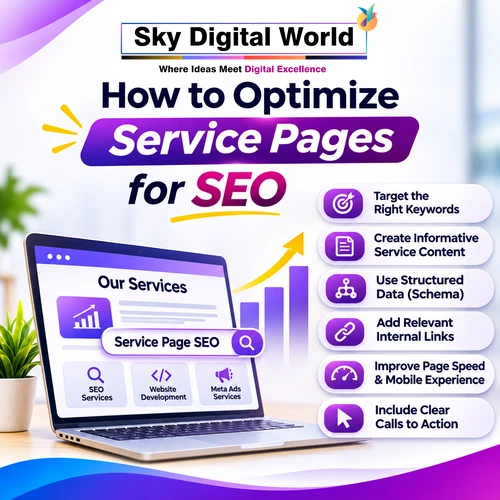
How to Optimize Service Pages for SEO
A business website may have an attractive design, professional branding and detailed information, but if its service pages are not optimized for search engines, potential customers may struggle to discover them.
Unlike blog posts, service pages are designed to attract people who are actively searching for professional solutions. These visitors are often closer to making a purchasing decision or submitting an enquiry.
Effective service page SEO helps businesses improve organic visibility, communicate their expertise and turn relevant website visitors into qualified leads.
Quick Answer
To optimize service pages for SEO, target relevant commercial keywords, create informative service descriptions, optimize title tags and headings, add internal links, implement appropriate schema markup and include clear calls to action. Each service page should address customer requirements while providing a fast, mobile-friendly browsing experience.
What Is Service Page SEO?
Service page SEO is the process of optimizing individual website pages that describe the services offered by a business.
For example, a digital marketing agency may have separate pages for SEO services, website development, social media marketing, Meta advertising and WhatsApp automation.
Each page should target a distinct customer requirement and relevant search intent.
Instead of relying entirely on the homepage to rank for multiple services, businesses can develop dedicated pages that communicate their expertise in specific areas.
Why Is Service Page SEO Important for Businesses?
A customer searching for “professional website development services” is likely to have different requirements from someone searching for “what is website development?”
The first search indicates commercial intent, while the second is primarily informational.
Optimized service pages help businesses:
- Attract visitors with relevant purchasing intent.
- Improve visibility for service-specific keywords.
- Generate qualified business enquiries.
- Communicate expertise and credibility.
- Support local and international SEO strategies.
- Reduce dependence on paid advertising over time.
A well-optimized service page should function as both a search discovery resource and a customer conversion opportunity.
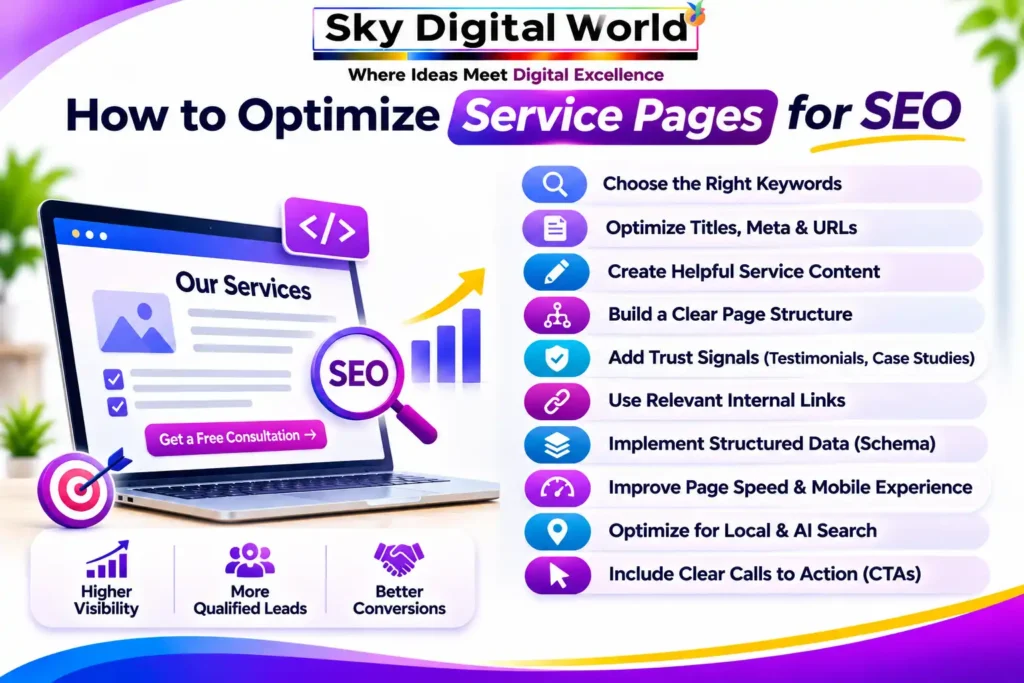
How to Optimize Service Pages for SEO: 10 Essential Steps
1. Choose Keywords Based on Customer Search Intent
Start by identifying the terms potential customers use when searching for your services.
Avoid targeting the same broad keyword across every page. Instead, assign a specific primary keyword to each service.
Service Page | Target Keyword Example |
SEO Services | SEO Services India |
Website Development | Website Development Company India |
Social Media Marketing | Social Media Marketing Services |
Meta Advertising | Meta Ads Management Services |
AI Automation | AI Automation Services India |
Graphic Design | Professional Graphic Design Services |
E-commerce Development | Shopify Development Services India |
These are illustrative keyword opportunities. Actual selection should consider search volume, competition, relevance and customer intent.
2. Optimize SEO Titles, Meta Descriptions and URLs
Every service page should have a unique SEO title, meta description and descriptive URL.
For example, an SEO service page could use:
SEO Element | Example |
SEO Title | Professional SEO Services in India |
H1 Heading | SEO Services for Business Growth |
URL Slug | /seo-services-india/ |
Meta Description | Improve your business visibility with professional SEO services, technical optimization, keyword research and content strategies. |
Use the primary keyword naturally without unnecessary repetition.
3. Create Content That Answers Customer Questions
Many service pages focus heavily on promoting the company but provide limited information about the actual service.
Potential customers want to understand what is included, how the process works and whether the service meets their requirements.
An informative service page should explain:
- What the service includes.
- Which businesses can benefit.
- Problems the service addresses.
- The working process and deliverables.
- Relevant experience and expertise.
- Pricing factors and engagement options.
Focus on providing meaningful information rather than increasing word count unnecessarily.
4. Build a Clear Service Page Structure
A logical page structure helps visitors navigate information and allows search engines to interpret content more effectively.
Recommended SEO-friendly service page layout
Service Name & Value Proposition
Primary keyword · Service introduction
Request a Consultation
Service Overview
Customer Benefits
Scope of Services
Working Process
Experience & Expertise
Case Studies & Results
Frequently Asked Questions
Address common customer concerns
Final Call to Action
Contact form · WhatsApp · Phone
Use one descriptive H1 heading, relevant H2 sections and supporting H3 headings wherever necessary.
5. Add Genuine Trust Signals
Customers often compare multiple service providers before contacting a business.
Including genuine evidence of expertise can help them make informed decisions.
Useful trust signals include client testimonials, completed projects, verified certifications, team profiles, case studies and original portfolio images.
For example, a website development company can showcase completed websites, while a digital marketing agency can present documented campaign results.
Avoid fabricated testimonials, misleading performance claims and guaranteed ranking promises.
6. Optimize Internal Linking
Internal links help search engines discover related pages and understand relationships between website topics.
For example, a blog about technical SEO can link to a dedicated technical SEO service page. Similarly, a website development page can link to website maintenance and e-commerce development services.
Use descriptive anchor text that explains the destination page.
A strong internal linking strategy connects informational blog content with commercially relevant service pages.
7. Implement Relevant Structured Data
Structured data provides machine-readable information about website content and business entities.
Depending on the service page, businesses can consider the following schema types:
Schema Type | Purpose |
Organization | Identifies the company |
LocalBusiness | Describes relevant local business details |
Service | Explains the service offered |
BreadcrumbList | Communicates website navigation |
Person | Identifies relevant professionals |
Structured data must accurately reflect the visible page content. Service schema does not automatically generate Google rich results or guarantee higher rankings.
8. Improve Page Speed and Mobile Experience
A slow or difficult-to-navigate service page can discourage potential customers from submitting enquiries.
Businesses should compress website images, reduce unnecessary scripts, use responsive layouts and maintain reliable hosting.
Contact forms, navigation menus and CTA buttons should work properly across smartphones, tablets and desktop devices.
Tools such as Google PageSpeed Insights can help identify performance improvement opportunities.
9. Optimize Service Pages for Local SEO and AI Search
Businesses targeting specific geographical markets should include relevant location information naturally.
For example, an agency serving Indore can explain its local expertise, service coverage and contact information.
For AI search and GEO optimization, service pages should provide clear service definitions, consistent business information, original insights and direct answers to common customer questions.
These practices can support discoverability, although inclusion in AI-generated recommendations is not guaranteed.
10. Include Clear Calls to Action
Generating organic traffic is only part of the objective. Service pages should also guide visitors towards a meaningful next step.
Effective CTAs include:
- Request a Free Consultation
- Get a Customized Quotation
- Discuss Your Business Requirements
- Connect With Our Experts
- Enquire on WhatsApp
Place relevant CTAs throughout the page without interrupting the browsing experience.
Common Service Page SEO Mistakes to Avoid
Common Mistake | Recommended Solution |
Targeting identical keywords on multiple pages | Assign distinct keyword targets |
Publishing generic service descriptions | Create original, customer-focused content |
Missing internal links | Connect relevant blogs and service pages |
Excessive keyword repetition | Use natural, readable language |
Missing contact information | Provide accessible enquiry options |
Slow mobile performance | Optimize images and page resources |
Unsupported marketing claims | Include genuine evidence of expertise |
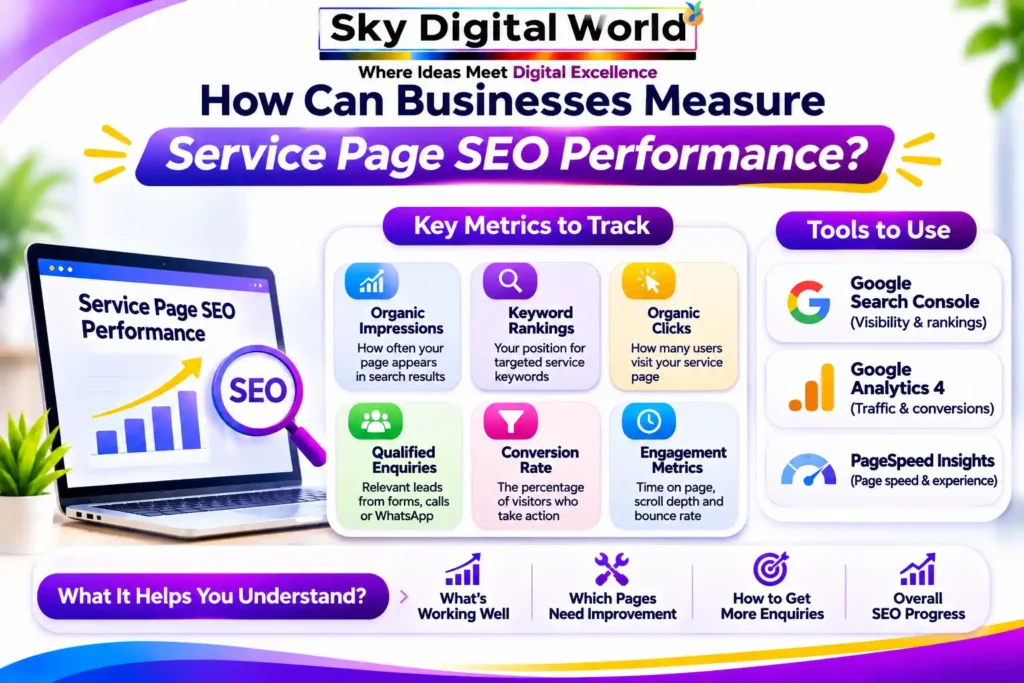
How Can Businesses Measure Service Page SEO Performance?
Businesses should evaluate service pages based on both search visibility and business outcomes.
Important performance indicators include organic impressions, keyword rankings, organic clicks, qualified enquiries, conversion rates and engagement.
Google Search Console and Google Analytics 4 can help businesses monitor performance and identify pages requiring further optimization.
Conclusion
Effective service page SEO combines keyword research, customer-focused content, technical optimization, genuine trust signals and clear conversion opportunities.
Businesses should treat service pages as valuable digital sales resources rather than simple descriptions of their offerings.
At Sky Digital World, we help businesses develop SEO-friendly websites, optimize service pages, implement technical SEO and build GEO-focused content strategies that support long-term digital visibility.
Frequently Asked Questions
Service page SEO involves optimizing individual service pages to improve organic search visibility and attract relevant potential customers.
Each page should target one primary keyword theme supported by closely related secondary keywords and natural variations.
There is no fixed SEO word count. Content should be comprehensive enough to explain the service and answer important customer questions.
Service pages may appear in AI-powered search results when they provide relevant, accessible and trustworthy information. However, inclusion is not guaranteed.
Yes, when the services address distinct customer needs and search intents. Avoid creating unnecessary pages with nearly identical content.