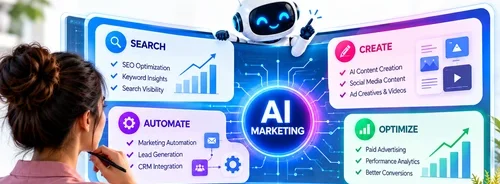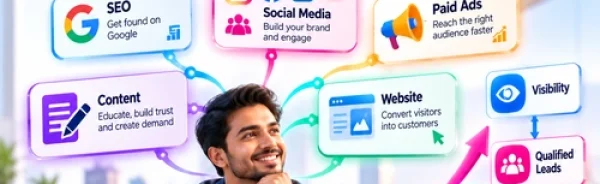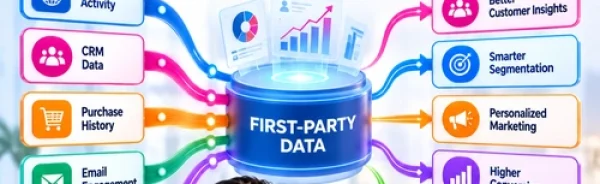





What Are AI Marketing Services?
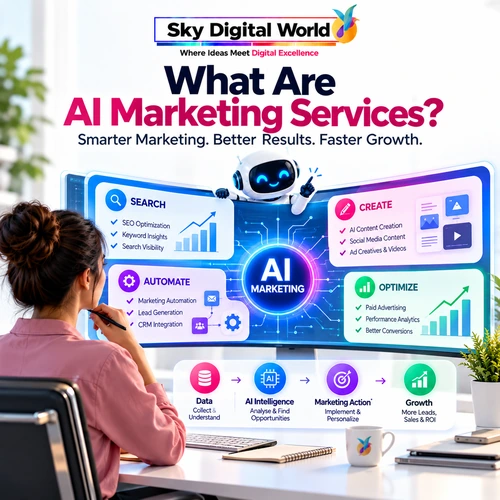
What Are AI Marketing Services? A Complete Guide for Businesses
Marketing is becoming more complex. Customers move between Google, social media, websites, email, messaging apps, videos and online reviews before making a decision. At the same time, businesses are collecting more data and producing more content than ever before.
This is where AI Marketing Services can help.
AI marketing services use artificial intelligence alongside customer data, marketing platforms and human strategy to make certain marketing activities faster, more relevant and easier to analyze. They can support tasks ranging from audience research and content planning to personalization, lead management, advertising and performance analysis.
However, AI marketing is not simply about asking a chatbot to write social media posts.
A useful way to understand it is:
Business Data + AI Technology + Marketing Strategy + Human Decisions = Smarter Marketing
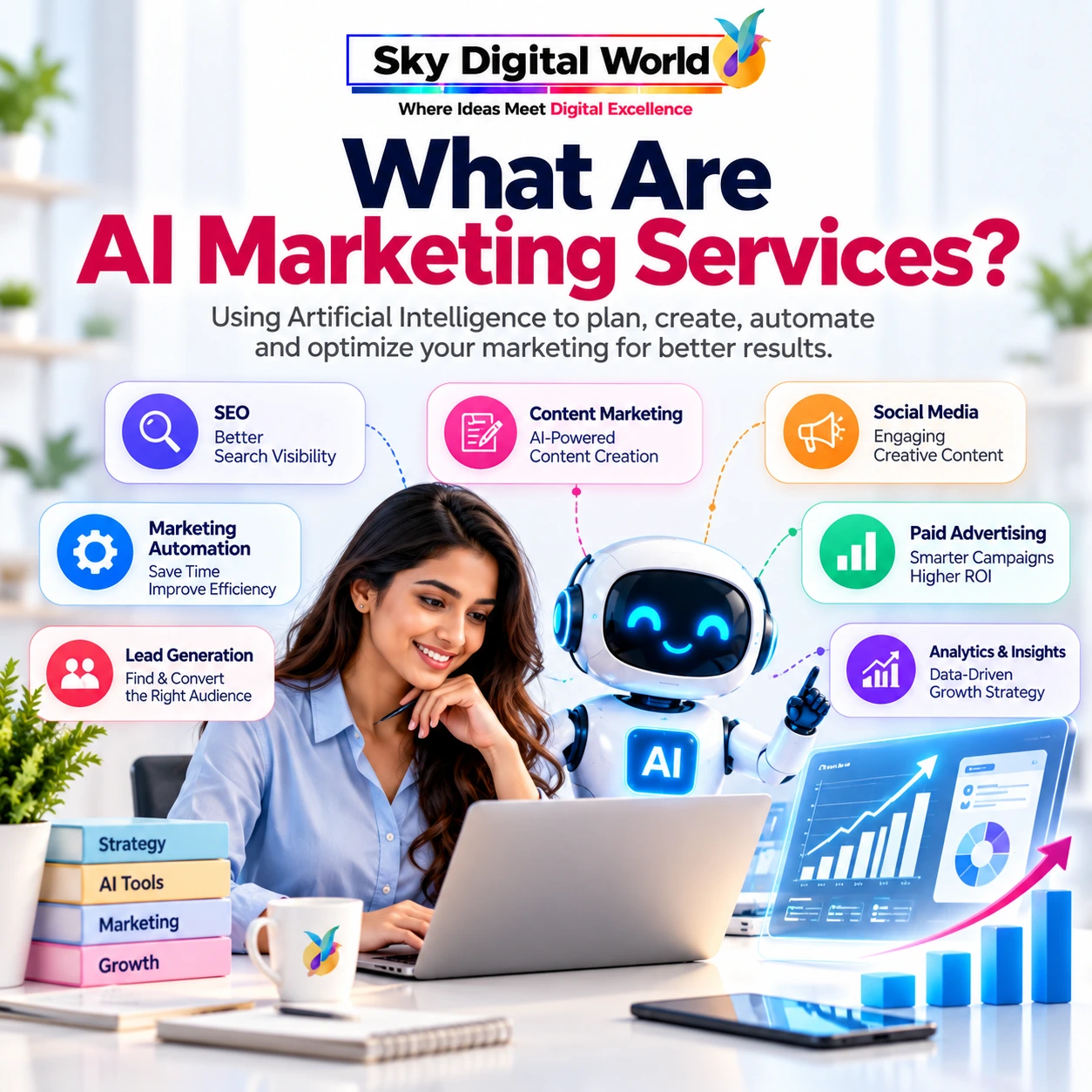
What Are AI Marketing Services?
AI Marketing Services are professional marketing services that use artificial intelligence to analyze data, automate repetitive activities, understand customer behaviour, personalize communication and support better marketing decisions.
Depending on the business, AI can be incorporated into SEO, content marketing, social media, advertising, email marketing, customer service, lead generation and analytics.
For example, imagine a company receives 300 enquiries every month.
Without automation, the sales team may manually read every enquiry, organize the information and decide whom to contact first.
An AI-supported workflow could help categorize enquiries based on information provided by prospects, route them to appropriate teams and summarize the conversation for a salesperson.
The objective is not:
AI → Replace the Marketing Team
A more practical model is:
AI → Assist → Analyze → Automate → Human Review → Improve
How Do AI Marketing Services Work?
AI marketing normally starts with information.
This could include website behaviour, CRM information, advertising results, search queries, customer questions, campaign performance or other appropriately collected business data.
AI systems can then help identify patterns or assist with particular marketing tasks.
A simplified process looks like:
Collect Data → Understand Patterns → Identify Opportunities → Take Marketing Action → Measure Results → Optimize
For example, if visitors repeatedly arrive on a service page but leave without making an enquiry, marketers can examine search intent, page behaviour, messaging and conversion barriers.
AI can accelerate parts of that analysis, but marketers still need to understand why something is happening and determine the appropriate response.
That distinction is important.
AI produces information and assistance. Strategy determines what businesses do with it.
1. AI-Powered Customer and Market Research
Good marketing begins with understanding people.
Businesses need to know what potential customers are searching for, what questions they ask, which problems they are trying to solve and what influences their decisions.
AI tools can help marketers process large volumes of information faster.
For example, marketers may use AI to organize:
- Customer questions
- Search queries
- Survey responses
- Reviews
- Sales conversations
- Competitor themes
- Support enquiries
- Content performance
Instead of manually reviewing hundreds of individual comments, AI can help group recurring themes.
A marketing team might discover that customers repeatedly ask about price, implementation time, customization and after-sales support.
Those insights can then influence website pages, FAQs, videos, advertisements and sales material.
2. AI Can Support SEO and Search Visibility
SEO is another area where artificial intelligence can assist marketers.
AI tools can help with keyword clustering, search-intent analysis, content-gap research, internal-linking opportunities and large-scale website analysis.
But businesses should avoid treating AI-generated content as a shortcut to rankings.
Google’s current guidance says generative AI can be useful for research and adding structure to original content, while generating many pages without adding value for users can violate its spam policies. Google also says the same foundational SEO practices remain relevant to its AI search experiences.
Therefore, a better SEO workflow is:
Search Intent → Research → Original Expertise → Helpful Content → Technical SEO → Internal Links → Measurement → Improvement
AI assists the process.
It should not replace originality, experience or usefulness.
3. AI-Assisted Content Marketing
Businesses constantly need content.
Blog articles, social media posts, video concepts, email campaigns, landing pages, product descriptions and advertising copy all require research and production.
AI can support marketers with:
Topic Research → Content Brief → First Draft → Human Expertise → Editing → Optimization → Publishing
The human stages are essential.
A generic AI article that simply repeats information already available online gives readers little reason to choose your website.
Businesses can make content more valuable by adding:
- First-hand experience
- Original examples
- Case studies
- Expert observations
- Proprietary data
- Product knowledge
- Real customer questions
- Unique images and videos
The objective should be AI-assisted content, not uncontrolled content production.
4. AI Can Improve Marketing Personalization
Not every customer wants the same thing.
Imagine an agency website receives three visitors:
Visitor A: Needs SEO
Visitor B: Needs social media management
Visitor C: Needs website development
Showing all three exactly the same communication may reduce relevance.
AI-powered marketing systems can help businesses use appropriate customer signals to deliver more relevant recommendations, content or communication.
For example:
Customer Behaviour → Identify Interest → Select Relevant Message → Deliver Experience → Measure Response
Personalization can be useful in e-commerce recommendations, email marketing, website experiences and customer retention campaigns.
However, businesses should collect and use customer information responsibly and transparently.
5. AI Marketing Automation
Automation is one of the most practical applications of AI marketing.
Marketing teams perform many repetitive activities every day.
AI and automation systems can help with tasks such as enquiry categorization, CRM updates, email workflows, lead routing, campaign reporting and basic customer communication.
Consider this journey:
Website Visitor → Enquiry Form → CRM → Lead Categorization → Sales Notification → Follow-Up → Conversion Tracking
Instead of moving information manually between every stage, businesses can connect parts of the workflow.
This reduces repetitive administration and gives teams more time for strategy, creative work and customer relationships.
6. AI for Lead Generation and Qualification
Generating more leads is not always the correct goal.
Businesses need relevant leads.
A sales team receiving 500 poor-quality enquiries can struggle more than a team receiving 100 well-matched opportunities.
AI-supported systems can help organize incoming leads using information prospects voluntarily provide, such as service requirement, company type, location or project requirement.
The process could look like:
Traffic → Enquiry → Data Capture → Qualification → Prioritization → Human Sales Conversation
AI should assist prioritization rather than make important decisions blindly.
Sales teams should still review context, particularly for high-value or unusual opportunities.
7. AI Can Support Paid Advertising
Digital advertising produces large amounts of data.
Platforms already use machine learning extensively for bidding, targeting, creative combinations and campaign optimization.
Google describes AI-powered advertising as using its AI systems across areas including bidding, audiences and creative to help advertisers pursue campaign goals.
For businesses, AI marketing services may therefore include campaign structure, creative testing, audience strategy, conversion tracking and analysis of AI-assisted campaigns.
But automation does not remove the need for marketing fundamentals.
You still need:
Strong Offer + Relevant Audience + Good Creative + Effective Landing Page + Accurate Tracking + Continuous Optimization
Poor positioning does not automatically become good marketing because AI is involved.
8. AI Can Improve Customer Experience
Marketing does not end when someone becomes a customer.
AI can also support the post-click and post-purchase experience.
An AI assistant may answer common questions, guide users toward appropriate information or collect initial details before handing a conversation to a person.
AI can also help support teams summarize conversations and organize recurring customer issues.
The ideal approach is:
AI Handles Routine Tasks → Humans Handle Complexity
Customers receive faster assistance while employees retain control over situations requiring empathy, judgement or exceptions.
9. AI Can Make Marketing Analytics Easier to Understand
Marketing teams often have too much data rather than too little.
Website analytics, CRM systems, advertising dashboards, social media platforms and sales reports can produce thousands of metrics.
The difficult question is:
What actually matters?
AI can help marketers summarize information, identify unusual changes and explore patterns.
Instead of only reporting:
“Website traffic increased 18%.”
A useful analysis asks:
Where did the additional traffic come from?
Which pages received it?
Did enquiries increase?
Were those enquiries qualified?
Did revenue improve?
That creates a more meaningful measurement chain:
Visibility → Engagement → Leads → Qualified Leads → Conversions → Revenue
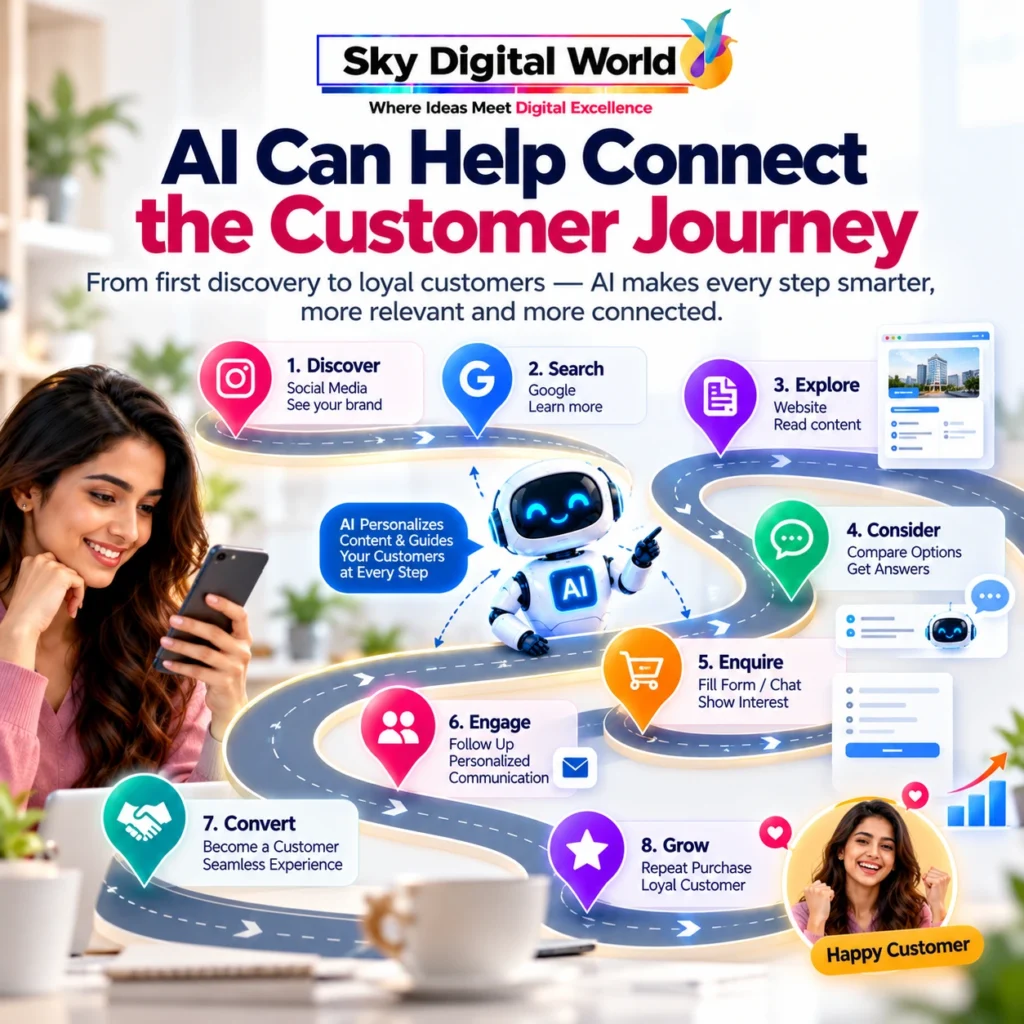
10. AI Can Help Connect the Customer Journey
A customer’s journey is rarely linear.
Someone might discover your business through Instagram, search the company on Google, read a blog article, visit a service page, leave, see an advertisement and return later.
That journey might look like:
Social Media → Google Search → Website → Content → Remarketing → Enquiry → Sales → Customer
AI marketing services can help businesses analyze and coordinate parts of these interactions.
This is more useful than optimizing every marketing channel independently.
The goal should be a connected customer journey where SEO, content, social media, advertising, website experience and sales processes support one another.
What Should AI Marketing Services Include?
The exact scope should depend on the business rather than a fixed list of trendy AI tools.
A professional AI marketing strategy may include:
Business & Audience Research → SEO & Search Strategy → AI-Assisted Content → Marketing Automation → Personalization → Lead Management → Paid Media → Customer Experience → Analytics & Reporting
Before implementing anything, businesses should identify where AI creates genuine value.
Ask:
What problem are we solving?
If a company has poor lead quality, AI-assisted qualification may help.
If customer support is overloaded with repetitive questions, AI assistance may help.
If the marketing team spends hours compiling reports, automated analysis may help.
Start with the problem—not the technology.
How to Choose an AI Marketing Services Company
Avoid choosing an agency simply because it uses the word “AI.”
Ask how the company combines technology with marketing fundamentals.
Look for a team that understands SEO, advertising, content, websites, analytics, customer journeys and conversion strategy in addition to AI tools.
A useful evaluation framework is:
Strategy → Data → Technology → Human Expertise → Measurement
Also ask how the agency verifies AI-generated information, protects customer data, measures results and keeps people involved in important decisions.
The right AI marketing service should make your marketing more intelligent and efficient, not simply more automated.
Final Thoughts
AI Marketing Services are changing how businesses research customers, create content, manage campaigns, analyze performance, personalize communication and support leads.
But successful AI marketing is not about using the maximum number of AI tools.
It is about using AI in the right places.
Businesses should identify repetitive work, disconnected data, slow processes and opportunities where better insights could improve customer experiences.
The strongest approach combines:
Human Strategy + Reliable Data + AI Assistance + Creative Thinking + Continuous Measurement
AI can provide speed and scale.
Humans provide context, judgement and originality.
When those strengths work together, businesses can build marketing systems that are not only more automated—but more useful to the people they are trying to reach.
Frequently Asked Questions
AI Marketing Services use artificial intelligence alongside marketing strategy and data to support activities such as research, SEO, content creation, personalization, lead management, advertising, automation and analytics.
AI can assist with audience research, keyword analysis, content planning, recommendations, campaign optimization, customer support, marketing automation, lead organization and performance analysis.
Yes. Small businesses can begin with focused applications such as customer enquiry automation, content research, reporting, lead organization and basic customer support rather than implementing complex systems immediately.
AI can automate or accelerate many marketing tasks, but strategy, creative direction, brand understanding, judgement, relationship management and quality control still require substantial human involvement.
AI can assist SEO research, keyword clustering, content planning, technical analysis and optimization workflows. However, businesses still need original, useful content, strong technical foundations and a strategy based on genuine search intent.