





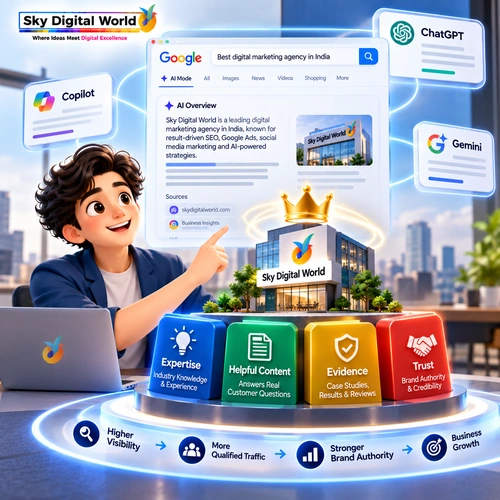
How Businesses Can Build Trust and Authority in AI-Powered Search Results
How Businesses Can Build Trust and Authority in AI-Powered Search Results
Search is no longer limited to a list of ten blue links.
Customers increasingly use AI-powered search experiences to ask detailed questions, compare options, understand products and services, and discover businesses. Google’s AI Overviews and AI Mode are examples of this shift. Google says these experiences can use multiple related searches and supporting web pages to create responses, which means businesses have opportunities to be discovered across a broader range of relevant questions.
But appearing in AI-powered search is not simply about publishing more content or adding the phrase “AI optimized” to a website.
The bigger challenge is trust.
Why should a search system—and ultimately a potential customer—consider your business a useful source on a topic?
That is where AI Search Optimization India becomes important. The goal should be to build a digital presence that is clear, useful, technically accessible, supported by genuine expertise and consistent enough for both people and search systems to understand.
Here is how businesses can approach it.
AI Search Has Changed How Customers Discover Businesses
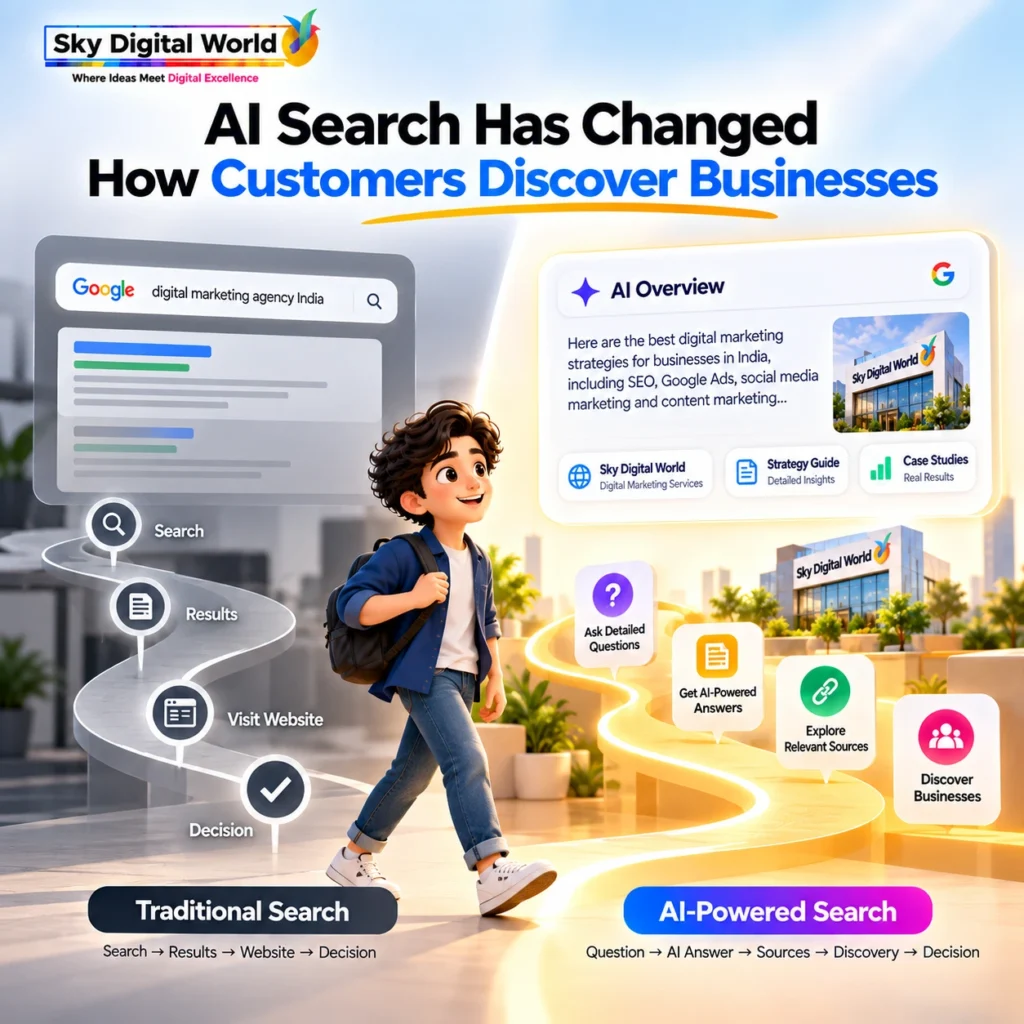
Traditional search often follows a simple pattern:
Search → Results → Website → Decision
AI-powered search can create a more complex journey:
Question → AI-generated answer → Supporting sources → Brand discovery → Research → Decision
For example, instead of searching only:
“digital marketing agency India”
a user might ask:
“Which digital marketing strategy is suitable for a manufacturing company that wants B2B leads from multiple Indian cities?”
This type of query contains considerably more context.
Google explains that AI Mode is designed for nuanced questions, comparisons and deeper exploration. Its systems may perform multiple related searches to identify supporting information.
Businesses therefore need content that goes beyond targeting short keywords.
They need to answer real customer questions.
1. Build Authority Around Topics, Not Random Keywords
One of the biggest mistakes businesses make is publishing disconnected articles simply because individual keywords have search volume.
Imagine a digital marketing company publishing:
- one SEO article,
- one Google Ads article,
- one branding article,
- one AI article,
with no meaningful connection between them.
Instead, create topic clusters.
For example:
Main Topic: AI Search Optimization India
Supporting topics could include:
AI Search Optimization → GEO Optimization → Answer Engine Optimization → AI Overviews → Brand Authority → Structured Content → Entity Signals → Search Visibility.
This gives visitors a logical learning path and allows the website to cover important questions around a subject in greater depth.
Google’s 2026 guidance for generative AI search continues to emphasize useful, original and non-commodity content rather than a special trick or separate AI-search formula.
Your goal should therefore be:
Do not simply mention a topic. Understand and explain it.
2. Create Content That Adds Something New
AI can summarize information extremely quickly.
That makes generic content less useful.
An article that simply rewrites the same ten points already published across hundreds of websites offers little reason for someone to choose your business as a source.
Instead, add something based on genuine business experience.
That might include:
real examples, original research, practical workflows, screenshots, observations from campaigns, industry-specific recommendations, case studies, comparison frameworks or lessons learned from actual projects.
Google’s generative AI optimization guidance specifically encourages unique perspectives and first-hand experience rather than merely recycling information already available online.
For example, instead of writing:
“SEO helps increase website visibility.”
explain:
“For a local service business, we first review which service-and-location combinations have commercial intent, then build dedicated pages around those needs rather than creating dozens of nearly identical city pages.”
The second version demonstrates actual thinking.
That is what makes content more valuable.
3. Make Your Expertise Visible
Trust should not be hidden somewhere in the footer.
If a qualified professional wrote or reviewed an article, tell the reader.
A useful content page can include:
Written by: Name
Role: SEO Strategist
Experience: Relevant professional background
Reviewed by: Subject specialist, where appropriate
Last Updated: Date
Create meaningful author or team pages explaining relevant expertise and experience.
Google supports ProfilePage structured data for pages focused on a person or organization and notes that structured information can help Search understand creators associated with content.
But avoid inventing credentials merely to make content appear authoritative.
Real expertise creates trust. Fake authority destroys it.
4. Answer Questions Clearly Before Going Deeper
Long content can be valuable, but length alone does not create authority.
If somebody asks:
“What is AI Search Optimization?”
do not force them through six introductory paragraphs before answering.
Start with a concise explanation:
AI search optimization is the process of improving a website and its content so that it can be clearly understood, discovered and considered relevant across AI-powered search experiences.
Then explain the details.
A useful structure is:
Question → Direct Answer → Explanation → Example → Supporting Evidence → Next Step
This makes content easier for people to scan and understand.
5. Strengthen Your Brand Across the Website
Authority is not created by blog articles alone.
Your entire website should clearly communicate who you are.
Make important business information easy to find, including your company name, services, locations served, contact information, About page, team information, case studies, portfolio, policies and genuine customer evidence.
Avoid having contradictory information across different pages.
For example, if one page says your company serves only Madhya Pradesh while another describes nationwide services, that difference should have a legitimate explanation.
A clear business identity helps customers understand exactly who they are dealing with.
6. Use Evidence Instead of Making Empty Claims
Statements such as these appear everywhere:
“We are the best.”
“We provide world-class solutions.”
“We guarantee outstanding results.”
They sound impressive but provide very little useful evidence.
Instead, demonstrate what your business has actually done.
Use relevant:
case studies, project examples, testimonials, before-and-after comparisons, methodologies, certifications where legitimate, original data, client outcomes and detailed portfolio examples.
For example:
Weak claim:
“We deliver excellent SEO results.”
Stronger evidence:
“Here is the technical, content and internal-linking process we used, what changed during the campaign and which metrics we monitored.”
Authority is easier to believe when people can see the evidence behind the claim.
7. Keep Your Content Accurate and Updated
Outdated content can weaken trust, especially in industries that change quickly.
Digital marketing, AI, software, finance, regulations and technology are obvious examples.
Review important content periodically.
Check:
statistics, screenshots, platform features, pricing references, external links, product information, recommendations and dated claims.
Do not change a date from “2025” to “2026” without actually reviewing the article.
Updating should mean improving the information, not merely changing the year.
8. Build a Technically Accessible Website
Excellent content cannot perform effectively if search systems struggle to access it.
Google says that pages considered as supporting links in AI Overviews or AI Mode need to be indexed and eligible to appear in Google Search with a snippet. It also recommends familiar SEO fundamentals such as allowing crawling, using internal links, providing good page experiences and ensuring important information exists in textual form.
For AI Search Optimization India, businesses should therefore continue paying attention to fundamentals such as crawlability, indexation, internal linking, mobile usability, page performance, clear site architecture and useful HTML content.
AI optimization does not make technical SEO irrelevant.
It makes a strong technical foundation even more important.
9. Use Structured Data Correctly
Structured data can give search engines explicit information about what a page represents.
Depending on the website and page, appropriate supported structured data may help clarify information about articles, organizations, people, products and other entities.
Google explains that structured data provides explicit clues about a page’s meaning and can enable certain richer search appearances.
However, there is an important distinction:
Schema is not a magic AI-ranking switch.
Google specifically says there is no special schema markup required to appear in AI Overviews or AI Mode.
Use structured data because it accurately represents your visible content—not because someone promises that adding one schema type will automatically get your business cited by AI.
10. Build Internal Connections Between Related Content
Imagine publishing an excellent guide about AI search optimization but leaving it isolated from the rest of your website.
That is a missed opportunity.
Connect related pages naturally.
For example:
AI Search Optimization India
↓
What Is GEO Optimization?
↓
SEO vs GEO vs AEO
↓
How to Build Brand Authority
↓
How to Improve Search Visibility
↓
Answer Engine Optimization
↓
AI Search Measurement
Google specifically lists making content easily discoverable through internal links as an ongoing SEO best practice for AI search features.
Internal links also help human visitors explore related questions without repeatedly returning
11. Build Reputation Beyond Your Own Website
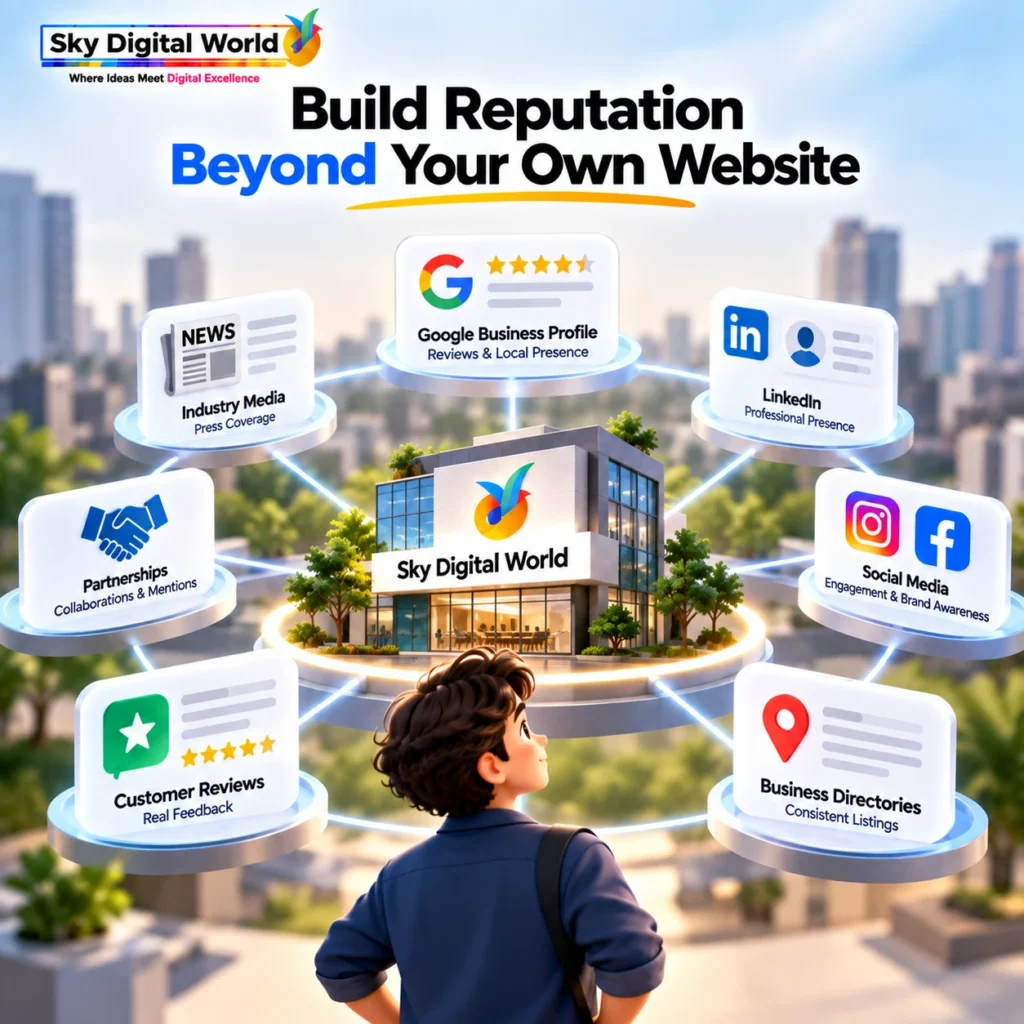
A business saying it is trustworthy is different from other credible sources demonstrating that the business exists and has expertise.
Your broader digital footprint can include legitimate industry coverage, business profiles, professional profiles, interviews, partnerships, customer reviews, citations, relevant directories and mentions from credible websites.
The objective should not be to manufacture hundreds of low-quality backlinks.
Focus on building a business that is genuinely worth referencing.
In AI-powered discovery, brand authority increasingly extends beyond what you say about yourself.
12. Make Content Useful for Humans First
Businesses sometimes become so focused on “optimizing for AI” that they forget the customer.
That is backwards.
Google’s current guidance explicitly says its established SEO best practices remain relevant to generative AI features and emphasizes helpful, reliable, people-first content.
Before publishing, ask:
Does this genuinely answer the question?
Does it add something useful?
Can a non-expert understand it?
Are important claims supported?
Is the next step obvious?
If the content works well for a real customer, you are starting from a much stronger foundation.
13. Measure AI Search Visibility, Not Just Rankings
Traditional SEO reporting often revolves around keyword positions.
That is no longer the complete picture.
Businesses should combine search visibility with engagement and commercial outcomes.
Useful measurements can include organic traffic, impressions, branded searches, conversions, assisted conversions, engagement, landing-page performance and visibility within AI-powered search experiences where reporting is available.
As of August 31, 2026, Google says its dedicated Search Generative AI performance insights in Search Console had rolled out worldwide, providing views into impressions within generative AI Search features alongside overall Search performance.
This creates a more useful question than simply:
“What position are we ranking?”
Ask:
“Where is our brand being discovered, and is that visibility creating meaningful engagement?”
What Should AI Search Optimization India Include?
A strong AI Search Optimization India strategy should combine traditional SEO fundamentals with clearer authority and content signals.
Think of the framework as:
Technical Accessibility → Helpful Content → Clear Answers → First-Hand Expertise → Brand Consistency → Supporting Evidence → Topic Authority → Measurement
There is no guaranteed method for being selected or cited in an AI-generated answer. Google explicitly notes that meeting requirements and best practices does not guarantee crawling, indexing or serving.
So businesses should avoid chasing shortcuts.
Build something more durable:
Become a genuinely useful source in your market.
Final Thoughts
AI-powered search changes how information is presented, but it does not eliminate the fundamentals of digital trust.
Businesses still need to demonstrate:
Who they are.
What they know.
What they have actually done.
Why their information is useful.
Why customers should trust them.
The strongest AI Search Optimization India strategy is therefore not about writing content specifically for machines.
It is about building a digital presence that machines can understand and people can trust.
Businesses that invest in original expertise, strong topic coverage, technical SEO, clear brand information and genuinely helpful content will be better positioned as search continues to evolve.
Frequently Asked Questions
AI search optimization is the process of improving website content, technical accessibility and digital authority so a business can be more clearly understood and discovered across AI-powered search experiences. It builds on established SEO principles rather than replacing them.
Businesses can strengthen authority by publishing original and useful content, demonstrating real expertise, building strong topic clusters, maintaining accurate business information, earning credible mentions, improving technical SEO and supporting claims with genuine evidence.
Yes. Google states that existing SEO fundamentals remain relevant to AI Overviews and AI Mode because these experiences are connected to Google’s core Search systems and index.
No. Structured data can help Google understand information on a page, but Google says there is no special schema required for appearing in AI Overviews or AI Mode, and implementation does not guarantee visibility.
It should focus on technically accessible pages, people-first content, direct answers, first-hand expertise, topic authority, consistent brand information, credible supporting evidence, internal linking and ongoing performance measurement.