




SEO in the Age of AI: What Businesses Need to Change in 2026
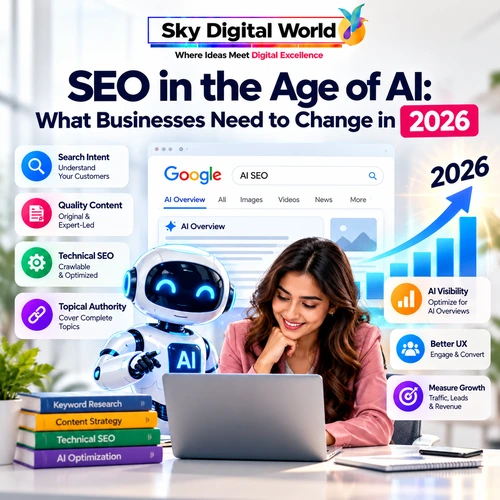
SEO in the Age of AI: What Businesses Need to Change in 2026
Search is no longer just about typing a short keyword into Google and choosing one of ten blue links.
In 2026, customers can discover businesses through traditional organic results, AI Overviews, AI Mode, image-based searches, local results, videos and other AI-assisted search experiences. Google itself says users are increasingly moving toward generative AI experiences, while also emphasizing that traditional SEO best practices remain foundational to visibility in these experiences.
For businesses, this does not mean SEO is dead. It means SEO has become broader.
The old approach was often:
Keyword → Page → Ranking → Click
A more useful 2026 approach is:
Customer Question → Search Intent → Helpful Answer → Evidence → Search/AI Visibility → Brand Discovery → Conversion
Businesses investing in AI SEO Services India should therefore focus less on shortcuts and more on building a website that search engines, AI-powered search systems and real customers can understand and trust.
What Does SEO Look Like in the Age of AI?
AI-powered search can provide users with synthesized responses before they visit a website. However, these experiences still use information from the web.
Google says its generative AI search features are rooted in its core Search ranking and quality systems. Its AI optimization guidance specifically recommends continuing foundational SEO while creating unique, useful and non-commodity content.
This creates an important distinction.
SEO in 2026 is not simply about getting a page indexed.
Businesses need to make their information:
Discoverable → Understandable → Useful → Trustworthy → Relevant → Easy to Act On
That means technical SEO, content quality, search intent, brand expertise, multimedia and conversion experience need to work together.
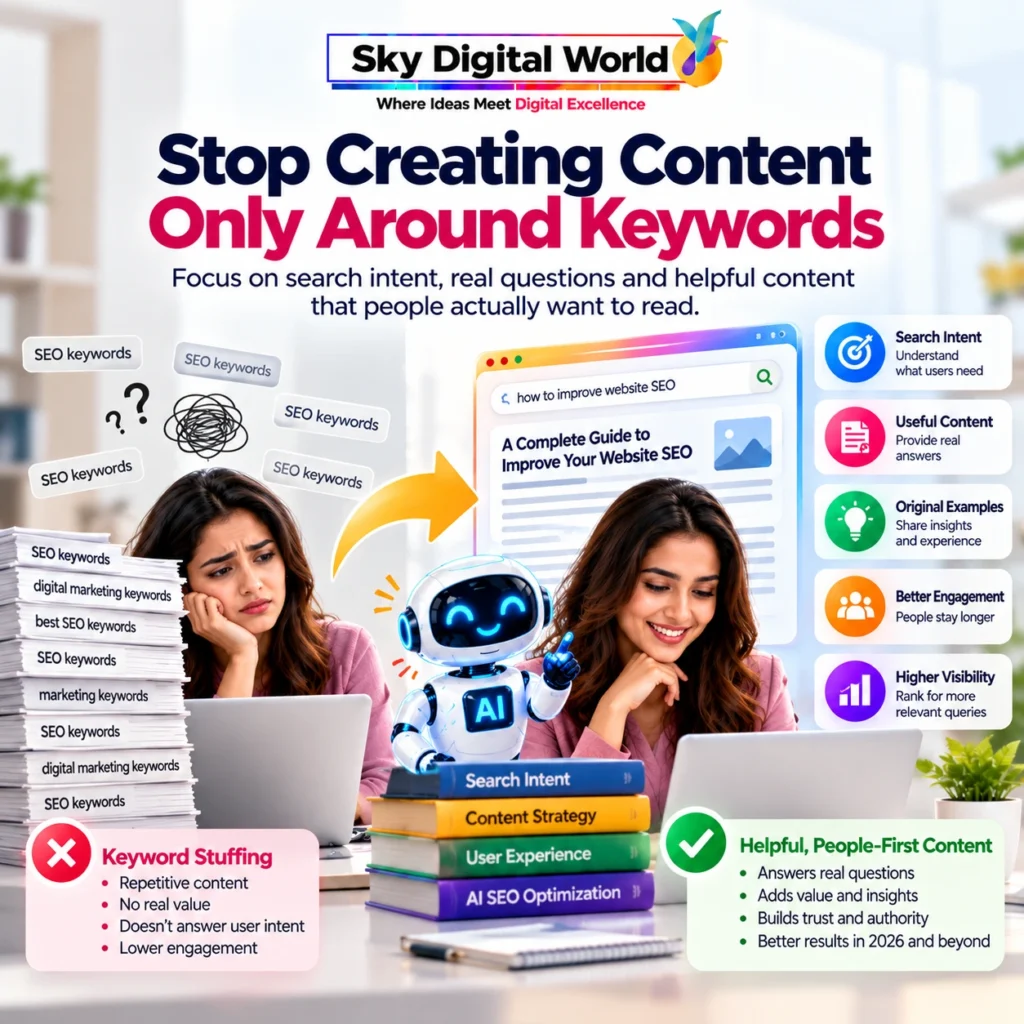
1. Stop Creating Content Only Around Keywords
Keywords still matter because they help businesses understand how customers describe their needs.
But a keyword should be the starting point, not the entire strategy.
Suppose someone searches:
“How much does SEO cost for a small business?”
A page that repeatedly uses “SEO cost” without actually explaining pricing factors provides limited value.
A stronger page might explain:
- what affects SEO pricing,
- differences between local and national SEO,
- what services are normally included,
- realistic timelines,
- common pricing mistakes,
- and questions businesses should ask an SEO agency.
The goal is to satisfy the underlying intent rather than achieve a particular keyword density.
Google’s people-first guidance specifically encourages original information, substantial coverage and content that leaves visitors feeling they have learned enough to achieve their goal.
2. Create Content That AI Cannot Easily Commoditize
AI can summarize common information extremely quickly.
That makes generic content less differentiated.
For example:
“SEO improves website visibility and helps businesses rank on Google.”
That may be accurate, but thousands of websites can say essentially the same thing.
Businesses should add information derived from genuine expertise, such as original examples, project experience, screenshots, processes, comparisons, research, observations, case studies and practical recommendations.
Think:
Common Knowledge + First-Hand Experience + Original Analysis = More Valuable Content
Google’s 2026 AI-search guidance explicitly recommends unique, expert-led, non-commodity content rather than relying on generic material available everywhere.
For an agency offering AI SEO Services India, this could mean showing how an SEO audit is conducted, what problems are commonly discovered, how priorities are selected and what happens after implementation.
3. Answer Real Customer Questions Clearly
AI-driven search is increasing the importance of natural, question-based information.
Instead of creating pages only around broad terms such as:
SEO Services India
build supporting content around actual questions:
How long does SEO take?
Why is my website not ranking?
Can AI-generated content rank?
How does technical SEO affect rankings?
What is the difference between SEO, AEO and GEO?
This creates a topical content ecosystem.
A useful structure is:
Main Service Page → Core Topic → Supporting Questions → Detailed Guides → Case Studies → Conversion Page
Each article should answer its primary question early and then provide deeper context.
This improves usability for people while making the subject of each page clearer.
4. Technical SEO Still Matters
The rise of AI has not eliminated technical SEO.
Quite the opposite: content still needs to be accessible before search systems can use it effectively.
Google says pages that may appear as supporting links in AI Overviews or AI Mode must be indexed and eligible to appear in Google Search with a snippet. Google also recommends crawlable pages, internal links, strong page experience, accessible textual content, useful images/videos and structured data that matches visible page content.
Businesses should therefore continue checking:
Crawling → Indexing → Site Architecture → Internal Links → Mobile Experience → Page Performance → Canonicals → Structured Data → Content Accessibility
There is no point creating an outstanding guide if search engines cannot properly discover or understand the page.
5. Do Not Chase Every New “AI SEO Hack”
AI search has created new terminology and plenty of questionable shortcuts.
Businesses may hear that they need special AI files, unusual page formatting or entirely different optimization systems just to appear in AI-generated search experiences.
Google’s current guidance is more straightforward.
It says there are no additional technical requirements for appearing in AI Overviews or AI Mode beyond eligibility for Google Search, and no special schema or AI-specific machine-readable files are required.
In June 2026, Google also clarified that llms.txt is not needed for Google Search and does not positively or negatively affect Google Search visibility or rankings.
So the strategy should be:
Strong SEO Fundamentals + Useful Content + Original Expertise + Clear Website Structure
not:
Shortcut → Trick → Temporary Hack → Repeat
6. Use AI to Improve Content, Not Mass-Produce It
AI can be valuable for research, topic organization, content briefs, identifying missing questions and assisting editorial workflows.
But publishing hundreds of generic AI-generated pages is not a sustainable SEO strategy.
Google says generative AI can be useful for research and adding structure to original content, but generating many pages without adding user value can violate its scaled content abuse policy.
A better workflow is:
Research → Search Intent → AI Assistance → Human Expertise → Original Examples → Fact Check → SEO Optimization → Publish → Update
AI should improve the team’s capability—not remove quality control.
7. Build Topical Authority Instead of Publishing Random Blogs
Businesses often publish disconnected articles simply because keywords have search volume.
That can create a website with no clear subject expertise.
Instead, build topic clusters.
For example, a digital marketing agency could create:
AI SEO Services India
↓
AI SEO
↓
AI Overviews
↓
Technical SEO
↓
Search Intent Optimization
↓
Content Optimization
↓
Local SEO
↓
AI Search Visibility
↓
SEO Analytics
Each supporting article should naturally connect to relevant service and educational pages.
This helps users explore related questions while creating stronger internal linking and clearer topical organization.
8. Optimize for Humans After the Search
Visibility is only one part of SEO.
A page may appear in search and still fail commercially if visitors cannot understand the offer or determine what to do next.
Think beyond rankings:
Visibility → Useful Content → Trust → Engagement → Enquiry → Customer
Service pages should therefore communicate what the business does, who the service is for, how the process works, evidence supporting claims and a logical next action.
SEO traffic without a useful website experience is an incomplete strategy.
9. Visual Search Deserves More Attention
Search is also becoming increasingly visual.
In September 2026, Google announced Search Console reporting for web multimodal search, including searches involving Lens, Circle to Search, image uploads and Chrome’s image-search functionality.
That gives businesses another reason to treat images as useful content rather than decoration.
Use original and relevant visuals where possible. Give images descriptive filenames and alt text, position them near relevant copy, and use diagrams or graphics when they genuinely explain something better than text alone.
For products, locations and visual services, this can be particularly valuable.
10. Change How You Measure SEO Success
Rankings remain useful, but they should not be the only KPI.
Google rolled out dedicated Generative AI performance reporting in Search Console worldwide by August 31, 2026, providing visibility information related to generative AI features such as AI Overviews and AI Mode.
Businesses should therefore evaluate SEO across a wider funnel:
Search Visibility → AI Visibility → Organic Traffic → Engagement → Qualified Leads → Conversions → Revenue
A keyword moving from position eight to position four is useful information.
But if the page generates no meaningful engagement or enquiries, the business should investigate whether the keyword, content or conversion journey is actually aligned with customer intent.
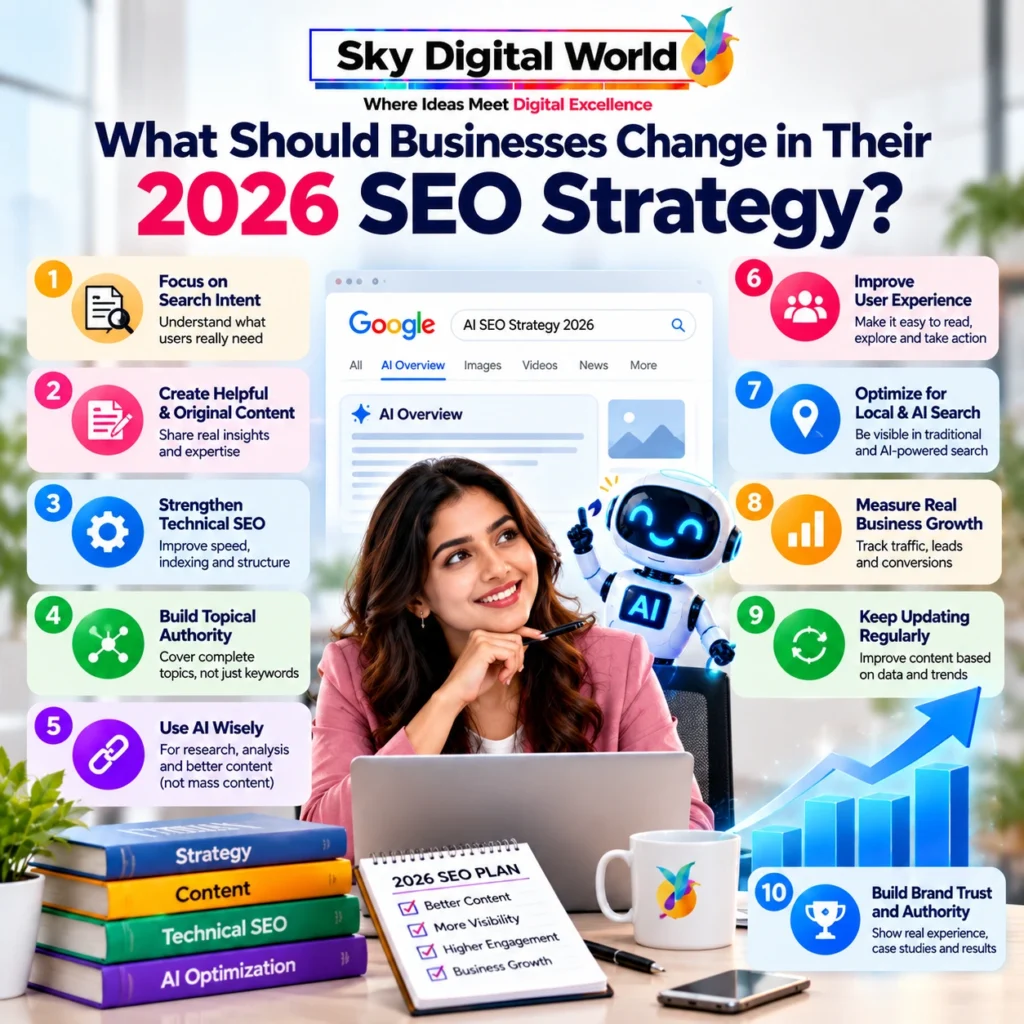
What Should Businesses Change in Their 2026 SEO Strategy?
The biggest change is not abandoning SEO. It is expanding what good SEO means.
A strong 2026 strategy can follow this framework:
Understand Customer Intent → Build Technical Foundations → Create Original Expert Content → Answer Real Questions → Connect Related Topics → Strengthen Brand Trust → Optimize User Experience → Measure Search & AI Visibility → Improve Continuously
This is also how professional AI SEO Services India should evolve: using AI to make research and analysis more efficient while keeping human expertise, originality, technical quality and customer needs at the center.
Final Thoughts
SEO in the age of AI is not about writing for robots.
It is about making genuinely useful business information easier for both people and search systems to discover, understand and trust.
Google’s own 2026 guidance reinforces that foundational SEO remains relevant for generative AI search and recommends unique, reliable, people-first content rather than special AI-search tricks
The practical formula is:
Technical SEO + Search Intent + Original Expertise + Helpful Content + Strong Brand Signals + AI Assistance + Continuous Measurement
Businesses that build around these fundamentals will be better prepared not just for today’s SERPs, but for search experiences that continue evolving beyond traditional results.
FAQs
Yes. Google states that SEO best practices remain relevant because its generative AI Search features are rooted in core Search ranking and quality systems.
Start with standard SEO fundamentals: make pages crawlable and indexable, create useful original content, answer search intent clearly, use relevant internal links, provide good page experience and ensure structured data accurately represents visible content. Google says no special AI Overview schema is required.
Using AI is not automatically a problem. Google says generative AI can help with research and content structure, but scaled generation without added user value may violate its spam policies.
AI SEO Services India generally refers to SEO services that combine established SEO practices with AI-assisted research, analysis, content workflows and optimization. The objective should remain improved search visibility and useful customer experiences rather than automated content production alone.
Focus on useful, original and trustworthy content supported by strong technical SEO and clear search intent. Measure performance across traditional Search and emerging AI search experiences rather than relying only on individual keyword rankings.