





How Technical SEO Improves Website Performance and Rankings

How Technical SEO Improves Website Performance and Rankings
A website can have attractive design, useful content and strong products or services—and still struggle to perform in search.
Why?
Because search engines first need to access, crawl, understand and index the website correctly. At the same time, visitors expect pages to load quickly, work smoothly on mobile devices and take them to the right information without technical problems.
This is where technical SEO becomes important.
Technical SEO works behind the visible content of a website. It improves the technical foundation that supports crawling, indexing, website speed, usability and search visibility. Google itself recommends paying attention to technical requirements, crawlability, indexing and overall page experience as part of maintaining a search-friendly website. Google for Developers
For businesses looking for a Technical SEO Company India, the objective should not simply be fixing a few errors in an SEO tool. A good technical SEO strategy should make the website easier for both search engines and real customers to use.
Let’s understand how it works.
What Is Technical SEO?
Technical SEO is the process of improving the technical structure of a website so search engines can efficiently discover, crawl, render, understand and index its important pages.
Think of your website as a store.
Your content is the products on the shelves. Your design is the interior. Your marketing brings people to the store.
Technical SEO is the infrastructure behind everything—the entrance, signs, pathways, electricity and organization.
If that infrastructure is broken, even a beautiful store becomes difficult to use.
Technical SEO commonly includes:
Crawlability → Indexability → Site Architecture → Page Speed → Mobile Experience → Canonicalization → Redirects → HTTPS → Structured Data → Internal Linking → Error Monitoring
These elements work together rather than independently.

1. Technical SEO Helps Search Engines Crawl Your Website
Before a page can compete in Google Search, Google needs to discover and crawl it.
Googlebot uses links and other discovery methods to find pages across websites. Website owners can also control aspects of crawling through mechanisms such as robots.txt. Google for Developers
Problems arise when important pages are accidentally blocked or difficult to discover.
For example, imagine an e-commerce website containing 5,000 URLs.
Hundreds might be generated by filters, parameters, internal searches or duplicate category combinations, while some important product and category pages are buried deep inside the website.
A technical SEO audit helps determine:
Which pages should search engines crawl?
Which pages are important?
Which pages should not be indexed?
Are important pages easily discoverable through internal links?
The objective is not simply “get Google to crawl everything.”
It is to create a logical website where important content can be discovered efficiently.
2. It Helps Important Pages Get Indexed Correctly
Crawling and indexing are related, but they are not the same thing.
Google may discover a URL without necessarily including that page in its searchable index.
Technical problems can contribute to indexing issues, including accidental noindex directives, incorrect canonical tags, redirects, inaccessible pages and poor internal linking.
A business might therefore publish an excellent service page such as:
Industrial SEO Services in India
but if the page is accidentally marked noindex, its content quality alone cannot solve the underlying problem.
A professional Technical SEO Company India should regularly review indexing through tools such as Google Search Console and URL Inspection rather than assuming every published page is searchable.
Google specifically recommends URL Inspection for understanding how Google crawls and renders individual URLs. Google for Developers
3. Technical SEO Can Improve Website Speed
Website performance is not only an SEO issue.
It is a customer-experience issue.
Consider a visitor who clicks your website because they need a quotation.
The page starts loading.
The visitor waits.
A huge hero image appears.
Then the layout moves.
A popup appears.
The button finally becomes clickable.
By then, the visitor may have lost patience.
Technical SEO can identify performance problems related to oversized images, inefficient scripts, unnecessary third-party code, poor caching, heavy fonts, server response and rendering behavior.
The goal is simple:
Click → Load → Understand → Interact
The fewer unnecessary obstacles between these stages, the better the experience.
4. Core Web Vitals Help Measure Real User Experience
Core Web Vitals provide useful measurements for important aspects of page experience.
Three key metrics are:
LCP – Largest Contentful Paint
Measures loading performance.
INP – Interaction to Next Paint
Measures responsiveness to user interactions.
CLS – Cumulative Layout Shift
Measures unexpected visual movement.
Google states that Core Web Vitals are used by its ranking systems, while also making an important clarification: achieving good Core Web Vitals does not guarantee top rankings. Relevance and other signals remain important. Google for Developers
That distinction matters.
Technical SEO should not become a game of chasing a perfect performance score.
The real objective is a website that feels fast, stable and responsive to actual users.
5. Mobile Performance Cannot Be an Afterthought
Your desktop website might look perfect.
But what happens when someone opens the same service page on a smartphone?
Does the text fit properly?
Can they tap the CTA?
Does the menu work?
Are images oversized?
Does a popup cover the screen?
Can they complete the enquiry form comfortably?
Technical SEO and website development should address these issues together.
Google’s page-experience guidance specifically encourages websites to provide content that displays well on mobile devices. Google for Developers
A technically strong website should therefore be designed around the experience visitors actually receive—not just how impressive it looks on a designer’s desktop monitor.
6. Clean Website Architecture Makes Important Pages Easier to Find
A website should have a logical hierarchy.
For example:
Home
→ Services
→ SEO Services
→ Technical SEO
→ Technical SEO Audit
This is easier to understand than important pages being scattered across unrelated directories with no clear internal connections.
Good architecture helps users navigate and gives search engines clearer pathways to discover important content.
Internal links also help communicate relationships between pages.
For example, a Technical SEO page might naturally link to:
Website Speed Optimization, SEO Audit Services, Core Web Vitals, On-Page SEO, Website Development and Search Console Optimization.
This creates a connected information structure rather than isolated pages.
7. Canonical Tags Help Handle Similar URLs
Duplicate and near-duplicate URLs are common on modern websites.
An e-commerce product might be reachable through multiple URLs because of filters, tracking parameters or category paths.
Technical SEO can use canonicalization to indicate the preferred version where appropriate.
This helps search engines understand which URL represents the main version of substantially similar content.
Canonicalization requires careful implementation because blindly pointing every duplicate-looking URL to another page can create additional SEO problems.
It should reflect the actual website structure and content relationship.
8. Redirects Protect Users and Search Engines From Dead Ends
Websites change.
Products are discontinued. Services are renamed. URLs are improved. Categories are reorganized. Entire websites are redesigned.
When an old URL is removed without a proper plan, users may reach a 404 page and external or internal links may continue pointing to a dead destination.
Redirect management helps route users and search engines appropriately when content has genuinely moved.
But redirects should also be clean.
Chains such as:
Page A → Page B → Page C → Page D
create unnecessary complexity.
A better setup, where appropriate, would be:
Page A → Final Relevant Page
A Technical SEO Company India should review redirect chains, loops, broken URLs and outdated internal links during technical audits.
9. Structured Data Helps Search Engines Understand Content
Structured data provides explicit information about the meaning of content on a webpage.
Depending on the page type, supported structured data can help Google understand information relating to articles, products, organizations and other supported entities or content types. Google for Developers
However, structured data should accurately represent visible page content.
It is not a shortcut for rankings.
Adding hundreds of schema properties to weak pages will not magically turn them into strong search results.
The better approach is:
Good Content + Correct Technical Implementation + Relevant Structured Data
rather than:
More Schema = Better Rankings
10. HTTPS and Website Security Support a Better Experience
Visitors expect websites to protect information transmitted between their browser and the website.
HTTPS is therefore a fundamental part of a professional web presence.
Google includes secure delivery among the aspects website owners should consider when evaluating overall page experience. Google for Developers
Technical SEO audits can identify issues such as HTTP pages remaining accessible, mixed-content resources, incorrect redirects or inconsistent protocol versions.
Security should not be treated only as an SEO checklist item.
It is fundamentally about protecting users and maintaining trust.
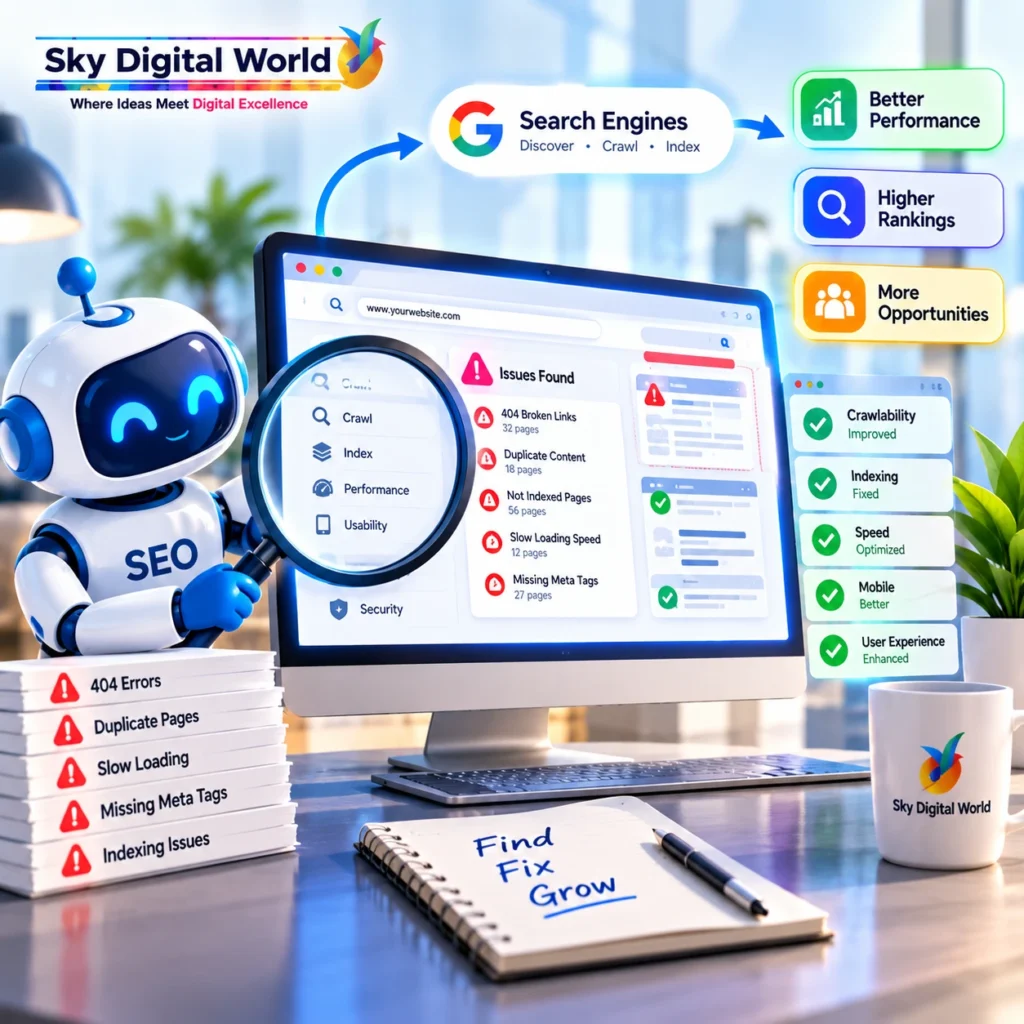
11. Technical SEO Finds Problems Before They Become Bigger
Some of the most expensive SEO problems are invisible from the homepage.
A website may look completely normal while:
important pages are blocked, canonical tags point to the wrong URLs, thousands of unnecessary URLs are generated, redirects are broken, structured data contains errors, sitemap URLs return errors, or important pages are missing from internal navigation.
Regular technical audits help catch these problems earlier.
A practical process looks like:
Crawl → Diagnose → Prioritize → Fix → Validate → Monitor
The word prioritize is important.
Not every warning from an SEO audit tool deserves immediate developer time.
Fix problems based on their likely impact on crawling, indexing, performance, user experience and business-critical pages.
12. Technical SEO Supports Content and On-Page SEO
Technical SEO cannot replace good content.
Likewise, good content cannot always overcome serious technical problems.
Suppose you publish the best guide in your industry, but the page is blocked from indexing.
The content cannot perform as intended.
Now suppose the page is technically perfect but contains thin, generic information.
Technical perfection will not automatically make the content useful.
Successful SEO requires both sides:
Technical Foundation + Helpful Content + Search Intent + Authority + User Experience
Google emphasizes that its ranking systems consider many factors, and a good page experience alone does not guarantee top rankings. Google for Developers
That is why technical SEO should support the broader SEO strategy rather than operate as an isolated activity.
13. Avoid Technical “SEO Tricks” That Create More Problems
Technical SEO should make websites clearer—not manipulate search engines.
For example, keyword stuffing, deceptive cloaking, manipulative link practices and large-scale low-value content can violate Google’s spam policies. Google for Developers
A legitimate Technical SEO Company India should focus on sustainable improvements rather than shortcuts.
Good technical SEO often looks surprisingly simple:
Make important pages accessible.
Make the structure understandable.
Remove unnecessary obstacles.
Improve performance.
Fix genuine errors.
Help users reach useful information faster.
What Should a Technical SEO Company India Include?
A professional technical SEO service should begin with diagnosis rather than making random changes.
A comprehensive strategy may include crawl and indexation analysis, XML sitemap review, robots.txt analysis, Core Web Vitals assessment, website speed optimization, mobile checks, canonical review, redirects, 404 monitoring, internal-link analysis, HTTPS checks, structured-data validation, JavaScript SEO review where relevant and ongoing Search Console monitoring.
Most importantly, findings should be prioritized.
A report containing 500 errors is not particularly useful if nobody explains which five issues matter most.
A better technical SEO report should answer:
What is wrong? → Why does it matter? → Which pages are affected? → What should be fixed first? → How will we verify the fix?
That turns technical SEO from an audit document into an actionable growth process.
Final Thoughts
Technical SEO is not about making a website attractive to algorithms while ignoring customers.
It is about removing technical barriers.
A strong technical foundation makes it easier for search engines to discover and understand important pages while creating a faster, cleaner and more reliable experience for visitors.
For businesses evaluating a Technical SEO Company India, look beyond promises of “100% SEO scores.”
Focus instead on whether the strategy improves:
Crawlability → Indexing → Speed → Usability → Structure → Search Visibility → Conversions
Because ultimately, technical SEO works best when search engines can access your website easily—and customers can use it comfortably.
Frequently Asked Questions
What is technical SEO and why is it important?
Technical SEO improves the underlying website structure so search engines can crawl, render and index important content more effectively. It also addresses areas such as website speed, mobile usability, redirects, canonicals and site architecture that can affect search performance and user experience.
Can technical SEO improve Google rankings?
Technical SEO can remove barriers that prevent pages from being crawled, indexed or experienced properly. Core Web Vitals are also used by Google’s ranking systems, but Google explicitly notes that good Core Web Vitals or technical performance alone do not guarantee top rankings
How often should a website have a technical SEO audit?
There is no universal schedule. Large e-commerce or frequently changing websites may require continuous monitoring, while smaller business websites can be reviewed periodically and after major redesigns, migrations or structural changes. Search Console should be monitored regularly for emerging crawl, indexing and performance issues.
What does a Technical SEO Company India usually check?
A technical SEO company may review crawlability, indexation, XML sitemaps, robots.txt, Core Web Vitals, page speed, mobile experience, canonical tags, redirects, broken links, HTTPS, structured data, JavaScript rendering and internal linking. The exact scope should depend on the website rather than a generic checklist
Is technical SEO more important than content SEO?
They solve different problems and work best together. Technical SEO helps search engines access and understand the website, while content SEO helps pages satisfy relevant searches and user needs. A technically excellent website with weak content—or excellent content hidden behind technical problems—can both struggle to reach their potential.